Starfish (also commonly referred to as "sea stars" or "starfish family") belong to the class Asteroidea within the phylum Echinodermata. There are approximately 1900 known species of starfish worldwide, distributed across almost all oceans: from the Arctic Ocean to the Atlantic , Pacific , Indian Oceans , and the Southern Ocean (Antarctic region) . They inhabit a wide range of depths, appearing in the intertidal zone as well as the deep sea and even the abyssal zone .
Most starfish are opportunistic predators or omnivores , often feeding on slow-moving, hard-to-escape benthic animals (such as shellfish). To better understand the "types of starfish," an overview by major taxa is provided below, along with typical characteristics and representative species examples for each taxa.

Table of contents
Brisingida (deep-sea starfish)
Notomyotida (Deep-sea long-armed starfish)
Paxillosida
Spinulosida (order Spinulosida)
Forcipulatida
Velatida (thick-bodied deep-sea starfish)
Valvatida (order Valvatida)
Examples of other common starfish species
Brisingida (deep-sea starfish)
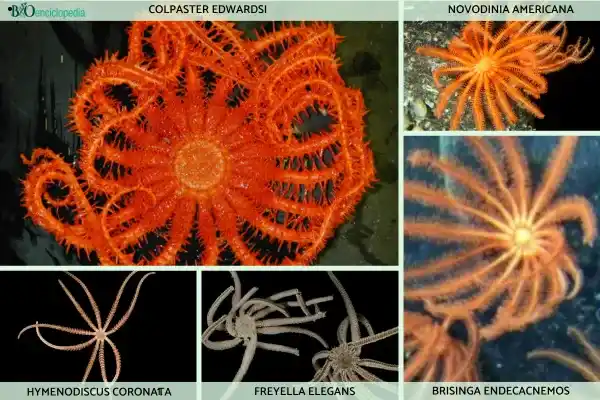
Brisingida mainly comprises two families: Brisingidae and Freyellidae , with approximately 16 genera and about 112 species . These starfish typically inhabit the deep sea , but some species can also be found in the shallow waters of Antarctica .
Typical characteristics
The central plate is small and relatively hard , and the overall design is not very soft.
It typically has 6 to 20 slender arms , suitable for suspending and feeding in water currents.
Longer thorns are commonly seen on the arms, giving them a "thorny cluster" appearance.
The bone plate structure is quite unique, for example, the disc bone plates are fused and the ambulatory girdle bone columns have distinct shapes.
In some species, the tube feet have rounded ends and the sucker structure is not prominent .
Examples of representative species
Colpaster Edwardsi
Novodinia americana
Hymenodiscus coronata
Freyella elegans
Brisinga endecacnemos
Notomyotida (Deep-sea long-armed starfish)
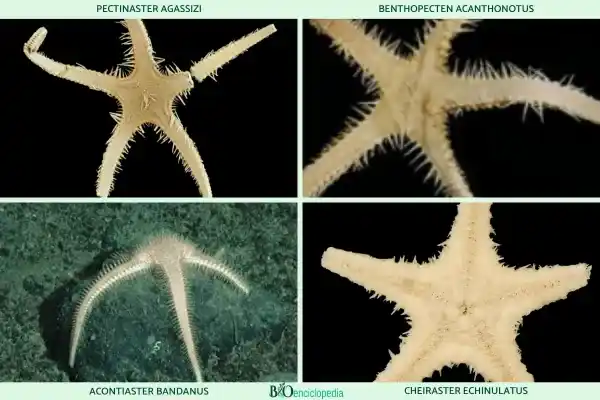
Notomyotida is a relatively small group, comprising only one family: Benthopectinidae , with about 12 genera and about 75 species . Most of its species are closely related to deep-sea ecosystems .
Typical characteristics
It has a mesh-like endoskeleton (the skeleton is supported by a mesh).
It typically consists of 5 very slender arms , with a noticeable tendency to be "flattened" in the dorsal and ventral direction.
Papulae are mostly concentrated in the proximal region near the central disc.
The arms are flexible, with longitudinal muscle bands on the inner and outer sides of the back, which facilitates bending movements.
Various types of bone plates can be observed: dorsal plate, ventral plate, supramarginal plate, oral plate, ambulatory lateral plate, etc.
Examples of representative species
Myonotus intermedius
Pectinaster agassizi
Benthopecten acanthonotus
Acontiaster bandanus
Cheiraster echinulatus
Paxillosida
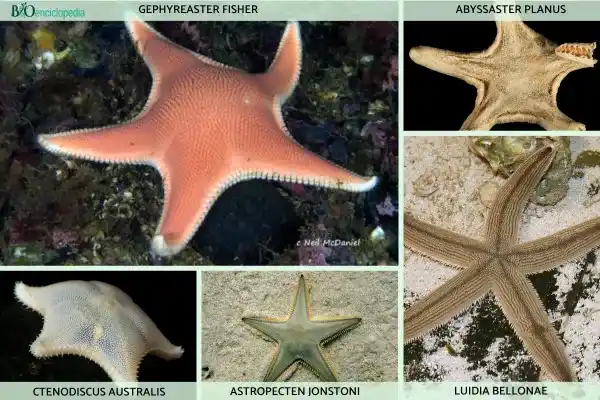
Paxillosida comprises 8 families (such as Astropectinidae , Ctenodiscidae , Luidiidae , Porcellanasteridae , etc.), about 46 genera , and about 255 species . They are highly adaptable to sandy seabeds , and many species are adept at burrowing or partially burying themselves in the sand .
Typical characteristics
Five or more arms are commonly found, which help with movement and digging on the sandy bottom.
Dermal gills are visible on the dorsal (upper) surface.
The tube feet are mostly arranged in two rows , often conical in shape, and the suckers are relatively weak or degenerate .
The submarginal lamina is often covered with spines, some of which extend to form pointed or scaly structures.
Examples of representative species
Gephyreaster (genus)
Abyssaster planus
Ctenodiscus australis
Astropecten jonstoni
Luidia bellonae
Spinulosida (order Spinulosida)
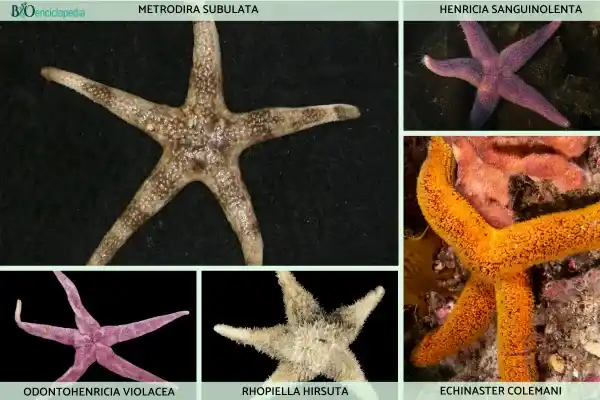
Spinulosida is mainly represented by one family: Echinasteridae , which comprises about 9 genera and about 120 species . This order has a wide distribution, ranging from tropical to temperate and polar seas, and can be found in both intertidal zones and deep waters.
Typical characteristics
The back is covered with thorns of varying sizes , giving it a rough texture.
The central disc is relatively small , and there are usually 5 cylindrical arms .
The lateral plates are often not obvious, and the appearance is more like "the whole body is covered with small thorns".
The ventral (carpal) bony plates are well-developed and often arranged in parallel rows.
Examples of representative species
Metrodira subulata
Henricia sanguinolenta
Odontohenricia violacea
Rhopiella hirsuta
Echinaster colemani
Forcipulatida
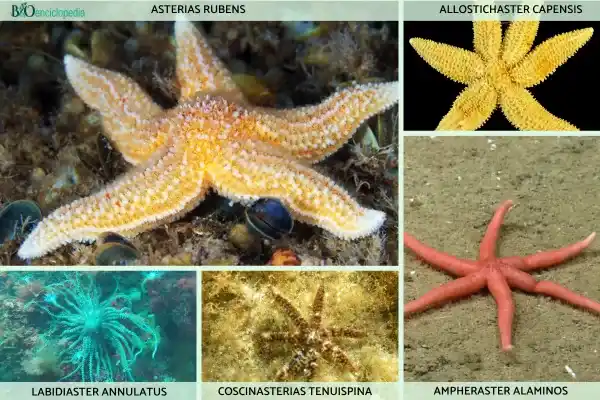
Forcipulatida comprises six families (such as Asteriidae , Heliasteridae , Labidiasteridae , etc.), about 68 genera , and approximately 300 species . It has a very wide distribution, found in both cold and tropical waters.
Typical characteristics
The body surface often has obvious pincer-shaped small clamps (pedicellariae) , like miniature clips.
The walking belt has small and numerous bony plates, resulting in a compact overall structure.
The dorsal sclera do not have the protruding columnar shape of a "sand-digging" type, and the marginal plates are not necessarily conspicuous.
The tube feet are usually arranged in four rows , with a noticeable suction cup at the end.
Examples of representative species
Asterias rubens
Allostichaster capensis
Labidiaster annulatus
Coscinasterias tenuispina
Ampheraster alaminos
Velatida (thick-bodied deep-sea starfish)
Velatida comprises approximately 5 families (such as Caymanostellidae , Korethrasteridae , Myxasteridae , etc.), about 25 genera , and about 200 species . They mostly prefer deep-sea environments and are usually more "bulky" in appearance.
Typical characteristics
The body is sturdy and heavy , with five or more arms .
Carinal plates on the dorsal midline are often difficult to distinguish .
Only some species possess intermarginal plates, and their distribution is not uniform.
The mouth plate is relatively wide and protruding, while the ventral bone plate is relatively less "compressed and compacted".
Examples of representative species
Asthenactis australis
Caymanostella phorcynis
Belyaevostella hispida
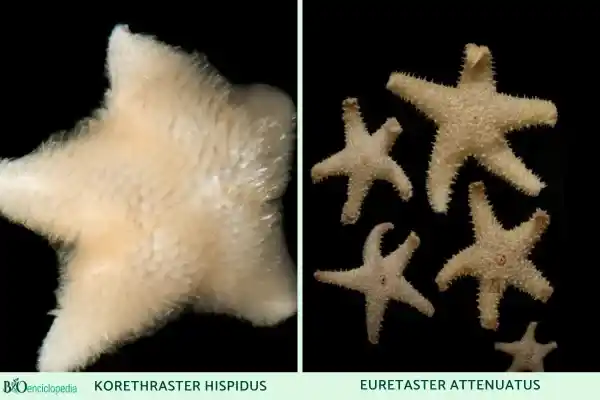
Korethraster hispidus
Euretaster attenuatus
Valvatida (order Valvatida)
Valvatida is one of the largest and most commonly seen groups of starfish, comprising up to 14 families (such as Acanthasteridae , Archasteridae , Asterinidae , Asterodiscididae , Chaetasteridae , etc.), about 165 genera , and more than 695 species.
Typical characteristics
They are typically robust, thick, or large in stature, with a more "full" outline.
Bone fragments at the body edge (marginal bones) are usually more prominent .
The dorsal skeletal plates are closely arranged and can be flat or have granular, spiky, or other structures.
The wrist may be short and wide , or it may be more cylindrical, showing great variation in shape.
Examples of representative species
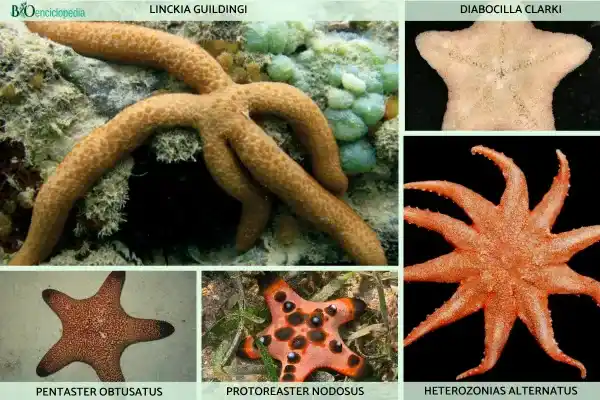
Linckia guildingi
Diabocilla clarki
Pentaster obtusatus
Protoreaster nodosus
Heterozonias alternatus
Examples of other common starfish species
Starfish in the ocean are far more numerous than the few examples listed above. They are not only important members of the seabed ecosystem, but also attract considerable research attention due to their ability to regenerate severed limbs . Below are some examples of frequently mentioned starfish species to help you quickly expand your knowledge:
More starfish examples
Bythiolophus acanthinus (Acanthinus starfish)
Marthasterias glacialis (common spiny starfish)
Echinaster sepositus (Red Star)
Pycnopodia helianthoides (Sunflower Starfish)
Asterina gibbosa (one of the common small starfish in the genus Asterina)
Luidia ciliaris (Luidia starfish)
Ophidiaster ophidianus (Purple Starfish)
Astropecten irregularis (sand starfish)
Astropecten bispinosus (Double-spined starfish)
Astropecten acanthifer (Spiny Starfish)