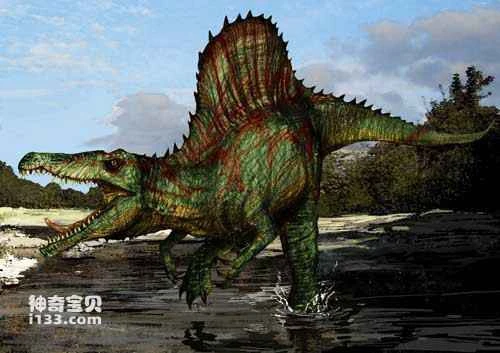
Spinosaurus was a giant carnivorous dinosaur that lived in Africa during the Late Cretaceous period. It belonged to the Spinosaurus group of theropods and was a very peculiar dinosaur, which can be seen from its long spines on its back, rounded teeth, and long crocodile-like mouth. These features are extremely rare among large carnivorous dinosaurs.
Spinosaurus possessed attack and predation capabilities on par with Tyrannosaurus Rex. Its size was similar to Tyrannosaurus Rex, weighing between 4 and 8 tons, slightly heavier, but its forelimbs and hindlimbs were not as extreme. Tyrannosaurus Rex's hind limbs accounted for a much larger proportion of its weight than its forelimbs, with its forelimbs only about the length of a human arm. This meant that its several-ton body was entirely supported by its hind limbs; whereas Spinosaurus's forelimbs were much longer than Tyrannosaurus Rex's, allowing for more efficient hunting.
Unlike other theropod dinosaurs with their knife-shaped teeth, Spinosaurus's teeth were conical with several parallel longitudinal lines on the surface. This feature is typically found in crocodiles and other fish-eating reptiles. Later, paleontologists discovered fish scales in the stomach of Spinosaurus fossils. It seems that Spinosaurus was a dinosaur that primarily fed on fish, and the longitudinal lines on its teeth may have helped prevent fish meat from sticking to its teeth.
Spinosaurus had numerous spines, up to 1.8 meters long, extending from the back of its head to the front edge of its tail. These spines were covered with a skin, resembling sails on a small boat. Paleontologists have several hypotheses regarding the function of these "sails." Some theories suggest that the spines were covered by a thin skin filled with capillaries. These capillaries would carry away excess heat from the body, allowing it to be dissipated by the air, thus serving a cooling function. Therefore, the heat dissipation theory has become the mainstream explanation.
Recently, paleontologists discovered a tooth embedded in the cervical vertebrae of an Early Cretaceous pterosaur fossil. The owner of this tooth was identified as Spinosaurus, which directly proves that Spinosaurus's diet included other foods besides fish, such as this unfortunate pterosaur.
Chinese name: Spinosaurus
Latin name: Spinosaurus
Age of existence: Late Cretaceous
Fossil origins: Morocco, Egypt
Physical characteristics: 15-17 meters in length
Diet: Carnivorous
Type: Theropod
Definition: A spiny lizard