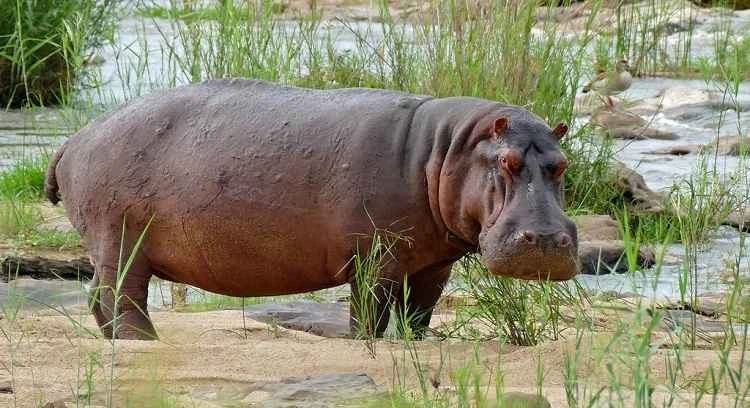
The hippopotamus, or hippopotamus amphibius , is one of the most unique animals on Earth. Known for its enormous size and semi-aquatic lifestyle, it often leaves many wondering: is the hippopotamus a land animal? In this article, we will explore the hippopotamus's lifestyle, adaptations, habitat, and classification in detail, providing a comprehensive answer to this question.
What is a hippopotamus?
Hippos are large mammals primarily found in sub-Saharan Africa. The word "hippo" originates from the ancient Greek word meaning "horse of the river," vividly describing their lifestyle. Hippos are known for their semi-aquatic lifestyle; they cannot live without water, but their terrestrial activities are equally significant. This unique lifestyle, coupled with their distinctive barrel-shaped body, makes hippos one of the most recognizable animals in the world.
Hippos are the third largest land mammal after elephants and some rhinoceros species. Male hippos can weigh up to 3,200 kilograms (about 7,000 pounds), while females typically weigh around 1,500 kilograms (about 3,300 pounds). Their bulky size and short legs mask their amazing speed and agility in both water and on land.
Are hippos land animals?
Whether hippos belong to the land animal category is not a simple question. To answer this question fully, we need to understand the definitions and characteristics of land and aquatic animals, and examine how hippos adapt to both environments.
1. Hippos are semi-aquatic animals.
Hippos are classified as semi-aquatic animals , meaning they depend on both water and land for their lives. Although hippos spend up to 16 hours a day in rivers or lakes, they also play a vital role in the surrounding terrestrial ecosystems. The ability to live in both water and on land distinguishes hippos from animals that are entirely aquatic or entirely terrestrial.
2. Hippos depend on water sources
A striking characteristic of hippos is their dependence on water. Hippos spend most of their day in the water to regulate their body temperature and protect their skin from the scorching African sun. Their eyes, ears, and nostrils are located on the top of their heads, allowing them to maintain awareness of their surroundings even when most of their body is submerged.
Although hippos rely on water, they are not entirely aquatic like fish. Hippos cannot breathe underwater and must surface to breathe every 3 to 5 minutes. They can also hold their breath for up to 30 minutes to rest underwater.
3. Hippos foraging on land
Although hippos spend most of their day in the water, they do come ashore at night to forage. Hippos are herbivores, primarily feeding on grass. An adult hippo can consume 35 to 40 kilograms (77 to 88 pounds) of grass per day. To find food, hippos can travel up to 10 kilometers (6 miles) away from water sources, demonstrating their excellent adaptation to terrestrial environments.
This nocturnal foraging behavior has a significant impact on the surrounding ecosystem. Hippos maintain the balance of vegetation by grazing and create usable trails for other animals. It is precisely because of this terrestrial foraging habit that hippos can be considered terrestrial animals to some extent, even though they spend most of their time in the water.
Hippos' adaptability to water and land
Although hippos are considered semi-aquatic animals , they exhibit remarkable adaptability in both water and land. Here are the main adaptations of hippos in both environments:
1. Adaptation in water
Buoyancy and Movement : Hippos possess strong buoyancy. Although they cannot swim like fish, they can propel themselves through the water by pushing against the riverbed or lake bottom with their limbs. This mode of movement allows hippos to move easily in deep water.
Location of eyes, ears, and nostrils : Hippos' sensory organs are concentrated on the top of their heads, allowing them to remain aware of their surroundings even when most of their bodies are submerged. This helps them stay cool in the water and avoid detection by predators.
Thick skin and secretions : Hippos have very thick skin, which effectively protects them from harm. In addition, they secrete a natural oily substance, commonly known as "blood sweat," which has sun protection and antibacterial properties and can prevent skin infections.
2. Land adaptation
Strong limbs : Despite their large size, hippos have very strong limbs that allow them to walk on land and even run at high speeds. When necessary, hippos can run at speeds of up to 30 kilometers per hour (about 18 miles per hour) on land.
Nocturnal foraging : Hippos mainly forage at night to avoid the high temperatures of the day while still obtaining sufficient food.
Territorial behavior : On land, male hippos exhibit a strong possessiveness of their territory. They fiercely defend their territory, especially near the boundaries of rivers or lakes.
The importance of hippos in the ecosystem
Hippos play a vital role in both aquatic and terrestrial ecosystems. Their foraging behavior helps control plant growth, preventing overgrowth and disruption of ecological balance. Furthermore, hippo dung is rich in nutrients, providing essential nourishment for fish and birds in the water. This nutrient cycle between land and water makes hippos a keystone species in the African ecosystem.
The current state of hippopotamus conservation
There are two species of hippopotamus in the world: the common hippopotamus ( Hippopotamus amphibius ) and the pygmy hippopotamus ( Cheropsis liberiensis ). Their conservation statuses differ. The common hippopotamus is listed as vulnerable by the International Union for Conservation of Nature (IUCN), and its population is declining due to habitat loss, illegal hunting, and conflict with humans. The pygmy hippopotamus, on the other hand, is listed as endangered , with a global wild population of less than 3,000 individuals.
Global conservation efforts are crucial to ensure the survival of hippos, as their habitats and populations are threatened by human activities such as agricultural expansion, poaching, and climate change.
Conclusion: Are hippos land animals?
In conclusion, hippos are both terrestrial and not entirely terrestrial animals . Their lives depend on both water and land, giving them unique semi-aquatic characteristics. Hippos come ashore at night to forage, exhibiting terrestrial traits, but they also rely on water for body temperature regulation and rest. Therefore, hippos cannot be strictly classified as either terrestrial or aquatic animals, but rather as a combination of both.
Understanding the hippopotamus's unique dual-habitat lifestyle helps us better comprehend their complex role in the ecosystem. Like the hippopotamus's adaptation, many organisms in nature demonstrate a balanced adaptation between water and land, making us cherish these amazing animals and their habitats even more.