The shoebill is one of the most fascinating and unique birds on Earth. With its enormous beak, prehistoric-looking appearance, and slow, deliberate movements, it captivates anyone fortunate enough to witness it. Here are some interesting facts about this extraordinary bird, presented in simple, accessible language.
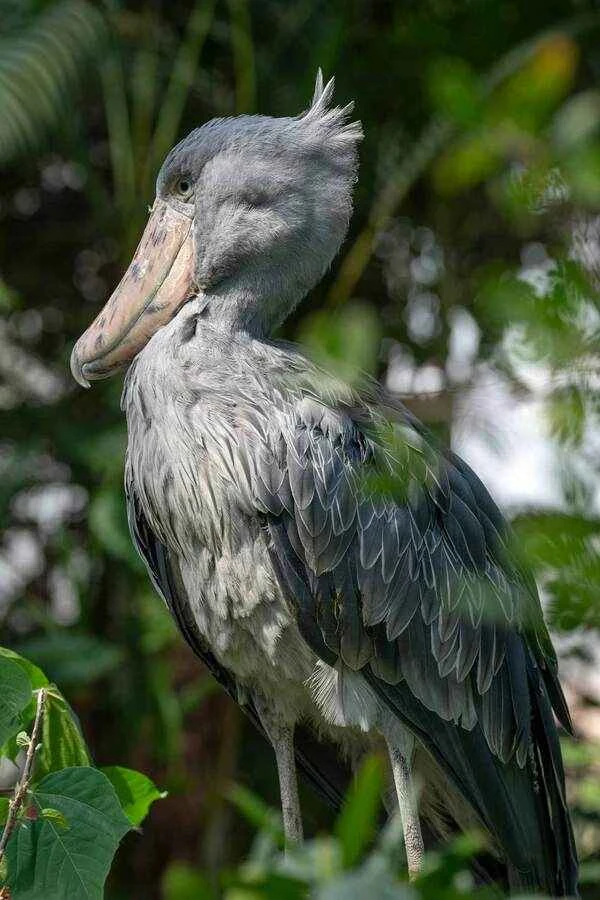
1. The shoebill's beak is enormous.
The shoebill's most distinctive feature is its enormous, shoe-shaped beak, from which it gets its name. Its beak can exceed 23 centimeters in length and 10 centimeters in width! This massive beak helps the shoebill hunt large prey, including fish, frogs, snakes, and even small crocodiles. It easily grasps and crushes its prey with its powerful beak.
2. It looks like a dinosaur.
The shoebill has a very ancient appearance, a huge body, long legs, and moves slowly and cautiously. Some even say it looks like a living dinosaur! Although it is not a dinosaur, the shoebill does have a prehistoric look, and scientists believe its lineage can be traced back millions of years.
3. The shoebill is a quiet hunter.
Unlike many birds that make noise while hunting, the shoebill is remarkably quiet. It often stands motionless for long periods, observing its prey almost without moving. This patience and stealth make it an efficient hunter. Once it spots its prey, the shoebill strikes swiftly, catching and swallowing it with its beak.
4. They can make loud noises.
Although silent while hunting, shoebills can produce a sound known as "bill clattering." This sound is made by rapidly opening and closing their beaks, and it sounds somewhat like a machine gun. They typically make this sound during courtship or when communicating with their young.
5. The shoebill stork is a solitary bird.
Shoebills are typically solitary, meaning they prefer to live and hunt alone. They are highly territorial and generally do not tolerate other birds entering their territory. This solitary lifestyle makes it very rare to see more than two shoebills in the wild.
6. They live in swamps.
Shoebills inhabit the marshes and wetlands of Central and East Africa, particularly in countries like Uganda, Sudan, and Zambia. They prefer areas with abundant dense vegetation and shallow water, where they can silently hunt fish and other prey. Marshes provide the perfect environment for the shoebill's quiet and stealthy hunting methods.
7. The shoebill stork's height is astonishing.
Shoebills are large birds, standing approximately 1.2 to 1.5 meters (4 to 5 feet) tall! This makes them among the tallest birds in the world. Despite their enormous size, they move slowly and cautiously, making them impressive to see in person.
8. They will take care of the baby birds.
Although shoebills typically lay two eggs, they usually raise only one chick. The stronger chick usually survives, while the weaker one may not. However, shoebill parents are very protective of the surviving chick, carefully feeding and protecting it until it is able to stand on its own.
9. Their numbers are threatened.
Unfortunately, shoebills are considered a vulnerable species due to habitat loss and poaching. As wetlands are drained for agriculture or development, the places shoebills rely on for survival and foraging are disappearing. Although conservation efforts are underway, they still face enormous challenges.
10. They have a strong gaze.
One of the most striking features of shoebills is their intense, focused gaze. When a shoebill stares at you, it feels as if it's gazing into your very soul! This focused gaze helps them stay alert while hunting, but it also makes them appear both majestic and awe-inspiring.
The shoebill is one of the most fascinating birds in nature, a stunning creature with its enormous beak, dinosaur-like appearance, and unique solitary lifestyle. Despite its unusual appearance, these features make it a highly efficient hunter in wetlands. Unfortunately, this incredible bird is facing threats, making the protection of the shoebill and its habitat crucial for its survival. The next time you hear about a shoebill, you'll know just how extraordinary this bird is.
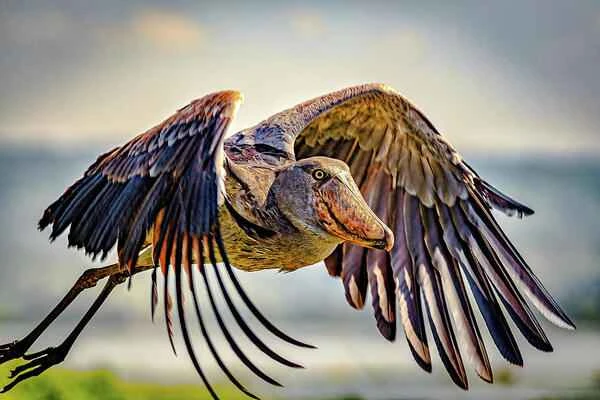
Can shoebills fly?
Shoebills are capable of flight, although they don't fly as frequently or gracefully as other birds. Despite their large size, standing up to 1.5 meters tall with a wingspan of about 2.4 meters, they are indeed able to fly. However, shoebills fly rather slowly and heavily, usually only when necessary, such as to find new hunting grounds or escape danger.
When flying, shoebills tend to glide rather than flap their wings frequently. They make a few powerful flaps when taking off, and then glide for a long time to conserve energy. Although their flight is not as agile and swift as that of smaller birds, it is sufficient for them to fly over the marshes and wetlands where they inhabit and to travel relatively long distances.

Do shoebills pose a danger to humans?
Shoebills generally pose no danger to humans . While their large size, intense gaze, and massive beaks can be intimidating, they are actually quiet and solitary birds. Despite their somewhat frightening appearance, shoebills tend to avoid interaction with humans and are typically quiet and slow-moving. Here's a detailed explanation of why they are generally not dangerous:
1. A solitary and shy nature
Shoebills prefer to live alone in swamps and wetlands. They are highly territorial but not aggressive towards humans. In the wild, shoebills typically keep their distance from humans, more likely to remain still or retreat than to attack. They focus their energy on hunting fish and small reptiles rather than engaging in human contact.
2. The huge beak looks dangerous, but it is not a threat to humans.
The shoebill's large, powerful beak is one of its most striking features and is indeed intimidating. This beak is designed to catch and crush large prey, such as fish, frogs, and even small crocodiles. However, shoebills do not use their beaks for hostile behavior towards humans. Their beaks evolved specifically for hunting, and there are no reports of shoebills attacking people with their beaks.
3. Defensive behavior is rare.
Shoebills are not inherently aggressive. They are known for their patience and stillness, often remaining motionless for extended periods while hunting. If someone gets too close, a shoebill may spread its wings or emit its distinctive "beak call" as a warning, but actual physical attacks are very rare. In most cases, shoebills will choose to fly away or move to another location to avoid a threat.
4. Behaves calmly in captivity.
In captivity, shoebills behave relatively calmly around keepers and visitors. Some zoos and sanctuaries even allow people to observe these birds at relatively close range. Their lack of aggression, which makes them easier to care for in these environments, further demonstrates that they generally do not pose a threat to humans.
5. Respect wild animals
While shoebills themselves are not dangerous, respecting wildlife is always a wise practice. Getting too close to wild animals can cause stress or trigger defensive behavior. Whether in the wild or in captivity, it is best to observe shoebills from a distance to ensure the safety of both the bird and the observer.
While shoebills may appear awe-inspiring due to their large size and powerful beaks, they are generally shy, solitary, and non-aggressive towards humans. They pose no real threat, as they prefer to avoid conflict and remain calm when encountering humans. Given the respect and space they deserve, shoebills are fascinating and harmless subjects to observe.
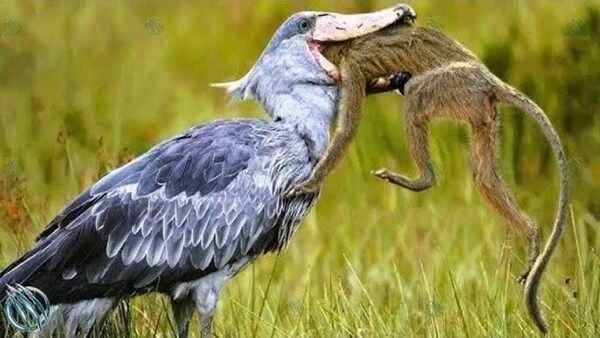
Shoebill Stork vs. Moa
Shoebills and moas, despite being large and awe-inspiring birds, are not closely related . They belong to different taxa and have completely different evolutionary histories. To better understand the relationship (or lack thereof) between shoebills and moas, we can make a detailed comparison through their origins, physical characteristics, and behaviors.
Key Comparison: Shoebill vs. Moa
| feature | Shoebill Stork (Balaeniceps rex) | Moa (Phorusrhacidae) |
|---|---|---|
| taxonomic groups | Storks are birds belonging to the order Pelecaniformes, including pelicans and herons. | A large, extinct flightless bird belonging to the family Phorusrhacidae. |
| Time of appearance | Extant species, living in parts of Africa | Extinct, it lived approximately 62 million to 1.8 million years ago. |
| Habitat | Swamps and wetlands in Central and East Africa | South America's grasslands, forests, and open plains |
| body shape | It stands approximately 4-5 feet tall (1.2-1.5 meters) and has a wingspan of approximately 8 feet (2.4 meters). | Some species can reach a height of 10 feet (3 meters). |
| Flight capability | It can fly, although the flight is relatively slow and heavy. | Unable to fly, it relies on running to chase prey. |
| diet | Carnivorous, it preys on fish, frogs, small reptiles, and sometimes birds. | Carnivorous, primarily preying on small animals; some species are apex predators. |
| beak | A large, shoe-shaped beak used to catch prey. | Large, hooked beak used to tear apart prey. |
| Behavior | Quiet, solitary, and patient hunters are generally not aggressive towards humans. | Aggressive predators; some species are capable of quickly hunting their prey. |
| Recent extant related species | Pelicans, herons and other storks | Modern birds such as the South American slender stilt |
| Extinction | Not yet extinct, but considered a vulnerable species due to habitat loss. | Completely extinct; the last species disappeared approximately 1.8 million years ago. |
| Cultural awareness | Birds are often considered calm and prehistoric due to their slow movements and ancient appearance. | Considered a fierce predator, it is known for its large size and hunting prowess. |
Detailed comparison
Evolutionary background :
The shoebill belongs to the order Pelecaniformes and is related to birds such as pelicans and herons. They evolved to live in wetlands and primarily prey on aquatic animals.
Moas belong to the family Moaidae . They are a group of flightless predators that evolved in South America after the extinction of the dinosaurs. They are distantly related to modern South American birds such as the swan, but not closely related to storks or pelicans.
Appearance and body shape :
While shoebills are large birds, standing about 4 to 5 feet tall, moas are even larger, with some species reaching up to 10 feet in height. The most significant difference is that shoebills have a large, shoe-shaped beak used for hunting in swamps, while moas have a large, hooked beak adapted for tearing prey.
Behavior and hunting methods :
Shoebills are slow and cautious hunters who rely on patience and stealth to catch their prey. They are generally non-aggressive towards humans and prefer to live a solitary life.
Moas are active predators that may hunt prey at high speeds, using their size and strength to capture and subdue their prey. Some species are apex predators in their respective ecosystems.
Flight capability :
Shoebills can fly, but they are not powerful fliers. They typically only fly when necessary, such as to change locations or escape danger. They fly slowly, relying more on gliding.
Moas were completely flightless . Their body structure was adapted for running on the ground rather than flying, and their powerful legs helped them quickly chase prey.
Geographical distribution :
Shoebill storks are native to Africa, mainly living in swamps and wetlands in central and eastern Africa, such as Uganda, Sudan and Zambia.
Moa lived in South America and were found in a variety of environments, including grasslands and forests, during the Cenozoic era.
Although both shoebills and moas are fascinating and intimidating creatures, they are not closely related. Shoebills are extant birds that primarily inhabit wetlands, while moas were flightless predators that went extinct millions of years ago and once roamed the plains of South America. Their physical similarities—such as their large size and powerful beaks—are more coincidental than indicative of a shared evolutionary relationship.

The Shoebill Legend: Exploring its Genetic Relationships with Storks and Rails
The shoebill (Balaeniceps rex) is a striking bird, both in appearance and genetics. Despite its unique physical appearance and distinctive behavior, it is not entirely isolated on the bird family tree. The following is a detailed explanation of the shoebill's genetic relationships:
1. Taxonomy
The shoebill stork is classified in the order Pelecaniformes, which also includes:
Pelicans
heron
moorhen
storks
Within this order, the shoebill belongs to the family Balaenicipitidae, which contains only one extant species—the shoebill.
2. Close relatives
Genetic studies have shown that the shoebill is genetically closer to certain stork species than to pelicans or herons. Some key points regarding its close relatives include:
Storks : The shoebill stork is particularly closely related to some other stork species. They share similarities in nesting behavior and certain anatomical features, such as long legs and large beaks.
Rail : There is also a genetic link between the shoebill and the rail. These birds are known for their long beaks and wading habits.
3. Evolutionary History
The shoebill's evolutionary history is quite complex. The divergence between the shoebill and its close relatives occurred approximately 40 to 50 million years ago . Genetic data shows that the shoebill has retained many primitive traits, linking it to the ancestors of these birds and making it a "living fossil."
4. Genome Research
Recent genomic studies utilizing advanced DNA sequencing technology have provided deeper insights into the evolutionary relationships among various bird species. These studies further confirm the shoebill's close relationship with the following species:
Storks : such as the white stork ( Ciconia ciconia ) and the black stork ( Ciconia nigra ).
Grey herons and egrets : Although they are not closely related to shoebill storks, they are genetically linked.
5. Unique features
Despite these genetic relationships, the shoebill has many unique characteristics that distinguish it from its relatives:
A large, shoe-shaped beak : suitable for hunting large fish and amphibians.
Large size : The shoebill can reach up to 5 feet in height and has a wingspan of about 8 feet.
Behavior : Known for its patience and stillness, it contrasts with the more active hunting style of other related birds.
In summary, the shoebill is genetically related to several species in the order Pelecaniformes, particularly storks and rails. While it shares a common ancestor with these birds, its unique adaptations and evolutionary history make it a distinct species in the bird world. The shoebill is a fascinating example of how evolution has shaped birds in diverse ways, showcasing the astonishing diversity we see today.