The mimic octopus ( Thalumoctopus mimicus ), also known as the mimic octopus, is one of the most fascinating creatures in the ocean, renowned for its ability to mimic the appearance, behavior, and characteristics of other animals. This ability serves not only for self-defense but also as a crucial skill in hunting. So, which animals can the mimic octopus imitate? And how does it utilize this skill to ensure its survival? Today, we'll take a comprehensive look.
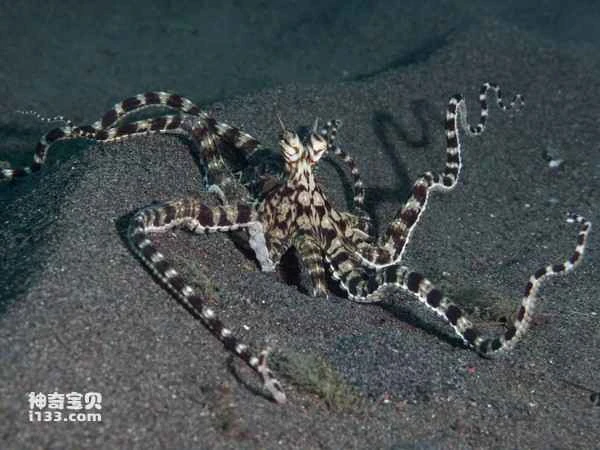
Table of contents
What is an octopus mimicry?
The role of imitation in the animal world
Three animals that octopuses often imitate
1. Lionfish
2. Flatfish
3. Clownfish
How to imitate an octopus using camouflage
Imitation: Defensive or Offensive?
Mimicking the habitat of an octopus
Mimicking the biological principles of an octopus
The purpose of imitating the octopus's shape change
The Importance of Imitation Behavior for Marine Survival
The difference between an octopus and a mimic octopus
Conclusion: Masters of Disguise in the Ocean
1. What is an octopus mimicry?
The mimic octopus ( Thalumoctopus mimicus ) is an octopus capable of mimicking other animals by changing its body color, shape, and posture. It inhabits the tropical waters of Southeast Asia, particularly the shallow waters near Indonesia. Belonging to the cephalopod family, the mimic octopus shares similar biological characteristics with other marine mollusks such as squid and cuttlefish.
By changing its body color and shape, it mimics the octopus's ability to quickly adapt to its environment, avoid predators, or attract prey. Through a highly developed nervous system and pigment cells, it controls its appearance and behavior, making itself look like other animals in its vicinity.
2. The role of imitation behavior in the animal world
In nature, mimicry takes two main forms: defensive mimicry and offensive mimicry . Defensive mimicry refers to animals mimicking dangerous or poisonous species to avoid becoming prey; offensive mimicry refers to animals mimicking other species in order to approach prey or hide themselves.
The mimic octopus uses these two mimicry strategies to increase its chances of survival. By imitating other animals, it can both avoid attacks from predators and increase its hunting success rate.
3. Three animals that octopuses often imitate
1. Lionfish
Lionfish are among the most common animals that mimic octopuses. Lionfish are characterized by their large size, venomous spiny fins on their tails, and vibrant colors, making them a highly dangerous species. By mimicking the appearance of lionfish, octopuses can make predators perceive them as venomous targets, thus avoiding attacks.
This mimicry behavior is a defensive form of imitation , effectively reducing threats from predators. When mimicking an octopus, the fish becomes more "ostentatious" and increases its size, as if it were a lionfish.
2. Flatfish
Flatfish are another animal often imitated. Flatfish typically inhabit the seabed, with flat bodies and colors similar to the surrounding sand and rocks. Octopuses mimic the flatfish by spreading their bodies out to become even flatter and making their skin color resemble the sand, allowing them to hide on the seabed like flatfish and avoid detection by predators.
By mimicking the posture and coloration of a flatfish, the mimic octopus can blend perfectly into the sand. This is a typical defensive mimicry strategy that helps the mimic octopus evade most predators.
3. Clownfish
Clownfish are another species that mimics octopuses to confuse predators. Clownfish typically live near coral reefs and are small and brightly colored. By changing their coloration and shape, they can camouflage themselves as harmless clownfish near coral reefs. This mimicry not only allows them to blend into their environment but also attracts prey.
This behavior can also be seen as aggressive mimicry , where the octopus approaches its prey with a seemingly harmless appearance in order to increase its hunting success rate.
4. Imitate how octopuses use camouflage
The ability to camouflage itself is one of the keys to the octopus's survival. It can blend into its surroundings by changing the color, texture, and shape of its skin. The mimic octopus possesses special cells called pigment cells , which can rapidly change the color and pattern of its body surface.
Furthermore, mimicking octopuses can use the nipple-like structures on their skin to alter their shape, making them appear more like other species or blending completely into the sand or coral reefs. This camouflage ability allows them to quickly "disappear" in front of enemies or prey.
5. Imitation: Defensive or Offensive?
The mimicry behavior of octopuses can be both defensive and offensive . In defensive mimicry, they imitate dangerous or poisonous species (such as lionfish) to scare away predators; in offensive mimicry, they imitate harmless species such as clownfish to approach and hunt their prey.
This ability to skillfully employ mimicry techniques allows the mimic octopus to adapt to and gain an advantage in ever-changing environments.
6. Imitating the octopus's habitat
Mimic octopuses primarily inhabit the shallow waters of Southeast Asia, especially areas with sandy beaches , coral reefs , and muddy bottoms . These locations not only provide abundant food resources but also offer ample camouflage. They utilize the sand, corals, and other marine life in these environments for mimicry and concealment.
7. Imitating the biological principles of octopuses
The ability of mimicking octopuses to perform such complex imitations is attributed to their unique biological structure. Their pigment cells and papillary structures allow them to precisely control their body color and surface texture. Their nervous system is also highly developed, enabling them to rapidly mobilize these cells to achieve camouflage or imitation.
These biological characteristics enable octopuses to change their appearance in a short period of time and quickly adapt to different environments.
How does one change shape to mimic an octopus?
The mimic octopus ( Thalumoctopus mimicus ) is a very special marine creature, renowned for its remarkable mimicry abilities. It can imitate other animals by changing its shape , color , and texture , giving it a significant advantage in the competition for survival. So, how does the mimic octopus achieve these morphological changes? Let's explore this in depth.
Mimicking the octopus's shape-changing mechanism
The ability to mimic an octopus's shape-changing ability relies on some of its unique physiological characteristics and biological mechanisms:
1. Flexible soft body and supple body structure
Like other octopuses, it has a soft body without a rigid skeleton, making it extremely flexible and able to bend, stretch, or contract at will. Its body is supported by a muscular system and collagenous skin , structures that allow it to quickly adapt to its environment and change shape.
The mimic octopus is incredibly flexible, able to flatten or expand its body to mimic the forms of other animals. It is this soft structure that allows the mimic octopus to change its appearance in different situations, much like a Transformer.
2. Tentacle control ability
The mimic octopus has eight tentacles , each equipped with suckers , which provide it with exceptional flexibility and maneuverability. When the mimic octopus changes shape, it typically does so by manipulating these tentacles.
For example:
Lionfish mimicry : When mimicking a lionfish, the octopus spreads its tentacles, displaying fin-like spines similar to those of a lionfish, and these tentacles also display sharp spines similar to those of a lionfish to scare away potential predators.
Mimicking flatfish : The octopus mimics the large, flattened body shape of a flatfish by flattening its body and tentacles. It lies close to the seabed, creating a flattened shape.
Mimicking Crocodiles : The octopus mimics the appearance of a crocodile by changing the position and angle of its tentacles to simulate the crocodile's mouth and body posture.
3. Variations in color and texture
Besides changing its shape, mimicking an octopus can also enhance its camouflage by altering its body color and surface texture . This ability stems from specialized cells in the octopus's skin: pigment cells and skin projections (also called skin "papills").
Pigment cells : These cells are filled with pigment and can expand or contract, thus changing the octopus's body color. Octopus mimicry involves controlling the contraction and expansion of pigment cells to change colors such as yellow, red, brown, or black, in order to blend into the environment or mimic other animals.
Skin papillae : The surface of the skin also contains some special muscle tissue that can change the texture of the skin. By expanding or contracting skin papillae, mimicking the ability of an octopus to change its surface texture, one can simulate the appearance of different animals, such as the spikes of a lionfish or the smooth surface of a flatfish.
For example, when mimicking a lionfish, the octopus not only extends its tentacles into fin-like structures similar to those of a lionfish, but also enhances its defensive capabilities by altering the texture of its skin to make it appear more "spiky" or "rough".
4. Behavioral adaptability
Besides changing its appearance and color, the mimic octopus can further enhance its camouflage by altering its behavior . When mimicking other animals, it typically adjusts its posture and movement to make itself look more like the creature it is imitating.
For example:
When imitating a flatfish , an octopus would lie prone on the seabed, moving slowly and discreetly, completely blending into its surroundings.
When mimicking a lionfish , an octopus will remain still, displaying a threatening still posture like a lionfish to avoid attracting the attention of predators.
These behavioral changes, combined with its morphological alterations, greatly increase the survival chances of mimicking an octopus.
8. The purpose of imitating the octopus's shape-changing behavior
The ability to mimic the octopus's shape-changing behavior is not only a physiological characteristic but also a survival strategy . This ability primarily serves the following purposes:
1. Avoid predation
One of the most significant uses of mimicking octopuses is avoiding predators . By mimicking venomous animals like lionfish , mimicking octopuses can effectively scare away predators. The lionfish's spiny fins and venom make it a predator of many marine creatures, and by mimicking these features, the mimicking octopus can mislead predators into thinking it is also venomous, thus avoiding attacks.
2. Disguise and concealment
By mimicking the octopus, it can blend into its surroundings through changes in shape and color, achieving perfect camouflage . For example, it can change color and shape to appear as part of the sand, rocks, or coral, thus evading predators and concealing itself from prey.
3. Attracting prey
The mimicry ability of the octopus is not only used for defense, but also to attract prey . By mimicking harmless or enticing animals, the mimicry octopus can lure small fish or invertebrates closer, then capture them with its powerful tentacles.
4. Social Interaction
In some cases, mimicry by octopuses may also serve a social function , conveying certain signals. For example, it may interact with other octopuses by imitating specific animals or behaviors, expressing threats, territoriality, or other social signals.
Mimicking the octopus's morphological changes is one of nature's most astonishing adaptations. Through the coordinated action of muscles and skin structures , combined with the flexible changes in pigment cells and skin papillae , the mimic octopus can alter its shape , color , and texture , and enhance its camouflage abilities through behavioral adjustments. These unique abilities make the mimic octopus a superb "master of disguise" in the ocean, effectively avoiding predators and navigating hunting and social interactions with ease.
9. The Importance of Imitation Behavior for Marine Survival
In the ocean, teeming with predators and competition, mimicking the octopus's survival skills is crucial. By mimicking venomous species, disguising themselves as benthic creatures, or altering their appearance to attract prey, mimicking the octopus increases their chances of survival. Their mimicry not only protects them from predation but is also key to successful hunting.
10. The difference between a real octopus and a mimic octopus.
Although both octopuses and mimic octopuses belong to the cephalopod order, they differ significantly in appearance, behavior, and survival strategies. The most significant difference lies in the mimic octopus's unique ability to mimic other animals. Below is a detailed comparative table to help us better understand the differences between these two types of octopuses.
Comparison Table: Octopus vs. Imitation Octopus
| feature | octopus | Imitating an octopus |
|---|---|---|
| scientific name | Octopus (multiple species) | Thaumoctopus mimicus |
| Habitat | Deep sea, rocky reefs, coral reefs, etc. | Shallow coastal areas, shallow sandy bottoms, or coral reef areas |
| body shape | Depending on the species, it is usually 1 to 3 feet | Generally smaller, about 1 to 2 feet |
| Appearance and physical features | Soft-bodied, without an inner shell, with an enlarged head and long tentacles. | It resembles other octopuses in appearance, but can change its body color and texture to mimic other animals as needed. |
| Color-changing ability | Camouflage is achieved by altering body color through pigment cells. | Besides changing color, it can also mimic other animals by changing its shape. |
| Imitation ability | No imitative behavior | It can mimic other animals, such as lionfish, flatfish, and clownfish. |
| Defense mechanism | Disguise, ink spraying, hiding | Mimicking dangerous animals (such as lionfish) to avoid predators |
| Predation strategies | Prey by concealment and ambush. | Mimicking other animals to attract prey or avoid predator attacks |
| Behavioral adaptability | Lonely, nocturnal, often hiding in crevices or caves | Highly adaptable, surviving by mimicking their surroundings or other animals. |
| life | Typically shorter, many species last 1 to 2 years. | Similar to other octopuses, it usually takes 1 to 2 years. |
| intelligence | Highly intelligent, adept at problem-solving and capable of using tools | Possesses high intelligence and is capable of learning and imitating behavior. |
| Reproduction methods | Oviparous, dies after one reproduction (single reproduction) | Oviparous, dies after one reproduction (single reproduction) |
| Special features | Highly intelligent, capable of solving complex problems and using tools | They can defend themselves and hunt by mimicking other animals such as lionfish and flatfish. |
Detailed differences
1. Habitat
Octopus : They live in deep waters such as deep sea, rocky reefs, and coral areas. They usually hide in crevices or caves and use their surroundings for camouflage.
Mimic Octopus : Unlike other octopuses, mimic octopuses mainly inhabit shallow coastal areas, especially sandy bottoms or coral reef areas, which provide them with abundant opportunities to hide and mimic.
2. Body shape
Octopus : Different species of octopus vary greatly in size, ranging from a few inches to giant Pacific octopuses (up to 16 feet).
Mimicking the octopus : Generally small in size, usually only 1 to 2 feet long, it is well-suited to moving nimbly in shallow water.
3. Color-changing ability
Octopus : Octopuses use pigment cells to change their body color and surface texture, thereby achieving the purpose of camouflage.
Mimicking octopuses : Not only can they change color, but they can also mimic other animals by changing their shape, such as lionfish and flatfish. This ability far exceeds that of ordinary octopuses.
4. Imitation behavior
Octopus : Octopuses do not mimic other animals; they primarily protect themselves through camouflage and concealment.
Mimicking the Octopus : The most distinctive feature of the mimicking octopus is its ability to mimic a variety of animals. It can imitate venomous lionfish , flat-shaped pufferfish , and even other harmless animals such as clownfish, using these mimicry techniques to avoid predators or attract prey.
5. Defense Mechanism
Octopuses primarily evade predators through camouflage, ink spraying, and hiding in rock crevices or caves. They can rapidly change their body color to blend into their environment.
Mimicking octopuses : In addition to conventional camouflage, mimicking octopuses also scare away predators by mimicking dangerous or venomous animals (such as lionfish), causing predators to mistake them for a poisonous target.
6. Predation strategies
Octopus : Octopuses are ambush predators that use their flexible tentacles and suckers to capture prey, and sometimes use ink to escape predators.
Mimicking the octopus : Mimicking the octopus can both camouflage itself and lie in wait for prey to approach, and can also attract prey or confuse predators by mimicking other animals.
7. Behavioral adaptability
Octopus : Octopuses are usually solitary, nocturnal animals that are good at hunting at night and avoid being tracked by predators by camouflage and hiding.
Mimicking octopuses : Octopuses are highly adaptable, not only able to blend into their surroundings through camouflage, but also able to increase their chances of survival by imitating the appearance and behavior of other animals.
8. Intelligence
Octopus : Octopuses are known for their extraordinary intelligence, capable of solving complex problems, using tools, and even engaging in simple learning.
Mimicking the octopus : Mimicking the octopus also possesses high intelligence, especially in its ability to learn and perform imitative behaviors to adapt to its changing living environment.
Although both octopuses and mimic octopuses belong to the cephalopod order, their biggest difference lies in their ability to mimic . Ordinary octopuses rely on color change and camouflage for protection, while mimic octopuses escape predators or attract prey by imitating other animals. This unique behavior allows them to secure a place in the struggle for survival. By understanding these differences, we can not only better appreciate these two amazing marine creatures but also gain a deeper understanding of the ingenious adaptations and evolution in nature.
11. Conclusion: Masters of Disguise in the Ocean
The mimic octopus is undoubtedly one of the ocean's most outstanding masters of disguise. By cleverly mimicking other animals, it not only evades predators but also increases its hunting efficiency. Whether through defensive or offensive mimicry, the mimic octopus demonstrates nature's wisdom and adaptability in the struggle for survival.
Through a deeper understanding of the mimic octopus, we not only appreciate the wonder of its biology but also admire the countless crystallizations of wisdom in nature. This amazing mimicry behavior makes the mimic octopus a true "master of disguise" in the ocean.
This article provides a comprehensive overview of the mimicry behavior of octopuses, the animals they often imitate, and their survival strategies. Hopefully, it will help you better understand this amazing marine creature and its unique adaptations.