Capybara, known as the world's largest large rodent, is famous for its gentle and friendly nature. As a social animal, Capybara interacts closely with many other species, even forming deep friendships with some. From birds to monkeys, from dogs to cats, and sometimes even reptiles or other rodents, they have formed bonds with them. So, how exactly do Capybara interact with these different species? This article will take you deeper into the unique relationships Capybara has with various animals.
What is Kapibala?
Capybara , scientifically known as *Hydrochoerus hydrochaeris *, is the world's largest rodent, belonging to the family Caviidae . Native to South America, they typically inhabit wetlands , swamps, rivers, and lakes. Highly social animals, they usually live in groups. Due to their docile nature and harmonious relationship with humans and other animals, Capybaras are often beloved.
physical characteristics of Kapibala
Capibalas are large animals, reaching up to 1.2 meters in length and weighing between 35 and 66 kilograms . They have rounded bodies, short, sturdy limbs, small ears, broad heads, and relatively flat faces. Their fur is light brown or yellow, darker on the back and lighter on the belly. They have webbed toes, which are suitable for swimming.
Kapibala's habits
Capibala are social animals, typically living in small groups of 10 to 20 individuals. Sometimes, groups can reach up to 100 members . They are herbivores, feeding on grasses, plants, and aquatic vegetation. Capibala love water; they swim and play in it, and can even hold their breath underwater for extended periods.
Kapibala's sociality
Capibalas are highly social animals with complex communication methods. They communicate through calls, hums, and snoring. Within their groups, they care for each other and work together to face external threats. Capibalas also groom each other to strengthen group bonds.
Kapibala's natural enemy
The Kapibala's natural enemies are mainly large predators, such as jaguars , caimans , and wolves . Despite their large size, when faced with a predator, the Kapibala usually escapes quickly into the water, relying on its excellent swimming ability to escape capture.
Kapibala's reproduction
The Kapibala breeding season typically occurs before the dry or rainy season each year. A female Kapibala usually has a gestation period of five months and gives birth to one to eight offspring . Kapibala offspring are remarkably resilient at birth and can follow their mother around for several hours after birth.
Kapibala's Relationship with Other Animals
Capibala live harmoniously with many other animals. They often live alongside different species of birds, monkeys, and even some predators in the same ecosystem. They are part of the food chain for many animals, but due to their social nature and escape abilities, Capibala often avoid becoming prey.
In general, the Capibala is a very docile and social animal. With its superior swimming ability, group cooperation, and harmonious coexistence with the surrounding ecosystem, it has become an important part of the South American wetland ecosystem.
The social characteristics of Kapibala
Kapibala's gentle nature
Capibalas are highly social animals, typically living in groups of 10 to 20 individuals. They have an innate and strong need for socialization, allowing them to easily form bonds with other animal species. Because of their gentle, tolerant, and non-aggressive nature, many other animals are willing to befriend Capibalas.
Highly adaptable and good at getting along with different animals
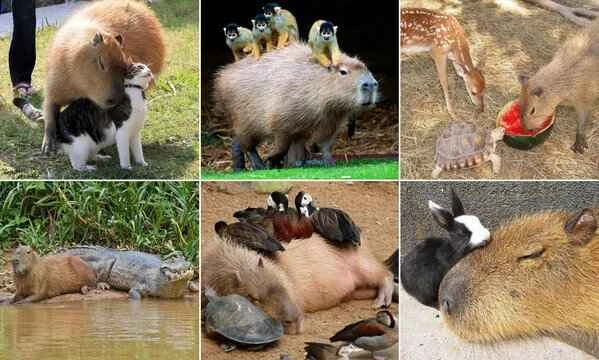
Capibalas are not limited to their own species; they can also form close relationships with many other animals. For example, they often interact closely with birds, monkeys, and even domestic dogs and cats. Their temperament is well-suited to living with these diverse animal species.
Kapibala's interaction with birds
Kapibala's Friendship with Birds
Interactions between Capibala and birds are the most common, especially in the wild. Many birds, particularly waterfowl such as herons and ibises, enjoy perching on the backs of Capibala. This is not uncommon, and some Capibala often have several small birds perched on them. The birds take this opportunity to clean parasites from the Capibala or pick up fallen food scraps.
Win-win relationship
This relationship is a mutually beneficial symbiotic one. Kapibala provides a safe habitat for birds, while the birds help them clean themselves of parasites. This close cooperation not only benefits both sides but also strengthens their social bond.
Kapibala's relationship with monkeys
The symbiotic relationship between Kapibala and monkeys
The relationship between Kapibala and monkeys is also quite unique, especially among primates such as capuchin monkeys or curly-tailed monkeys. The monkeys often climb onto Kapibala's back to enjoy a superior view, and sometimes they use this opportunity to forage or establish social interactions. The monkeys often enjoy playing with Kapibala near water or on grassy areas.
Harmonious partners
Kapibala is very tolerant of the monkeys' behavior and they do not exhibit any aggression. In fact, many monkeys seem quite dependent on Kapibala, especially when searching for food or roosting, where Kapibala often provides a quiet and safe environment.
Kapibala's friendship with his dog
Kapibala's interaction with dogs
The relationship between a Kapibal and a dog is equally fascinating. In some households, Kapibals and dogs live together, and they often get along harmoniously. The Kapibal's gentle nature is well-suited to interacting with a lively dog. Dogs may play with Kapibals and even sleep together. Both love water, so they often spend time together by the water.
Friendly pet companion
As Kapibala and the dog grew up together, their friendship deepened. The dog learned more tolerant and relaxed behavior from Kapibala, while Kapibala learned from the dog how to interact better.
Kapibala's relationship with cats
Kapibala and cats living together
While Kapibals don't interact with cats as frequently as they do with dogs, their relationship is still noteworthy. Cats are generally independent, but they seem to show some interest in Kapibals' gentle nature. Kapibals and cats usually get along peacefully, especially when they have enough space for each other. Cats may rest near Kapibals and occasionally show curiosity towards them.
A peaceful partnership
Kapibala are not bothered by the presence of cats, and cats generally do not interfere with the Kapibala's lifestyle. Although their interactions are not as frequent as with dogs and birds, they still coexist harmoniously.
Kapibala's Interaction with Reptiles
Kapibala and the turtle living together
While Kapibala interactions with reptiles are not as common as their interactions with mammals or birds, they do occasionally coexist with certain reptiles, particularly turtles or crocodiles. For example, in some wildlife sanctuaries, Kapibala and turtles may share the same wetlands, coexisting peacefully without disturbing each other.
The relatively calm relationship between the tortoise and Kapibala
Because Capibala typically prefer water, their relationship with aquatic reptiles is usually peaceful. While there isn't much direct interaction between them, Capibala respect the reptiles' space, while the tortoises forage and seek refuge in the same habitat.
Summary of Kapibala's interactions with other animals
Multi-species coexistence: Kapibala's unique relationships with other animals
The Kapibala demonstrates its sociality and adaptability through interactions with other species. From birds to monkeys, dogs, cats, and even reptiles, the Kapibala can coexist peacefully with almost all gentle animals. This interspecies friendship and cooperation not only secures the Kapibala's place in the natural world but also showcases the complex social relationships among animals.
Why is Kapibala able to get along with so many animals?
Kapibala's social nature, gentle disposition, and adaptability to diverse environments make them among the most inclusive animals in nature. Their relationships with other species are varied and resilient, enabling them to coexist peacefully with a wide range of animals in different ecosystems.
Kapibala and Animals That Can Coexist
| Animal species | Coexistence | Interactive features |
|---|---|---|
| birds | Stop on the back of a Kapibal and clean off parasites or food scraps. | Mutual benefit and resource sharing |
| monkey | Monkeys climb onto Kapibala's back in search of food or shelter. | Interdependence, social interaction |
| dog | Playing with the dog, and occasionally resting together. | Harmonious coexistence, shared space |
| cat | The cat showed curiosity about Kapibala and they coexisted peacefully. | Quiet and undisturbed |
| turtle/crocodile | Sharing habitats with aquatic reptiles | Do not disturb each other, live together |
Through observation of Kapibalas and other animals, we can conclude that these gentle, highly social animals are not only models of group living but also symbols of interspecies friendship. Whether in the wild or as pets, Kapibalas can coexist harmoniously with a variety of animals, demonstrating their unique social charm.
Why don't crocodiles eat Kapibala?
Crocodiles typically don't attack Kapibala unless provoked, even though Kapibala is one of their potential prey. There are several reasons for this:
1. Differences in habitat and activity time
The habitats of Capibala and crocodiles do not always completely overlap. Crocodiles typically live around water, especially in wetlands, rivers, and lakes, while Capibala, although fond of water, tend to live in shallow waters and on land areas such as grasslands and swamps. When Capibala are in the water, they usually stay in shallow areas, while crocodiles, although they can swim and lurk underwater, mostly wait at the bottom for prey to approach or swim close to them. Therefore, Capibala do not often enter the "attack range" of crocodiles.
2. Kapibala's sociality and alertness
Kapibals are highly social animals, typically living in groups. When they become aware of a predator, they alert other members of the group by emitting alarm calls. Within the group, they exhibit strong collective vigilance and cooperative behavior. If a crocodile attempts to approach, they usually leap quickly into the water en masse, scattering to escape predation, making them harder for the crocodile to catch.
3. Kapibala's size and defensive capabilities
Although crocodiles are powerful predators, the Capibala's size, rapid escape ability, and social lifestyle make them less likely to be a crocodile's primary prey. Especially in water, Capibala swim very fast, allowing them to escape quickly before a crocodile can strike. While crocodiles are adept at ambush, their attacks often require close proximity to the prey, and once the prey escapes, they are unlikely to catch it.
4. Crocodile's food choices
Crocodiles' food choices largely depend on their hunting strategies. They tend to prey on solitary, slower, or smaller animals, such as fish, birds, and young mammals. In contrast, the Kapibala is a highly social, agile animal, and is larger in size. Crocodiles may perceive attacking a Kapibala as riskier, especially when Kapibals are in groups, which significantly reduces the crocodile's chances of success.
5. The complexity of the habitat
The Capibala inhabits a complex environment, particularly in the transitional zones between water and wetlands, often at the edge of crocodile habitats. While crocodiles can camouflage themselves in the water and wait for prey, Capibala typically live near the water's edge and move in shallow water, making them less likely to venture into the deeper waters frequented by crocodiles. Furthermore, crocodiles generally prefer to ambush prey in deep water, while Capibala prefer shallow water; this difference in habitat further reduces their chances of encountering each other.
6. Kapibala's Group Defense
Capibalas typically live in groups, looking out for each other. When a predator appears, the group reacts collectively, becoming more alert and quickly fleeing. Even if a crocodile attacks suddenly, the Capibalas can increase their chances of escape by relying on the strength of the group. While crocodiles can ambush lone prey, hunting becomes much more difficult when facing a large group.
7. The symbiotic relationship between Kapibala and crocodiles
In certain specific ecological environments, Kapibala and crocodiles do not have a direct competitive or hostile relationship. Although crocodiles sometimes prey on small animals or the weaker ones, they also have their own predatory preferences and activity ranges. In some areas, crocodiles and Kapibala coexist in the same ecosystem, and when Kapibala are active near water, they interact less with crocodiles, and crocodiles do not frequently attack Kapibala.
Summarize
Although crocodiles are capable of preying on Capibala, the Capibala is not a primary prey for crocodiles due to habitat differences, the Capibala's alertness, social lifestyle, and the crocodiles' dietary choices. Crocodiles typically hunt alone, while the Capibala's social nature and escape abilities allow them to avoid becoming targets. Furthermore, the differences in their lifestyles and habitats mean that direct conflict between the two is infrequent.