I saw a "soil-moving expert" in the yard. Was it a woodchuck /groundhog or a pocket gopher? They both burrow and gnaw on plants, but they actually belong to different families, and their behaviors and the tracks they leave behind are quite different. Identifying the species is crucial for effective control.

These are not the same kind of animal.
Marmots belong to the family Sciuridae , and are related to ground squirrels and prairie dogs. Gophers, on the other hand, belong to the family Geomyidae , another group of rodents. Differences in lineage ultimately manifest in body size, facial features, burrowing methods, and feeding habits.
A visual comparison of body shape and appearance
Marmots are much more robust , typically weighing about 3–6 kg (7–13 lbs), with prominent ears, large eyes , and a medium-sized, bushy tail ; their incisors are large, but usually not exposed when their mouths are closed .
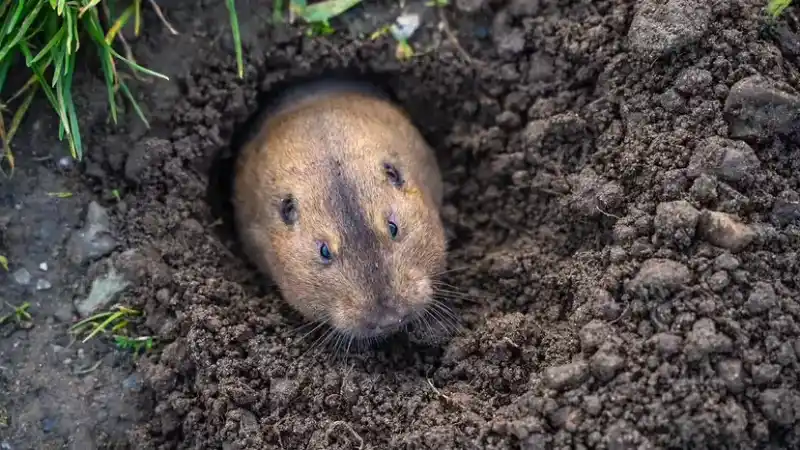
The burrowing hamster is more compact and smaller , mostly weighing less than 1 kg (<2 lbs), with small ears and eyes , and a short, sparsely haired tail ; its most distinctive feature is that its incisors are also exposed when closed , and it has hair-lined cheek pouches on both sides, which make it easy to stuff root vegetables into its "pocket".
Distribution range and preferred habitat
Marmots are widely distributed in eastern and central North America , southern Canada , and even Alaska , preferring open areas such as field edges, embankments, and woodland transition zones . They hibernate in winter.
Burrowing voles are mainly found in the Great Plains, western states , and grasslands, farmlands, and deep, loose soils of North and Central America . They are mostly burrowing throughout the year and rarely come out of the ground for extended periods.
Cave Structure and Surface Clues
Marmot burrows are deeper and larger , with entrances typically circular , about 15–25 cm (6–10 inches) in diameter. There are often fan-shaped or irregular mounds of earth next to the entrance, usually located at the base of fences or along bushes. The entire burrow can be 8–15 meters long , containing a bedroom and nursery, and also includes a hidden "escape tunnel".
The burrowing system of gophers is shallow and extensive , resembling a "feeding grid" beneath the surface, with exits often blocked by soil . The most easily identifiable features on the surface are fresh "crescent-shaped/horseshoe-shaped" mounds of soil , often strung together in a row; open burrow entrances are not visible because they are sealed off from within the burrow.
Feeding methods and the resulting damage
Marmots emerge from their burrows during the day to forage, nibbling on clover, alfalfa, tender seedlings, and even the tender branches of low shrubs along the ground. You can often see them sunbathing at the entrance of their burrows , and when startled, they dart back into their burrows. In autumn, they will gorge themselves to store fat in preparation for hibernation.
Gophers are "underground transporters ," preferring to pull plants down entirely from their burrows . On the surface, one often sees seedlings with their roots bitten off or suddenly "disappearing." They mostly complete their foraging and soil-moving activities underground , with new mounds of soil appearing most typically at night or in the early morning .

Practical tips for quick judgment at a glance
A large, round-shaped body with a fan-shaped mound, and prominent ears and tail—it's most likely a marmot.
New mounds appear at night, new moons line up in rows, and burrow entrances are often blocked—nine out of ten are gophers.
Targeted courtyard management suggestions
When encountering marmots, a more effective method is to use above-ground fencing combined with underground folding : Use galvanized wire mesh (rigid metal mesh) to enclose an area 90–120 cm high , burying 25–30 cm underneath and folding it outwards into an L-shape . Tightly seal the gaps around the enclosure and clear vegetation from the inside and outside of the fence for 30–60 cm to reduce concealment. If sealing the burrow is necessary, be sure to do so only after confirming that there are no cubs in the nest .
When encountering gophers, the focus should be on underground defenses: Install 6-13 mm mesh wire mesh around and at the bottom of the vegetable bed, 45-60 cm deep, to form a root barrier; place clamps or box clamps along the main passageways beneath the newest mounds ; supplement root crops with underground protective baskets . Surface fencing alone is usually ineffective, as they rarely forage on the ground.
Identifying who is "renovating" your lawn and choosing the right strategy will allow you to protect your vegetable garden and give you a yard that will no longer "collapse".