The European sharp-snouted shark is a mysterious deep-sea shark, famous for its bizarre, "alien" appearance. Its long, flat snout, translucent pink skin, and jaw that can suddenly spring forward make it unforgettable at first glance.
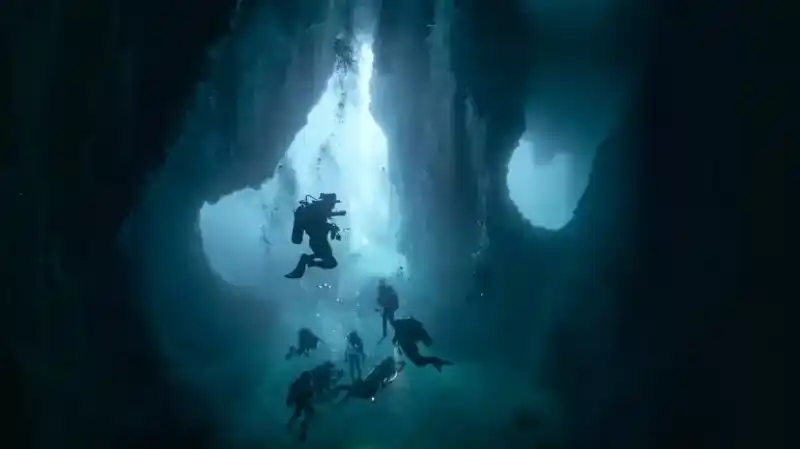
You have to dive to very, very deep waters to have a chance of seeing the European sharp-snout shark in its natural habitat.
Although it belongs to the frilled shark family , the European sharp-snout shark is the only known living species in the family , and is therefore often referred to as a " living fossil of the deep sea ".
Scientific name: Mitsukurina owstoni
Family: Mitsukurinidae
Distribution: Japan, Taiwan, Portugal, Gulf of Mexico, and offshore California. Habitat depth: Generally 200–1,300 meters, with records reaching even deeper. Other names: Goblin Shark
I. Physical characteristics: long snout + retractable jaw + translucent skin
The facial structure of the Eurythmus shark is a work of art, resembling a deep-sea monster.
| feature | illustrate |
|---|---|
| Kiss Minister and flat | The ampulla of Lorenz contains numerous electrosensors that can detect the faint electrical signals generated when prey muscles contract. |
| The lower jaw can "launch" forward. | They use ligament structures to launch a "sudden forward lunge" to capture their prey. |
| Teeth long and sharp | Used to pierce soft tissues and fish tissues, making it easier to "drag" back into the mouth. |
| Its body color is pinkish-white and semi-transparent. | The low-light environment of the deep sea causes thin skin and increased translucency of blood vessels. |
| Soft body, slow swimming | Deep-sea low-metabolism energy-saving strategy |
In particular, the retractable lower jaw, known as "slingshot feeding," is a very rare feeding method among known sharks.
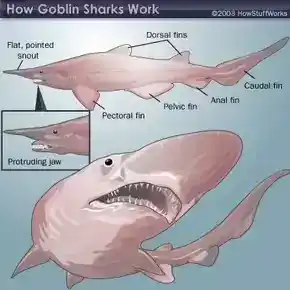
Body structure of the European sharp-nosed shark
II. Why is it called a "living fossil"?
The ancestors of the European sharp-snouted shark can be traced back to the early Cretaceous period 120 million years ago , and it is highly similar to prehistoric species such as Scapanorhynchus in the fossil record.
The modern and ancient forms are almost identical, indicating that:
Its body structure is already well adapted to the deep-sea environment and does not need to be changed .
This is what is called evolutionary stability , not "no evolution".
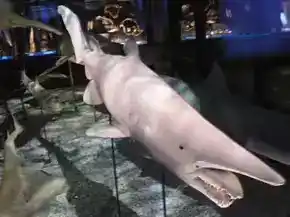
The Natural History Museum in Vienna, Austria, is exhibiting a life-size model of the Eurythmus shark.
III. Deep-sea stealth hunting: Its "secret weapon" is not its teeth, but its liver.
The European sharp-snout shark has an unusually large, oily liver .
What is the purpose of a giant liver?
Oil has a low density → body density is close to that of seawater
No need for frantic tail wagging → it can almost "float" forward.
Less water flow disturbance → less likely for prey to detect and approach.
Cooperate:
Inductive long kiss
ejected jaw
Approaching silently → biting down instantly → the prey has no time to react
This is a typical deep-sea ambush predator strategy.
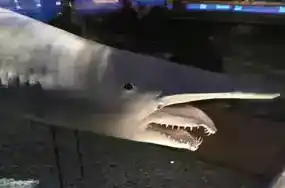
The European snapper is often called the ugliest shark species because of its long, thin snout.
IV. Main Foods
Small and medium-sized fish
Cephalopods (squid, baby squid)
Crustaceans (shrimp, crab)
Because specimens often have empty stomachs after being brought ashore (deep-sea fish will regurgitate or digest rapidly), dietary studies rely heavily on:
Hard tissue residue
DNA Trace Analysis
Deep-sea camera footage
V. Distribution and Habitat
The European sharp-snouted shark is a species widely distributed in the deep sea , but its density is extremely low, making it difficult to encounter.
High-record sea areas include:
| Sea area | illustrate |
|---|---|
| Offshore waters of Japan (Sagami Bay, Tokyo Bay) | Earliest records and most scientific observation points |
| Taiwan East Trench | There are clear video records in recent years. |
| Portugal - Deep Atlantic Ocean | Related to continental slopes and submarine canyons |
| Gulf of Mexico, off the coast of California | Mostly bycatch in deep-sea fisheries |
VI. Human Impact and Conservation Status
It does not attack humans : It lives in the deep sea and its layer of activity hardly overlaps with that of humans.
No commercial fishery value
The main risks stem from the potential interference between deep-sea trawls and deep-sea mining.
IUCN: LC (Least Concern), but data is insufficient and continuous monitoring is required.
Frequently Asked Questions (FAQ)
Do Eurasian sharks attack people?
No, it lives in the deep sea at depths of hundreds to thousands of meters and has no chance of contact with humans.
Can it be kept as a pet?
It's almost impossible. The temperature, pressure, and light conditions of the deep sea cannot be artificially simulated for extended periods.
What is the lifespan?
The estimated timeframe is 30–60 years , but more sample studies are still needed.
References
Michael Brett. *The Private Lives of Sharks: The Truth Behind the Myth*. Starkpol Press. 2000. (May 14, 2008) http://books.google.com/books?id=w31fF5IlqdoC
Cavadin, Mark. *Shark*. Firefly Publishing. 2004. (May 14, 2008) http://books.google.com/books?id=Qh44RNa5yh0C
Albert, David A. *Sharks, Rays, and Chipmunks of California*. University of California Press. 2003. (May 14, 2008) http://books.google.com/books?id=1SjtuAs702kC
Food and Agriculture Organization of the United Nations. *Mitsukurina owstoni*. Department of Fisheries and Aquaculture. 2001. (May 14, 2008) http://www.fao.org/fishery/species/13494
Jordan, Vanessa. "Goblin Shark". Department of Ichthyology, Florida Museum of Natural History. (May 14, 2008) http://www.flmnh.ufl.edu/FISH/Gallery/Descript/GoblinShark/GoblinShark.html
Crocker, Lexi. "Other Fish in the Ocean". NOVA Online. January 2003. (May 14, 2008) http://www.pbs.org/wgbh/nova/fish/other.html
Meta, Alok. "Rare 'prehistoric' goblin shark caught in Japan." National Geographic. February 9, 2007. (May 14, 2008) http://news.nationalgeographic.com/news/2007/02/070209-goblin-shark.html
ReefQuest Shark Research Center. "The Biology of the Goblin Shark." *Shark and Ray Biology*. (May 14, 2008) http://elasmo-research.org/education/shark_profiles/m_owstoni.htm
Kazunari Yano, Masaki Miya, Masahiro Aizawa, and Tetsuhisa Noichi. "Biological characteristics of goblin sharks (Mitsukurina owstoni) collected from the underwater canyon and surrounding waters near Tokyo, Japan." *Ichthyological Research*. May 22, 2007. (May 14, 2008) http://www.springerlink.com/content/p430623g30188246/fulltext.pdf