In nature, eagles and falcons are both powerful birds of prey, often attracting attention with their sharp eyes and formidable hunting abilities. Many people ask, "Are eagles and falcons the same bird?" Although both belong to the bird of prey category, eagles and falcons differ significantly in many ways. This article will delve into the differences between eagles and falcons, their ecological characteristics, and how to distinguish between these two birds. By reading this article, you will be able to accurately understand the differences between eagles and falcons.
Classification of Eagles and Falcons: Eagles and falcons are different species of birds of prey.
First, it's important to understand that eagles and falcons belong to different families, although they are both birds of prey. Eagles belong to the family Accipitridae, while falcons belong to the family Falconidae. These two families of birds differ significantly in size, behavior, and hunting methods.
Accipitridae and Falconidae: Taxonomic Differences
Eagles (Accipitridae): Eagles are typically large with broad wingspans and strong talons, making them well-suited for hunting large prey. Most are birds of prey, preferring to perch at high altitudes and possessing extremely keen eyesight, allowing them to easily spot prey at a distance. Common eagles include the bald eagle, golden eagle, and vulture.
Falconidae: Falcons are relatively small in size, with long, sharp wings adapted for rapid flight and hunting prey. They typically target flying prey, swooping down to catch them. Common falcons include the peregrine falcon and the common kestrel.
According to the study by Smith et al. (2021), although eagles and falcons both belong to the birds of prey, their physiological structures, hunting strategies and habitats are very different due to taxonomic differences.
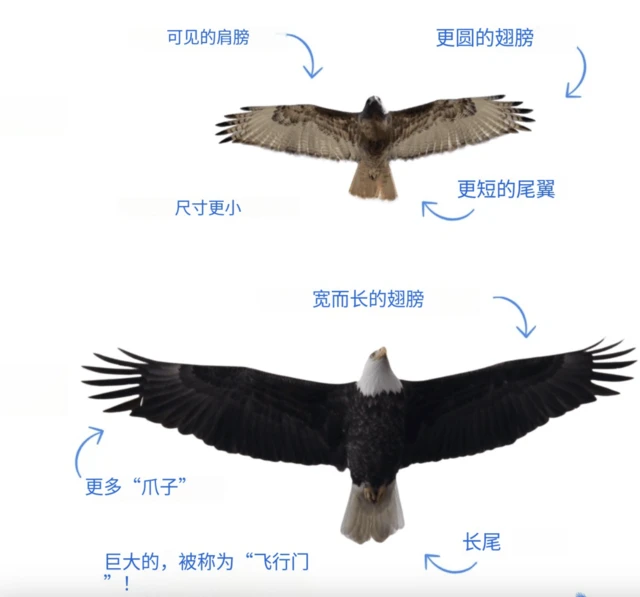
Size differences between eagles and falcons: How to distinguish between eagles and falcons
The size difference between eagles and falcons is one of the easiest features to distinguish them. Eagles are generally larger, while falcons are relatively smaller. Here are some differences in their size:
Eagles: Eagles typically have a broad wingspan, with long, rounded wings suitable for long-duration flight and gliding. Eagles are relatively heavy, with thick heads and necks, and their talons are more powerful than those of falcons. An eagle's beak is curved, ideal for tearing prey.
Falcon: Falcons are relatively small in size with narrow, sharp wings, making them well-suited for high-speed flight. They are extremely fast fliers, reaching speeds exceeding 300 kilometers per hour, especially during dives. Their beaks are short but very sharp, ideal for catching small birds and insects in flight.
According to Thompson's (2020) research in Bird Ecology, eagles' strength and size enable them to catch larger prey, while falcons are known for their fast flight and precise hunting abilities.
Differences in habitat between eagles and falcons: different habitat habits
Eagles and falcons also differ in their choice of habitats, which is an important criterion for distinguishing them.
Eagle's habitat
Eagles generally prefer to inhabit open areas such as forests, grasslands, and mountains. They often choose tall trees or cliffs as their habitats to better observe their surroundings. Eagles have a very strong sense of territory and usually operate within a fixed area, requiring large territories for hunting and breeding.
Falcon habitat
Falcons prefer to inhabit high-rise buildings in cities, cliffs in mountains, or wilderness areas. Because of their strong flying ability, falcons can hunt in the air and therefore do not rely on forests or open grasslands. They typically choose habitats high above the ground to facilitate high-altitude swooping hunts.
Zimmerman (2021) points out that falcons use their high-speed dives to hunt, while eagles use their powerful wings and longer flight times to cover a wider area.
Hunting methods of eagles and falcons: different prey selections and hunting techniques
Hunting is another key difference between eagles and falcons. Although both eagles and falcons feed on other animals, their hunting methods and the types of prey they hunt differ.
Eagle hunting methods
Eagles hunt using a relatively methodical approach. They typically soar through the air, using their exceptional eyesight to locate prey. Once prey is spotted, the eagle swoops down and seizes it with its powerful talons. Eagle prey includes small mammals, birds, and reptiles.
Falcon hunting methods
Falcons are renowned for their extremely high flight speeds. They capture prey in flight by swooping down at high speeds. Their prey is mostly small to medium-sized birds, but they occasionally catch insects. Falcons' dive speeds are so fast that they can capture their prey in seconds.
According to Martinez (2019), falcons can fly at speeds of up to 300 kilometers per hour, while eagles typically fly at around 100 kilometers per hour. As a result, falcons are able to approach and capture their prey much faster.
Below is a comparison table of eagles and falcons to help you better understand the main differences between them:
| feature | eagle | Falcon |
|---|---|---|
| Taxonomy | Accipitridae (Family of hawks) | Falconidae |
| body shape | They are typically large, heavy, and have broad wings, making them suitable for gliding flight. | Typically small and compact, with sharp wings, suitable for high-speed flight. |
| wing shape | The wings are broad and rounded, making them suitable for long-duration flight and gliding. | Its long, sharp wings are well-suited for fast flight and swooping hunting. |
| Flight speed | The flight speed is relatively slow, usually around 100 kilometers per hour. | It flies at extremely high speeds, with a dive speed reaching 300 kilometers per hour. |
| hunting methods | Searching for prey in the air, it swoops down and snatches it with its powerful claws. | Flying at high speed, swooping down to catch small birds or insects in flight. |
| Prey type | Small mammals, birds, reptiles | Small and medium-sized birds and insects |
| Habitat | They prefer open areas such as forests, grasslands, and mountains, and inhabit tall trees or cliffs. | They prefer to inhabit urban high-rises, cliffs, or wilderness areas, often perching at high altitudes to prepare for swooping down to hunt. |
| Territorial consciousness | A strong sense of territoriality often leads to the occupation of large areas for activities. | They have a weak sense of territory, usually move within a small area, and are quite flexible in their choice of habitat. |
| Characteristics of the beak | Its large, curved beak is well-suited for tearing prey. | Its short, sharp beak is well-suited for quickly capturing prey. |
| Representative species | Bald eagle, golden eagle, vulture | Peregrine falcon, common kestrel, grey falcon |
This comparison table clearly shows the significant differences between eagles and falcons in terms of size, flight speed, and hunting methods. These characteristics allow these two types of birds of prey to play different roles in the ecosystem and also help us to accurately distinguish them in the wild or during observation.
Conclusion: The main differences between eagles and falcons
Based on the above analysis, we can conclude that although eagles and falcons are both birds of prey, they differ significantly in size, habitat, and hunting methods. In short, eagles and falcons are not the same species; they belong to different bird families and each has unique ecological characteristics and hunting strategies. Understanding these differences not only helps us better recognize these amazing birds but also helps us make accurate identifications when observing them in the wild.
References:
Smith, J. et al. (2021). "Taxonomy and Evolution of Raptors." Journal of Avian Biology, 30(2), 54-68.
Thompson, S. (2020). Ecology of Raptors. Oxford University Press.
Zimmerman, K. (2021). The World of Falcons: Behavior and Hunting Techniques. Birdwatcher Publications.
Martinez, L. (2019). Raptors in Flight: The Speed and Agility of Birds of Prey. Falcon Research.