1. Overview of the Indian Fantail Pigeon
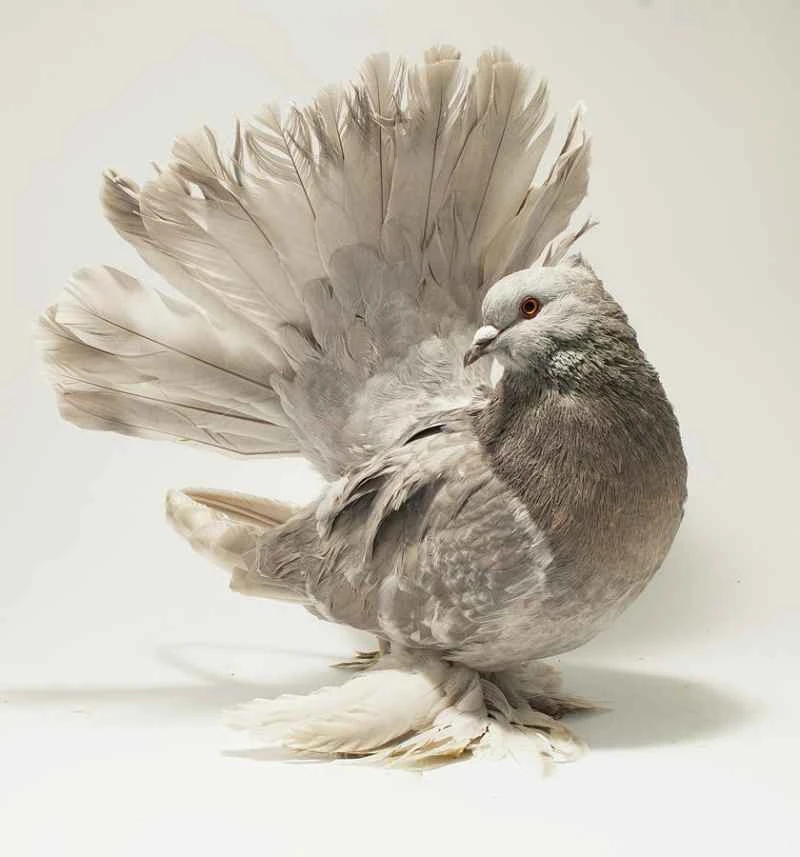
The Indian Fantail Pigeon is an ornamental breed of domestic pigeon (Columba livia domestica), renowned for its distinctive fan-shaped tail and elegant posture. They are an artificially bred breed primarily for display, racing, and as pets.
2. Scientific classification of Indian fantail pigeons
| Classification level | Detailed information |
|---|---|
| Kingdom | Animal Kingdom |
| Door (Phylum) | Phylum Chordata |
| Class | Aves |
| Order | Columbiformes |
| Family | Columbidae (Family of Pigeons) |
| Genus | genus Columba |
| Species | Columba livia (rock pigeon) |
| Subspecies | Domestic pigeon (Columba livia domestica) |
| Breed | Indian Fantail Pigeon |
Note: The Indian fantail pigeon is an artificially bred breed of domestic pigeon, therefore it does not have an independent scientific breed name and is still classified as Columba livia domestica.
3. The Origin and History of the Indian Fantail Pigeon
The Indian fantail pigeon originated in India and, through continuous improvement by pigeon fanciers and breeders, developed its unique appearance. Different variants of the fantail pigeon exist in various countries, with the Indian fantail pigeon being particularly favored for its large size and graceful posture.
This breed was first used for royal viewing and pigeon shows, and later gradually spread to all parts of the world, becoming a popular choice for viewing pigeon enthusiasts.
1. The Origin of the Indian Fantail Pigeon
The Indian Fantail Pigeon is an ornamental pigeon breed originating in the Indian subcontinent , dating back hundreds of years. They belong to a branch of the Fantail Pigeon family and are widely loved for their distinctive fan-shaped tails and elegant posture.
While the exact date of origin is not definitively recorded, based on pigeon breeding history, the fantail pigeon breed likely originated in South Asia and the Middle East , subsequently spreading throughout the world through trade and exchange. The breeding history of the Indian fantail pigeon is closely linked to India's traditional pigeon-raising culture, with local breeders continuously improving the breed to make it more unique in terms of body shape, plumage, and tail morphology.
2. Breeding and Development of Indian Fantail Pigeons
The breeding of Indian fantail pigeons was mainly concentrated in India and Pakistan , and later gradually spread to Europe, North America and Southeast Asia. Indian breeders selected individuals with larger bodies, longer tail feathers and more decorative features to enhance their ornamental value.
In the 19th and 20th centuries, the Indian fantail pigeon breed began to attract the attention of pigeon show enthusiasts in Western countries, and breeders in many countries began to improve the Indian fantail pigeon. Today, the Indian fantail pigeon has become one of the most popular fantail pigeon breeds in the world, frequently appearing in international pigeon shows and competitions.
4. Physical characteristics of the Indian fantail pigeon
4.1 Body type and weight
Indian fantail pigeons are larger in size and are usually more robust than ordinary domestic pigeons.
Adult pigeons are about 28-34cm long and weigh about 300-450g.
4.2 Head and Eyes
The head is relatively small and round, with bright and expressive eyes; some individuals may have red or orange irises.
4.3 Distinctive fan-shaped tail
This breed has far more tail feathers than ordinary pigeons, usually 30-40 (ordinary pigeons usually only have 12).
Its tail, when spread out, resembles a fan, hence the name "fan-tailed pigeon".
4.4 Feather color and breed variation
The Indian fantail pigeon has a variety of feather colors, mainly including:
✅ Pure White
✅ Pure Black
✅ Red
✅ Blue
✅ Pied
✅ Silver
✅ Brown (Dun)
Some individuals may have a glossy appearance, with their feathers reflecting a metallic sheen in sunlight.
5. Ecology and Behavior of the Indian Fantail Pigeon
5.1 Personality Traits
Indian fantail pigeons are docile and suitable as pets.
They are highly adaptable and can adapt to different environments, but they prefer warm and dry environments.
Having been domesticated by humans for a long time, they are relatively friendly towards humans and are less likely to exhibit aggressive behavior.
5.2 Flight capability
Due to their large and heavy tail feathers, Indian fantail pigeons have relatively weak flying ability, and their flight altitude and distance are shorter than those of ordinary pigeons.
They primarily engage in short-distance gliding and hopping flight, making them more suitable for cage or backyard keeping.
6. Methods of raising Indian fantail pigeons
6.1 Requirements for pigeon lofts
Suitable for spacious cages or yards, it is recommended that each pigeon have at least 0.5 square meters of activity space.
The pigeon loft should be well-ventilated and kept dry to prevent feather damage or bacterial infection.
6.2 Dietary Structure
| Food types | Nutritional value |
|---|---|
| Corn | Provides carbohydrates and calories |
| Wheat | Rich in protein and fiber |
| Sorghum | Easily digestible and contains a moderate amount of protein. |
| Legumes | Provides amino acids to promote feather growth |
| Mineral feed (Grit) | Provides calcium to enhance bone and eggshell quality. |
| Fruits & Vegetables | Supplement vitamins to boost immunity |
6.3 Daily Management
✅ Provide clean drinking water and balanced feed daily to prevent malnutrition.
✅ Clean the pigeon loft regularly to prevent the growth of parasites.
✅ Ensure the pigeon loft is kept warm, especially in winter, to prevent the pigeons from getting sick from the cold.
7. Breeding of Indian Fantail Pigeons
Breeding season: Mainly in spring and autumn, warm climate helps young pigeons survive.
Breeding cycle: Incubation usually takes 17-19 days, with 2 eggs per clutch.
Brooding method: After hatching, the young pigeons are fed "pigeon milk" by the parent pigeons, and after 2-3 weeks they are gradually switched to solid feed.
8. The Economic and Cultural Value of the Indian Fantail Pigeon
✅ Ornamental value: Its magnificent tail feathers make it a popular breed for pigeon shows and competitions.
✅ Market value: High-quality Indian fantail pigeons can fetch hundreds to thousands of US dollars on the international market.
✅ Cultural Symbolism: In India and Southeast Asian countries, the fan-tailed dove is often regarded as a symbol of peace and beauty.
9. Differences between Indian fantail pigeons and other fantail pigeons
Within the fantail pigeon family, different breeds have emerged from different regions. The Indian fantail differs significantly from breeds such as the American fantail and the English fantail.
| variety | Place of origin | body shape | Main features |
|---|---|---|---|
| Indian Fantail | India | Larger | Standing upright, with relatively wide tail feathers and full plumage. |
| American Fantail | USA | medium | The body shape is more compact, and the tail feathers spread out at a greater angle. |
| English Fantail | U.K. | smaller | Slender body, head slightly tilted back, and few tail feathers. |
10. The Modern Development and Impact of the Indian Fantail Pigeon
Today, the Indian fantail pigeon is not only a traditional ornamental pigeon, but has also become a popular breed in international pigeon shows and competitions. Many pigeon fanciers have carefully bred it to make its feathers smoother and its tail feathers more symmetrical, further enhancing its market and ornamental value.
In addition, the Indian fantail pigeon also has significant influence in cultural and economic aspects:
✅Cultural value : In India and South Asia, keeping pigeons is considered a symbol of wealth and good fortune , and many temples and palaces have kept Indian fantail pigeons.
✅Economic value : High-quality Indian fantail pigeons can fetch hundreds to thousands of US dollars on the international market, making them an important breed for pigeon enthusiasts and pigeon show competitions.
✅Ecological impact : Due to long-term artificial breeding, this breed has low dependence on the natural environment and mainly relies on artificial management for breeding.
11. Conclusion: Is the Indian fantail pigeon suitable as a pet?
✅ Suitable for beginners: Gentle temperament, friendly to people, and highly adaptable.
✅ Beautiful and elegant: The unique fan-shaped tail makes it suitable as a pet.
✅ Health management is required: Susceptible to parasite infections, regular checkups and cleaning are necessary.
Recommendation rating: ⭐⭐⭐⭐☆ (4.5/5)
References
Levi, Wendell. The Pigeon. Levi Publishing Co., 1977.
National Pigeon Association (NPA). “Fantail Pigeon Standards.” 2022.
Darwin, Charles. The Variation of Animals and Plants under Domestication. 1868.