Marsupials are a unique group of mammals known for giving birth to underdeveloped offspring, which then crawl into their mother's pouch to continue growing. These fascinating creatures are mainly found in parts of Australia , Tasmania , New Guinea , and the Americas .
Common types of marsupials
| marsupial types | Main features | Habitat | diet |
|---|---|---|---|
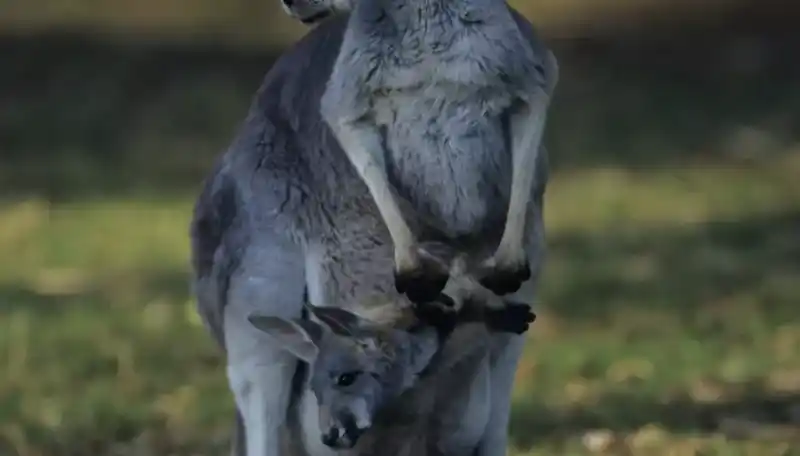
| Kangaroos and baby kangaroos | Big feet, powerful hind legs, jumping movements | Australia, Tasmania, New Guinea | Herbivorous (grass, leaves) |
| koala | Arboreal, grey fur, pouch facing backwards | Eastern and southeastern Australia | Herbivorous (eucalyptus leaves) |
| Wombat | Burrowing animals, plump bodies, with their pouches facing backwards. | Australia | Herbivorous (grass, roots, bark) |
| Tasmanian Demon | Carnivorous, with black fur, and a fierce temperament. | Tasmania | Carnivorous (fish, insects, snakes, carrion) |
| Opossum | Nocturnal arboreal animals, highly adaptable, and diverse in species. | Australia, North America and South America | Omnivorous (fruits, insects, small animals) |
| Glider | Gliding membrane, nocturnal, arboreal | Australia | Omnivorous (nectar, pollen, sap, insects) |
1. Kangaroos and baby kangaroos
Australia, Tasmania , and New Guinea are home to 50 species of kangaroos and wallabies , collectively known as giant kangaroos due to their large feet .
The red kangaroo is the largest of its kind, growing up to 6 feet (1.8 meters) tall.
The grey kangaroo is relatively small and is commonly found in woodlands .
Kangaroos are medium-sized marsupials that inhabit a variety of landscapes, including bushes, swamps, and rocky cliffs .
Interestingly, there are 14 species of tree kangaroos in Australia , including the Bennett tree kangaroo and the Lumholtz tree kangaroo .
These herbivorous marsupials primarily feed on grass, leaves, and vegetation .
2. Koala: The iconic arboreal marsupial.
Although commonly referred to as koala bears , koalas are not actually bears , but marsupials .
Koalas are found in eastern and southeastern Australia , and they spend most of their lives among eucalyptus trees .
Their entire diet consists of eucalyptus leaves , which provide very little nutrition, so they sleep 18-22 hours a day .
Adult koalas are 2 to 3 feet (0.6 to 0.9 meters) long and weigh 9 to 29 pounds (4 to 13 kilograms) .
Their rear-facing brood pouch evolved from their burrowing ancestors , serving to prevent soil from getting in while also allowing them to dig.
3. Wombat: Underground Engineer
Wombats are burrowing marsupials with robust bodies and strong claws, making them well-suited for digging.
Their rear-facing bags prevent soil from entering when digging tunnels .
They are herbivores, feeding on grass, roots, tubers, and bark .
wombat species
| type | Main features |
|---|---|
| Common Wombat | Short ears and rough fur |
| Northern hairy-nosed wombat | The fur is relatively soft, and it is endangered. |
| Southern hairy-nosed wombat | Larger ears, more adaptable |
Wombats are primarily nocturnal and, despite their robust appearance, can run at speeds of up to 25 miles per hour (40 kilometers per hour) .
4. Tasmanian devil: The largest carnivorous marsupial.
The Tasmanian devil is a nocturnal scavenger , known for its powerful jaws and aggressive feeding behavior .
This marsupial is found only in Tasmania , and is black or dark brown with a robust build .
It can grow up to 30 inches (75 cm) long and weigh about 26 pounds (12 kg) .
A female kangaroo can give birth to 20-30 kangaroos at a time, but only 4 will survive due to the limited number of nipples in the kangaroo pouch.
Because of their powerful jaws and teeth , these marsupials feed on insects, small animals, carrion, and even bones .
5. Opossum: The most widely distributed marsupial.
Opossums are arboreal marsupials , meaning they live in trees .
They have curlable tails that help them grab branches when walking in the forest.
Opossums are found in Australia, North America (Virginia opossum), and South America , and exhibit a variety of adaptations .
Virginia opossums are known for their "playing dead" defense mechanism when facing predators.
There is a unique species, the yapok (water possum) , from South America , which is an excellent swimmer and carnivore .
6. Glider: A flying marsupial.
Gliders are small, nocturnal marsupials that have special membranes that allow them to glide between trees .
Types of gliders
| Glider types | Main features |
|---|---|
| Feathered Glider | A small, curlable tail, resembling feathers. |
| sugar glider | Well-known, social animals, often kept as pets |
These marsupials live in the woodlands and forests of Australia , using gliding to evade predators and travel between trees .
They feed on nectar, pollen, sap, insects, and leaves .
in conclusion
Marsupials are a diverse group of mammals whose species are adapted to a variety of habitats , from forest canopies to arid plains . They possess a unique reproductive system in which undeveloped offspring develop in a pouch , distinguishing them from other mammals.
From powerful kangaroos to tiny sugar gliders , these fascinating creatures continue to fascinate scientists and nature lovers alike .