Crows and ravens are often confused: both have black feathers, are intelligent, and have a somewhat mysterious air. But to ornithologists and wildlife researchers, their differences are quite obvious.
Both belong to the genus Corvus , which includes more than 30 species of black birds such as crows, ravens, jackdaws, and white-billed jays, but crows and ravens are still two completely different types of birds.
This article focuses on comparing the two most common and easily confused types in North America:
Common Raven ( Corvus corax )
American raven ( Corvus brachyrhynchos )
If you want to quickly identify them by their size, calls, flight patterns, or even behavioral habits, the following popular science analysis will be very useful.
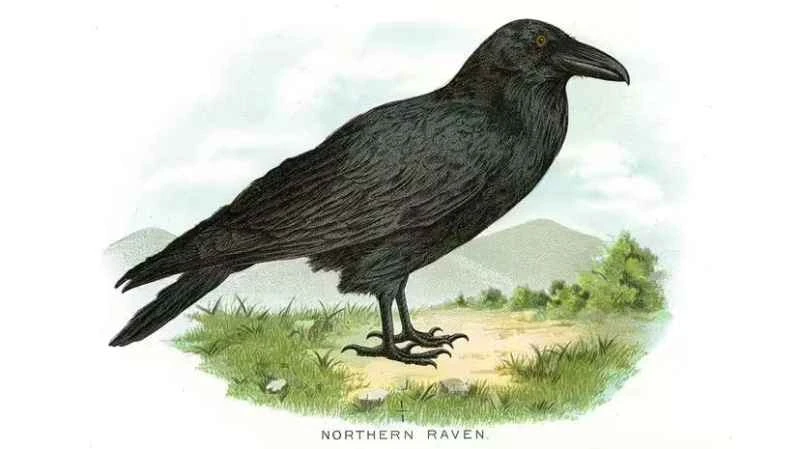
1. Size and shape: Ravens are significantly larger than crows.
Ravens are more robust.
Wingspan: Up to 46 inches (1.16 meters)
Height: Up to 27 inches (68.5 cm)
Strong-looking and resembles a small bird of prey
Crows are medium-sized
Wingspan: Approximately 36 inches (0.9 meters)
Slender body, lighter overall
In most cases, you can tell whether a bird is a crow or a raven just by its size when it flies overhead.
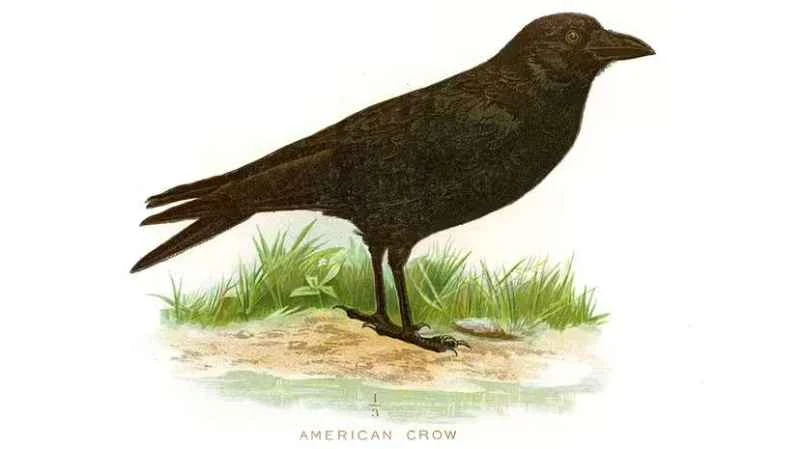
2. Differences in beak shape, throat feathers, and facial features
Ravens have thick, downward-curving beaks.
Heavy and powerful
Curved like a "dagger"
It is very eye-catching at first glance.
The crow's beak:
More straight
More detailed
More peaceful outline
Throat feathers: Ravens have "fluffy whiskers".
Ravens have distinctive, bushy "throat feathers" on their throats.
The crow had none.
This is one of the easiest features to distinguish when observing a stationary individual.
3. Tail and wings: the best way to identify them in flight.
The shape of the tail feathers is obvious at a glance
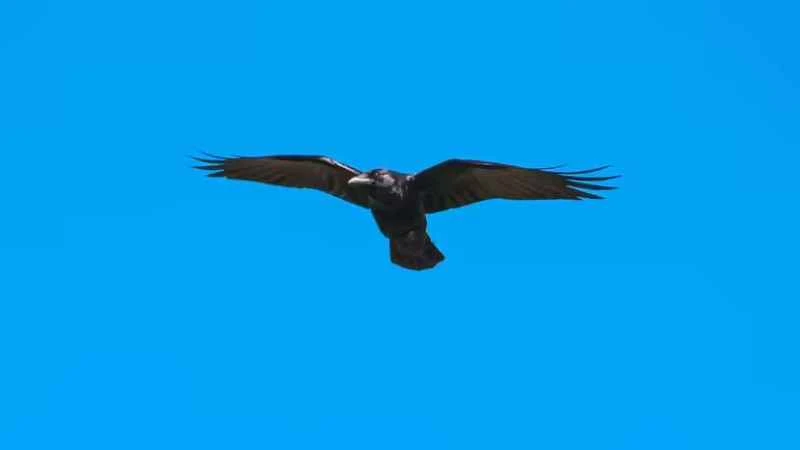
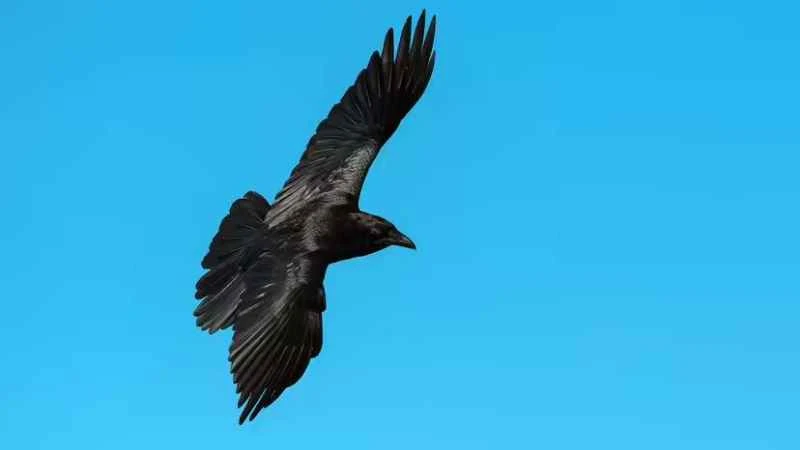
Raven's tail: wedge-shaped, forming a "V" shape.
Crow's tail: fan-shaped, with feathers of almost uniform length.
Wing shape and flight mode
Raven: With long, slender, and sharp wings, it excels at gliding and hovering.
Crow: Its wings are blunter, requiring frequent flapping.
So when you see a black bird gliding effortlessly high in the sky, it is almost certainly a raven.
4. Differences in calls: Crows "caw caw," ravens "clack clack."
The sound of crows
A piercing, clear "Caw! Caw!"
Rhythm and regularity
Commonly used for alarms or group communication
The sound of ravens
Lower and hoarse
The sound is similar to "ka—" or "kowa".
With an echo-like resonance
The differences in sound are very obvious, which is a key basis for outdoor identification.
5. Social Habits: Crows are gregarious, while ravens are solitary.
Crows: Super Social Animals
They like to form flocks of dozens, hundreds, or even thousands of crows (murder).
Shared nocturnal habitats in winter
They can be seen everywhere in cities and towns.
Group cooperation and information exchange are important reasons for their successful survival in the city.
Ravens: More solitary, more territorial
Activities are usually conducted in pairs of spouses or small families .
Occupy a large area of territory
Rarely mingling with large groups
If you see a pair or a single blackbird in a remote area, it is most likely a raven.
6. Habitat preferences
American ravens
It can survive in cities, farmlands, and open areas.
Highly adapted to human environment
Common Raven
Natural areas such as forests, mountains, wilderness, and deserts
It is better to avoid densely populated cities
While there is often overlap between the two, the differences in preferences remain quite significant.
7. Intelligence level: Among the most intelligent birds in the world.
Crows and ravens possess extremely high intelligence, comparable to that of chimpanzees and dolphins.
The intelligence of crows
Recognizing individual human faces
Holding a grudge or remembering a favor
They will give small gifts back to the people who feed them.
Skilled in teamwork and communication
The intelligence of ravens
Clear forward planning capabilities
Complex tool usage
Demonstrating advanced cognition such as deception and cooperation
Able to complete multi-step puzzle-solving tasks
Both of them belong to the "genius level" among birds.
8. Dietary differences
Ravens have a wider range of food sources.
Small mammals
Birds and bird eggs
Reptiles
Nuts, fruits, berries
Large carrion (deer, wild boar, etc.)
Garbage and waste
Crows prefer insects and small prey.
Insects, earthworms
mice, birds
Grains, fruits
Small carrion
Strong scavenging ability in the city
Both are extremely opportunistic predators.
Cultural Symbols: From Myths to Traditional Stories
Crows and ravens occupy an important place in global culture:
Norse mythology : Odin possessed two talking ravens, "Shukin and Mourning".
In Native American cultures , crows are often seen as symbols of wisdom, change, or cunning.
Legends from around the world : Ravens are seen as symbols of wisdom, not merely as omens of misfortune.
Their mysterious image stems from their high intelligence and unique behavioral habits.
Frequently Asked Questions (FAQ)
How can you distinguish between a crow and a raven by their sounds?
Crow: "Caw caw caw!" Bright and sharp
Raven: "Caw—" "Caw!" Low, hoarse voice
Will they live in the same area?
Yes, but:
Crows prefer cities and farmlands
Ravens prefer forests, mountains, and wilderness.
Which is smarter?
Both are very intelligent, but the raven is more outstanding in "tool use" and "complex behavioral planning", while the crow is stronger in "social intelligence".