Lufengosaurus lived during the Early Jurassic period, approximately 190 million years ago, and was an ancestor of later giant herbivorous dinosaurs. It is named after Lufeng County in Yunnan Province, China, where the type specimen was discovered, and it was the first complete dinosaur fossil found in China.
The Lufengosaurus was unearthed in a place now called "Dinosaur Mountain"—Dawa Dinosaur Mountain. Located northeast of Lufeng County, 4 kilometers from the county seat, Dawa Dinosaur Mountain is named "Dinosaur Mountain" because of the numerous dinosaur fossils unearthed there. Dinosaur fossils are also found exposed around 14 surrounding natural villages. As early as 1938, geologist Bian Meinian tracked this dinosaur down from a bone lamp held by Lufeng farmers.
The Lufengosaurus had a bulky, medium-sized body structure with a relatively small skull (approximately 3.5 times the length of the first vertebrae of the tail). Its nostrils were triangular, its anterior eye apertures were small and short, and its eye sockets were large and round. The superior temporal apertures were located on the upper part of the skull and were not visible from the side. The jaw joint was lower than the dental arch, and there was an unossified gap between the upper occipital and parietal bones. Its teeth were small, not sharp, and simple, with slightly flattened crowns and serrated edges on both the anterior and posterior margins. It had a relatively long neck, thick vertebrae, and a very long tail. There were 10 cervical vertebrae, 14 dorsal vertebrae, 3 sacral vertebrae, and 45 caudal vertebrae. Its scapulae were slender, its sternum was well-developed, its ilium was short, and its pubis and ischium were weak. Its forelimbs were about half the length of its hind limbs.
The Lufeng dragon was only 5 meters long and a little over 2 meters tall when standing, not much larger than a horse today. It had a small head, toes on its feet with large claws at the tips. Its forelimbs were short with five toes. It had a thick tail trailing behind it, which it used to support its body when standing, as if it were carrying a stool with it.
Lufengosaurus is divided into two species: giant Lufengosaurus and Xu's Lufengosaurus. Giant Lufengosaurus is about one-third larger than Xu's Lufengosaurus. The former has a more robust vertebrae. Apart from that, there are not many differences between the two. If not carefully distinguished, they may be mistaken for different growth stages of the same dinosaur, as their different sizes are due to their different ages.
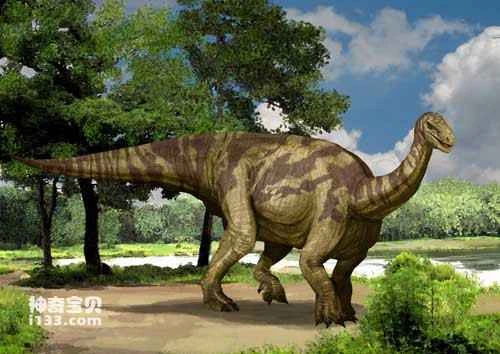
Chinese name: Lufeng Dragon
Latin name: Lufengosaurus
Era: Early Jurassic
Fossil origin: Yunnan, China
Physical characteristics: 5-6 meters in length
Diet: Plants
Species: Sauropods
Meaning: Lizard from Lufeng