Share this
What do tigers eat? Will they be eaten by other animals?

What do tigers eat? Will they be eaten by other animals?

2026-01-19 13:17:51 · · #1
What do tigers eat? Tigers are one of the largest cat species on Earth. Essentially, tigers are carnivores. They eat a wide variety of prey depending on the terrain they inhabit—from termites to small rhinoceroses. In this article, we will mainly introduce the various hunting patterns of tigers and their "recipe." Are tigers eaten by other animals? Let's discuss that below.

picture

  • What do tigers eat?

picture

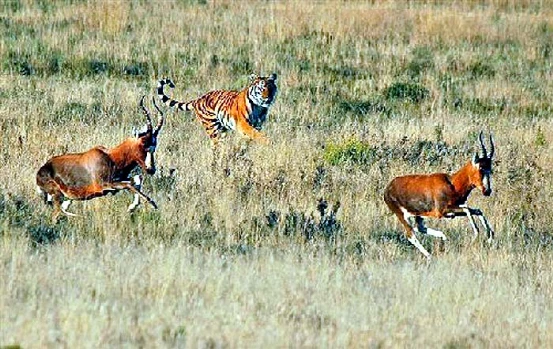
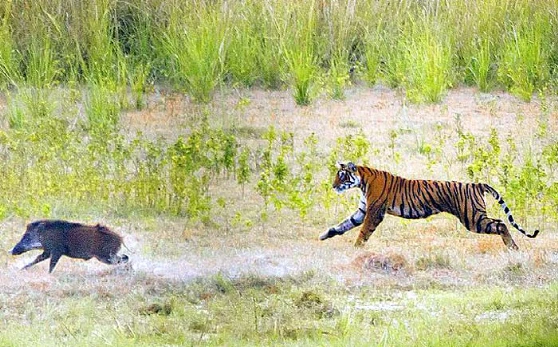
As apex predators, what animals do tigers eat? It's no exaggeration to say that tigers will eat any moving animal with meat on it. And tigers aren't picky eaters; they'll eat anything that's nutritious for them.
For example: all kinds of deer, leopards, wild boars, zebras, bears, tapirs, horses, buffalo, rhinoceroses, wild dogs, bison, antelopes, baby elephants, moose, and goats.
We didn't see any lions. Does that mean the tigers couldn't defeat the lions? Gentlemen, this is a question worth pondering.
If large prey is unavailable, tigers will choose small mammals such as hares, rodents, frogs, snakes, birds, monkeys (such as langurs), fish, lizards, and even termites.
If a tiger doesn't hunt any animals, will it starve to death? No, tigers will eat berries or grass to regulate their digestive system to relieve hunger.
Therefore, although tigers are carnivores, they can also be omnivorous under special circumstances.

  • How do tigers hunt?

picture

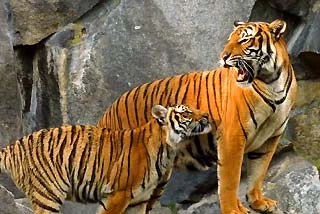
Tigers prefer to hunt alone rather than in packs. When tiger cubs are a few months old, their mothers involve them in the hunting process, thus training them at a very young age.
Below is an introduction to some tiger hunting techniques and habits.
Tigers hunt using their sight, not their sense of smell, to detect the scent of their prey. They use their dark, striped skin as effective camouflage, blending into hiding places, especially in grassy areas, where they resemble vertical patterns of light and shadow. This allows them to get very close to their prey without being detected before launching an attack.
Tigers can remain silent for a long time while still, and then pounce on their prey unexpectedly.
Observations suggest that tigers can make at least 20 such attempts before killing their prey.
Tigers can go from a complete standstill to speeds of up to 80 km/h in a short sprint.
Of course, hunting can also injure tigers. If the prey (such as crocodiles, porcupines, or heavy buffalo) fights back, the tiger may also be seriously injured in the process.
Male and female tigers hunt differently. Female tigers only hunt within their own territory, while male tigers hunt anytime and anywhere.

  • How much does a tiger eat?

picture

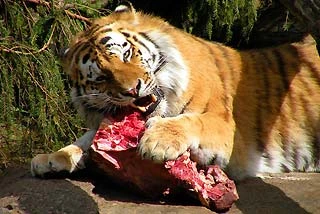
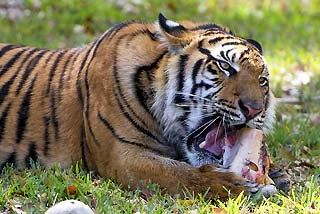
The average weight of a tiger is about 300 kilograms. They can consume an average of 15-50 kilograms of meat in one meal.

  • How often do tigers eat?

picture

Tigers typically eat every two days after consuming a large mammal. It is estimated that a tiger kills about one large animal per week, thus hunting approximately 50 to 60 animals per year.

  • How do tigers kill their prey?

picture

When a tiger catches its prey, it uses its sharp claws hidden in its forepaws as needed. These claws can be extended or retracted. When catching prey, the claws extend from the paws to firmly grasp the prey. In normal circumstances, the claws retract into the paws to facilitate walking and running.
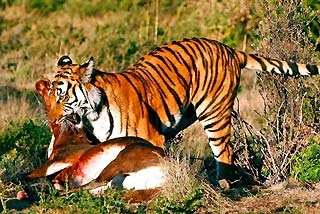
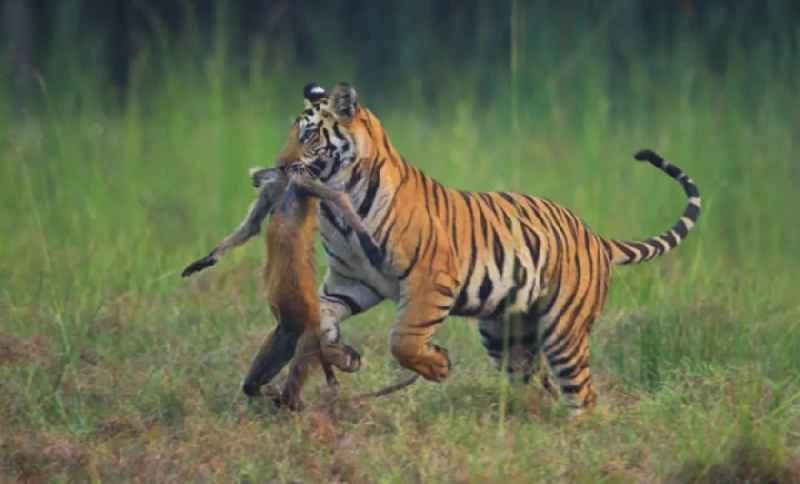
Tigers typically attack animals from the side or back, preventing their prey from escaping quickly. Their first move is to bite the animal's neck, breaking its neck bones, and then tearing its throat.
Once an animal is killed, the tiger will drag the dead animal to a secluded spot and eat it quietly.

  • When do tigers hunt?

picture

If a tiger is truly hungry and prey is right in front of it, it will hunt immediately. Generally, tigers prefer to hunt in cool weather or on cloudy days. Furthermore, sunset is an ideal time for tigers to hunt; research shows that tigers have six times the night vision of humans.

Do tigers eat people?


picture

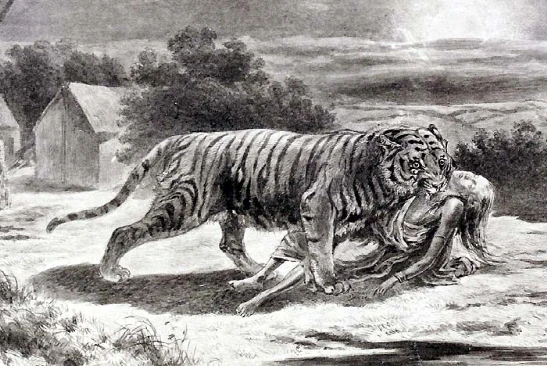
Tiger and Man (Painting from 1893 - Calcutta Museum)

The answer is yes! That's absolutely true.

There have been many incidents in the past where tigers have attacked and killed humans for food. Even now, we hear horrific stories in the news about zoos and villages as tigers invade due to habitat loss and in search of food.
In 1903, a tiger attack occurred at the Calcutta Zoo, which reportedly claimed the lives of more than 200 people.

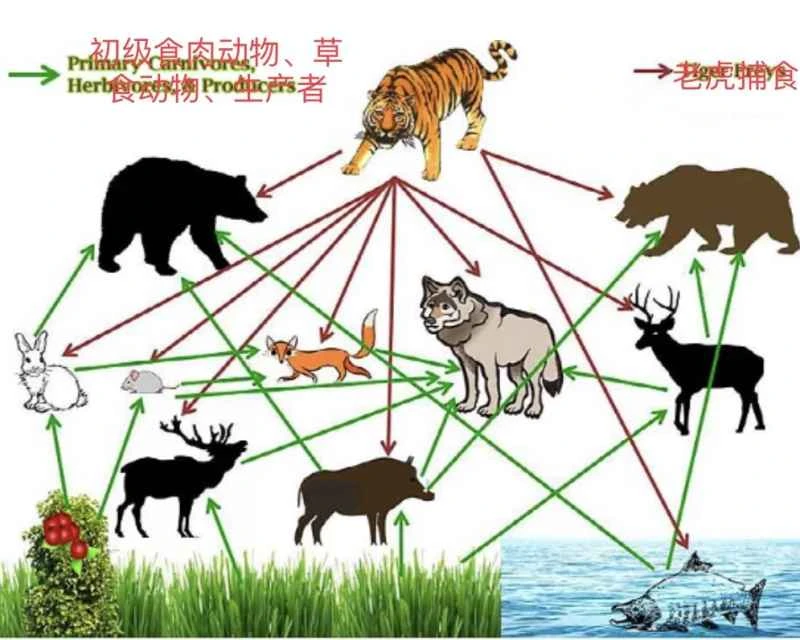
Tiger food chain diagram:

picture

The image above shows that tigers are at the top of the food chain in the ecosystem, with no predators to eat them. Tigers feed directly on primary carnivores and herbivores.
The second level of the food chain represents the main carnivores that feed on herbivores, such as foxes and wolves.
The third level of the food chain represents herbivores that feed on producers, such as deer, elk, and wild boars, which feed on vegetation such as trees, berries, and grasses.

Dietary habits of several different tiger species:
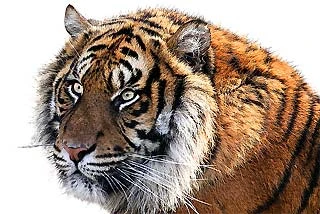
Each type of tiger has a different "diet," depending on the geographical location they inhabit. Below are some known tiger species and what they eat in the wild:

Siberian tiger
picture

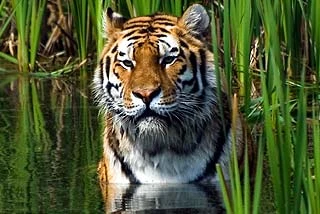
The Siberian tiger, also known as the Amur tiger, is now mainly distributed in the Primorsky Krai region of Russia.
In cold regions, Siberian tigers prey on red deer, wild boar, Père David's deer, and sika deer. Additionally, tigers attack and eat grizzly bears and black bears.
The Siberian tiger is at the top of the food chain in the Siberian ecosystem and has no natural predators.
However, due to their endangered status and declining populations, causing severe imbalances in the ecosystem, the number of wolves may triple while the number of deer/elk species may decline, forcing them into endangered status.

South China tiger
picture

The South China tiger, also known as the "Chinese tiger," is considered critically endangered by the International Union for Conservation of Nature (IUCN).
South China tigers prey on antelope, tufted deer, sambar deer, musk deer, and wild boar. A single South China tiger can consume approximately 20-40 kilograms of meat. At the top of the ecological pyramid, humans are their only predators.

Indochinese Tiger
picture

The Indochinese tiger is mainly distributed in Myanmar, Thailand, Laos, Vietnam, Cambodia, and southern China. It is listed as an endangered species by the International Union for Conservation of Nature (IUCN).


Their main diet includes sambar deer, antelope, wild boar, buffalo, catfish, young rhinoceros, baby rhinoceros, sea turtles, fish, and baby elephants.
When food is scarce, Indochinese tigers will even hunt porcupines, hog badgers, macaques, and musk deer.

Malayan tiger
picture

Malayan tigers are found in the Malay Peninsula. In 2015, they were officially declared a critically endangered tiger species.
The Malayan tiger's diet includes deer (sambar deer), wild boar, bearded hog, and antelope. It also preys on sun bears, young elephants, and rhinoceros calves. Due to human encroachment, livestock such as domestic cattle have become prey for these tigers.
Interestingly, Malayan tigers also hunt at night. As leaders of the food chain, they have no natural predators other than humans.

Sumatran tiger
picture

In 2008, the International Union for Conservation of Nature (IUCN) declared the Sumatran tiger, native to the Sumatra Islands and Indonesia, a critically endangered species. What do Sumatran tigers eat?
Sumatran tigers eat fish, monkeys, crocodiles, poultry (birds), wild boars, and deer.
They are patient hunters, typically tracking their prey for 1-2 hours before attacking. Sumatran tigers have an interesting habit—once they finish eating, they cover the animal carcass with grass using their paws so they can eat the leftovers later!

Bengal tiger
picture

What do Bengal tigers, who live in India, Bangladesh, Nepal, and Bhutan, eat?
Bengal tigers prefer to hunt large mammals, such as deer, cattle, and antelopes.
They frequently kill wild boars and rarely prey on deer, musk deer, or gray langurs (black-faced monkeys).
When Bengal tigers encounter small prey such as porcupines, hares, or peacocks, they will kill them as snacks.
Bengal tigers also preyed on domestic cattle due to human encroachment on their habitat, and were eventually killed by angry humans.

Tigers are undoubtedly at the top of the food chain in nature. They have no natural predators; they can only eat other animals. Other animals cannot possibly eat them, except, of course, humans. Perhaps there is another possibility: they could be killed by bacteria. Therefore, tigers truly deserve the title of "King of Beasts."

Read next

Asian Giant Bumblebee (Vespa velutina): Physical Characteristics, Nest Structure, and Sting Damage

In Europe, the Asian giant hornet (Vespa velutina), also known as the Asian hornet , yellow-legged hornet , or simply l...

Articles 2026-01-12