Morphology and Identification of Wild Boars
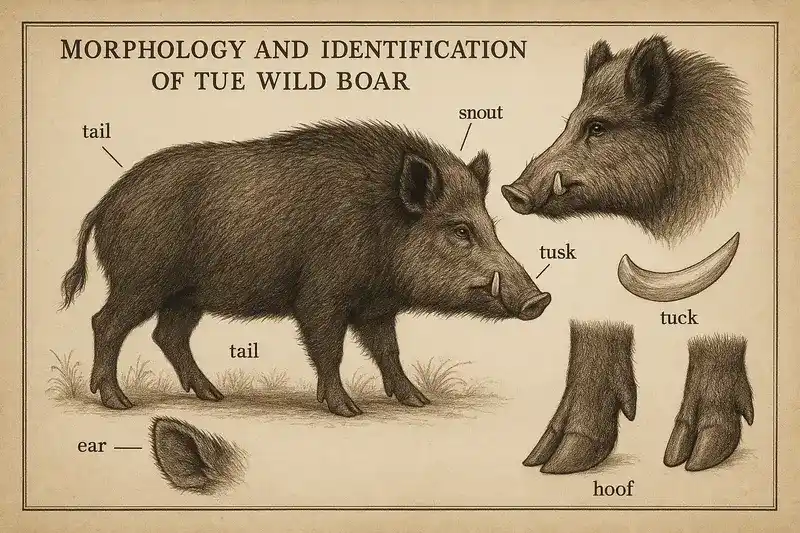
Wild boars are the ancestors of domestic pigs, and they are similar in size, with a stout body, short neck, slender legs, and a short tail with a tuft of black hair at the end. They are covered with characteristic bristles (called "wild hairs"), which are usually dirty brown; some individuals are almost black, while older individuals are distinctly gray.
The young are called "rayones" because their fur is tan with 11 lighter stripes running longitudinally (5 on each side and 1 on the back); this coloration begins to disappear when they are three to four months old.
Males are significantly larger than females; in addition, the latter have sharp noses and smaller canines, while the males have wider and larger heads and relatively large, upward-curving canines (called "fangs," "defenses," or "blades").
Wild boars gradually decrease in size in western and southern Eurasia; thus, in the Soviet Union, wild boar specimens weighing over 300 kg have been reported, in Poland over 200 kg, while in France they rarely exceed 150 kg, and in Spain, males weighing over 120 kg are also rare. In Burgos province, the average head-body length for males and females is 139 cm and 126 cm, respectively, with tail lengths of 20 cm and 18 cm; the average weight of 28 males over three years old and 22 females is 88 kg and 62 kg, respectively, with the largest of 197 individuals weighing 128 kg. However, in Dognana (Huelva), the average weight for males and females is 54 kg and 44 kg, respectively, with the largest weighing 80 kg and 63 kg.
Wild boar tracks:
Wild boars often leave extensive and clearly visible tracks to indicate their presence. These tracks are distinctive: they mark the two primary hooves, followed almost always by two clearly visible secondary hooves. Other ungulates, especially deer, may occasionally leave hind hoof tracks on very soft ground, but never as clearly as wild boar tracks. The distance between two consecutive tracks of the same foot is 30-40 cm (50-60 cm for deer).
The feces are black, shiny when fresh, and resemble blood sausage. They are 4-5 centimeters in diameter and are composed of countless round and flat elements (like small chestnuts). They decompose when dried.
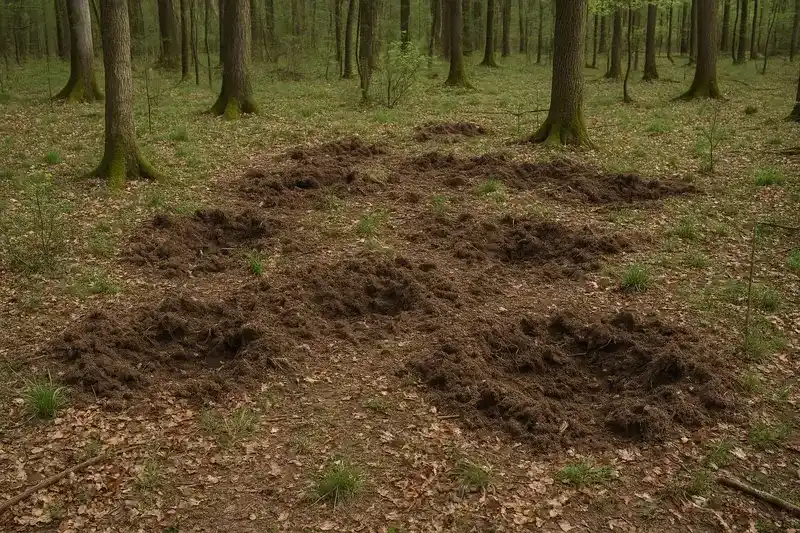
Wild boars wallow in the mud, creating distinctive and prominent "banyas" burrows measuring 1.5 x 0.7 meters (sometimes larger), marked by numerous footprints. A large tree usually occupies the area next to these burrows, where they rub against each other, leaving the trunk bare, covered in mud and bristles. Wild boars rummage through the grass, leaving countless furrows in their wake, often their most obvious sign of presence. Badgers sometimes leave similar tracks, though these are usually smaller and deeper.
"Beds" are oval-shaped excavations, sometimes filled with herbs and vegetation gathered from the surrounding area; they typically grow in dense, impenetrable vegetation and face south. They are very similar to bear beds and can be distinguished by their distinctive fur.
Feeding wild boars
Wild boars are true omnivores, possibly one of the most widely fed animals. A brief list of the Spanish wild boar's diet includes acorns (by far the most common), beech nuts, chestnuts, potatoes, beets, wheat, barley, corn, apples, pine nuts, olives, grass, mushrooms, worms, insects, scorpions, frogs, toads, fish carcasses, lizards, snakes, eggs and chicks of various birds, adult birds, young rabbits, rodents, moles, deer, and fallow venison, among others.
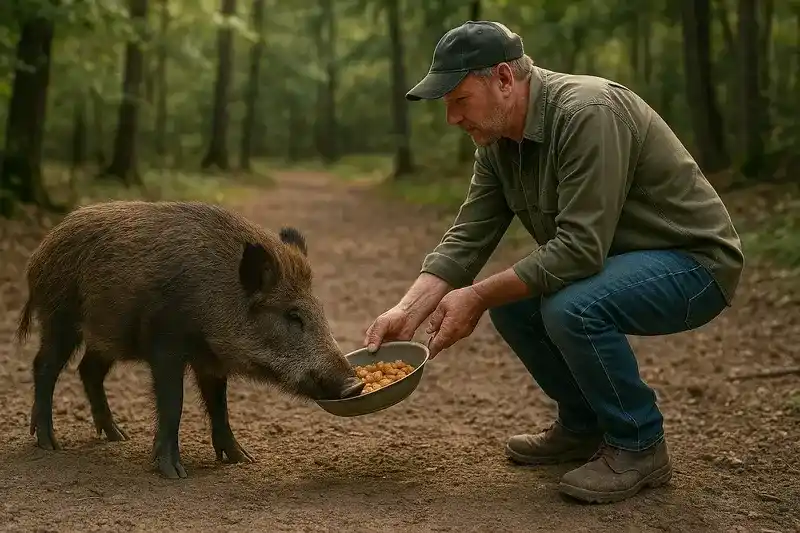
Generally speaking, their diet is far richer in plants than animals, and they tend to focus on one type of food each night. Due to their highly developed sense of smell, most of their food is underground, and they obtain it by searching for it with their noses. Two studies conducted in Dognana yielded very similar results. According to them, the bulbs of the maritimus conch (Scirpus maritimus) provided 60% of their food throughout the year; the second largest source was other bulbs, tubers, roots, and grasses—cod (Cynodon dactylon). Among the animals consumed, one amphibian stood out: the walt rabbit (Pleurodeles waltl), but animals from all faunas were also present, including carrion from rabbits and ungulates. Analysis of 239 stomachs from the southwestern Pyrenees during the autumn and winter seasons revealed that their diet was almost entirely vegetarian, consisting mainly of beech nuts, oak and oak acorns, hawthorn, and rose hips; animal food was scarce and primarily consisted of invertebrates.
wild boar behavior
Data on habitat use by Spanish wild boar is scarce. Social units consist of matrilineal groups of one or more females and their offspring. These groups, referred to as a colony, share a common foraging area, which always includes dense scrubland for daytime sleeping, several marshes, and food-rich areas. In a mark-and-recapture study conducted in France, 90% of the animals were killed within 5 km of the marked location, suggesting a distinctly sedentary lifestyle (in this country, the annual range measured has reached 60 square kilometers).
They can share the area with other herds, although they generally avoid overlapping in the same area at the same time. When this happens, they may ignore each other or attack one another. Males are solitary and have large ranges, encompassing multiple herds. Their lives are less stable compared to social animals. In France, a male rhinoceros tracked by radio for a year had a range of 150 square kilometers. Some have been known to travel long distances. A young female rhinoceros tagged in France traveled 50 kilometers in a straight line in just over three weeks, but never covered more than 7 kilometers on each leg. A male elephant died less than a month after being tagged, 250 kilometers from its location.
The size of the area covered each night also depends on the concentration of food and the distance between the feeding area and the sleeping area. The three males of the same age live on 45, 70 and 112 hectares of land respectively, and travel between 2 and 15 kilometers.
In most parts of Spain, wild boars are nocturnal. However, in areas where they are not persecuted, while they still exhibit a clear tendency towards twilight and nocturnal activity, they can also be observed during the day, as is the case in Dognana National Park. It turns out that people in France spend an average of fourteen hours a day in bed. In Dognana, researchers studied the percentage of time they spend on each activity: on average, they spend 59% of their time eating, 27% moving, 8% grooming, 4% monitoring, 2% sexual interaction, and a very small percentage (0.1%) engaging in aggressive interactions with other wild boars.
There are differences in feeding time between sexes and age groups: females spend significantly more time feeding (60% to 67%) than young males (50%) and adult males (29%); however, they spend more time commuting. These differences can be explained by the reproductive system: since males only interact with females during mating and do not participate in reproduction, their reproductive success depends on their ability to contact and fertilize females, and therefore on the time they spend on movement, marking, and surveillance. Conversely, female reproductive success increases with their feeding ability. Young people spend the most time playing aggressive games, marking the beginning of a hierarchy.
The social unit is a matrilineal group or herd, consisting of one or more females and their offspring, sometimes as a result of successive reproduction. Adult males are typically solitary, although they may sometimes be accompanied by subadult males, referred to as "gentry" in hunting literature. The composition of the herd changes throughout the year due to estrus, reproduction, and hunting.
During estrus, young males (8-9 months old) are driven from the matrilineal group by adult males; they form unstable and erratic groups until they begin a solitary life. During parturition, females isolate themselves and do not re-establish the herd until two or three weeks later. Ultimately, hunting brings unpredictable changes to cattle herds. In a study conducted in Doniana, based on observations of over 700 wild boars, 39% were solitary adults, 32% were in matrilineal groups, 13% were sub-adults (alone or in groups), 9% involved interaction between adults and sub-adults, and 7% involved interaction between adults (almost always one male and one female). Large herds consist of multiple females and their offspring. When chasing a female, the average number of scratches is close to five. The largest cattle herds consist of sixteen cattle.
Wild boar density is much higher than other ungulates of similar size, such as roe deer or red deer. In favorable areas of Burgos province, the average density is 4 wild boars per square kilometer; in the Riaño National Game Reserve (León), it is 2.84 per square kilometer. In Burgos province, the mortality rate in the first few months after birth is estimated at 17%. For individuals older than six months, life expectancy is only twenty-seven months. The mortality rate in the first two years is 81%; however, survival rates are much higher for those older than this. In the hunted population of Montflagüey Natural Park (Cáceres), the average age of hunted males and females is 21.9 months and 24.9 months, respectively; 71% of males and 64% of females are under two years old. The oldest males and females are 7.2 years and 8.5 years old, respectively.
This species has a lifespan of nine to ten years in the wild, although they can live up to twelve or thirteen years. These figures are very similar to those of other European populations suffering from severe hunting stress, which is by far the leading cause of death. In Burgos, two male elephants, aged three and five, are seriously ill with infections from wounds sustained during mating. Another two-year-old male elephant suffered severe injuries to its groin and hip, presumably inflicted by wolves, as wolves are likely the only natural predator of adult elephants.
Wild boar population parameters conform to an r-strategy, exhibiting a high reproductive rate (enabling them to withstand severe hunting pressure) and strong colonization capabilities. When wild boars expanded into what was then Old Castile in the late 1960s, the rate of expansion into the new territory was estimated at approximately 24 kilometers per year.
Wild boar reproduction
In a study conducted in Burgos, it was found that the estrus cycle of elephants occurs between October and January, peaking in November. Before estrus, fierce battles may take place between male elephants, with each male protecting one or more females in a herd.
Gestation lasts approximately four months; babies are born between January and April (most – 60% – in March), and a second calf may be born in the fall if conditions are favorable. This is rare in Burgos, but in Dognana, 10% to 20% of herds observed in November and December have calf markings. The number of calves born is related to the mother's weight, which in turn depends on the female's age and the availability of food that year. In France, females weighing 30-40 kg give birth to an average of 2.5 calves; those weighing 40-50 kg give birth to 4.25 calves; and those weighing 50-60 kg give birth to 5.4-5.6 calves. In years with abundant harvests, an average of one more calf is born than in normal years. Because wild boar weight decreases with increasing latitude, the average number of offspring per litter follows the same trend; thus, the average number of offspring per female is 5.8 in Austria, 4.8 in France, 3.3 in the Spanish Pyrenees, 4.3 in Burgos, and 4.2 in Montflaguay (Cáceres). The proportion of pregnant females also depends on their weight, and consequently, their age: thus, in Burgos, the pregnancy rate is 33% for females under one year old, 83% for females between one and two years old, and 91% for females over two years old. These figures are consistent with findings from other European studies, in which these percentages also increase in years with abundant food supplies.
Wild boars only produce milk from the teats of their young, and each striped boar always suckles from the same teat. The front teats produce more milk, so the rays that eat them grow faster and are less threatened by predators or food shortages.