Classification of iguanas
Iguanas belong to the family Iguanidae and are diurnal reptiles that can live on land, in trees, or in semi-aquatic environments. They are mainly distributed in the Americas, but two genera also exist in Madagascar and Fiji. According to the latest taxonomic research, the Iguanidae family includes the following genera:
Amblyrhynchus : One species found in the Galapagos Islands
Brachylophus : Vanuatu and Fiji (two types)
Conolophus : 3 species in the Galapagos Islands
Ctenosaura : 14 species in Central and North America (Southern United States and Mexico)
Cyclura : 10 Caribbean Seas
Dipsosaurus : 1 species in North America
Iguana : Two types, one from Central America, one from South America, and one from the Caribbean.
Sauromalus : 6 species in North America
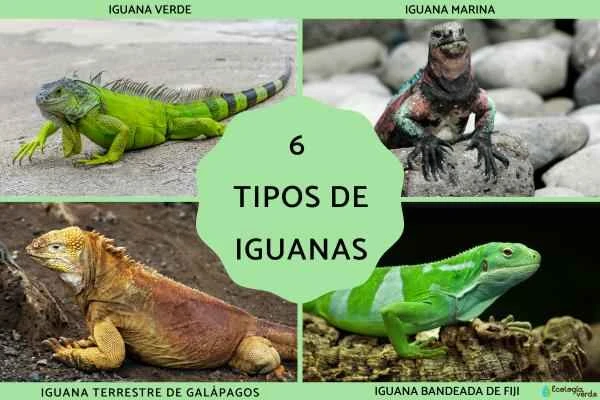
Green iguana ( Iguana iguana )
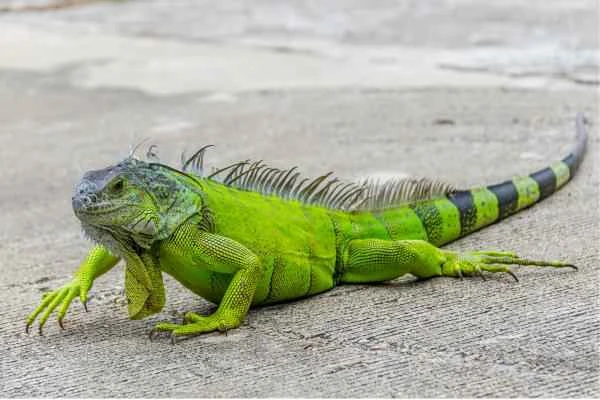
The green iguana, also known as the common iguana, is an arboreal lizard that can reach 2 meters in length and weigh up to 15 kilograms. Native to the Americas, it is distributed across Mexico, Central America, northwestern South America, Paraguay, and Brazil. It inhabits tropical rainforests and mangrove forests, but can also adapt to arid or semi-arid regions.
They are herbivorous (primarily feeding on leaves) and descend from the trees to the ground to lay their eggs in burrows during the breeding season. Their bodies are covered in green scales, and they have a prominent crest on their backs, which is more pronounced in males.
Caribbean iguana ( Iguana delicatissima )
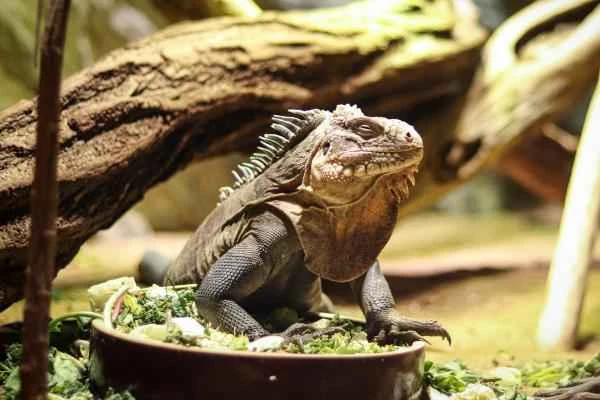
Caribbean iguanas are endemic to the Lesser Antilles and inhabit dry scrubland, coastal forests, riverside woodlands, and mangroves. They are broadly herbivorous, feeding on leaves, flowers, and fruits, and occasionally consuming meat.
Due to the introduction of the invasive green iguana ( Iguana iguana ) and habitat destruction, the number of Caribbean iguanas has declined sharply and they are now listed as critically endangered by the International Union for Conservation of Nature (IUCN).
Marine iguana ( Amblyrhynchus cristatus )
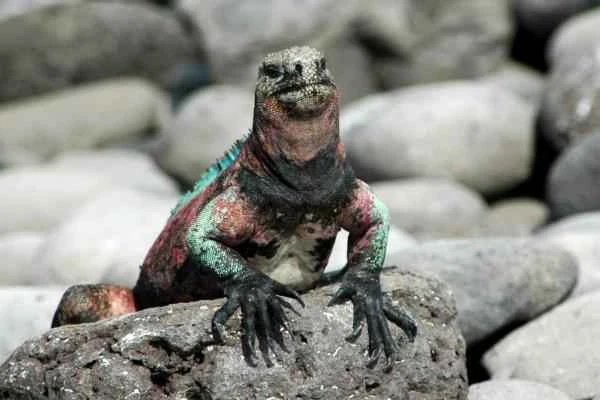
Marine iguanas are endemic to the Galapagos Islands and the only member of their genus. They primarily inhabit rocky coasts, but are sometimes found on beaches and in mangroves. They feed on seaweed and can swim in the sea; only adult males, due to their larger size (2-3 meters in length), can dive for extended periods, while females and juveniles feed on exposed seaweed at low tide.
They excrete excess salt through nasal glands. Marine iguanas are the only lizards that use a collective courtship system (lek) , where males compete for small territories for mating displays. The IUCN lists them as a vulnerable species .
Galapagos land iguana ( Conolophus subcristatus )
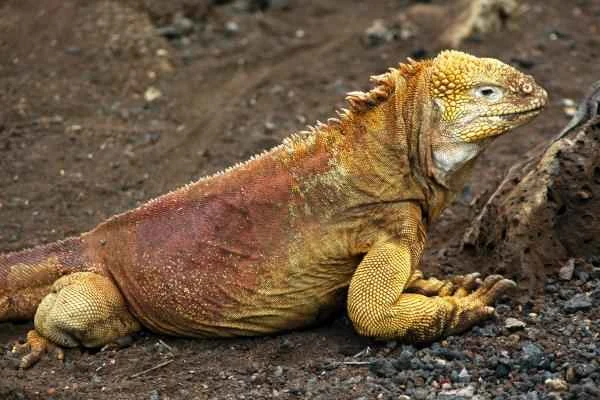
This species is endemic to the Galapagos Islands , inhabiting arid or sparsely vegetated areas of the islands. It feeds on more than 30 plant species, obtaining its water primarily from cacti ( Opuntia genus). It also occasionally eats insects or carrion.
As seed dispersers, they play a crucial role in the ecosystem. Currently, all Galapagos land iguanas live within national parks and marine protected areas. Local authorities have implemented conservation programs to eliminate invasive species such as goats, wild dogs, and feral cats.
Black iguana ( Ctenosaura pectinata )

The black iguana is native to western Mexico , inhabiting dry deciduous forests, rocky areas, and coastal cliffs. This species has been introduced to Texas and Florida in the United States . It can reach a length of 1.2 meters, with black scales interspersed with irregular yellow or white spots.
They are diurnal animals, feeding on leaves, fruits, insects, and small mammals (such as rodents) and birds. Black iguanas have high economic and cultural value to rural communities and are frequently hunted; coupled with habitat fragmentation, their survival is also severely threatened.
Fijian banded iguana ( Brachylophus fasciatus )
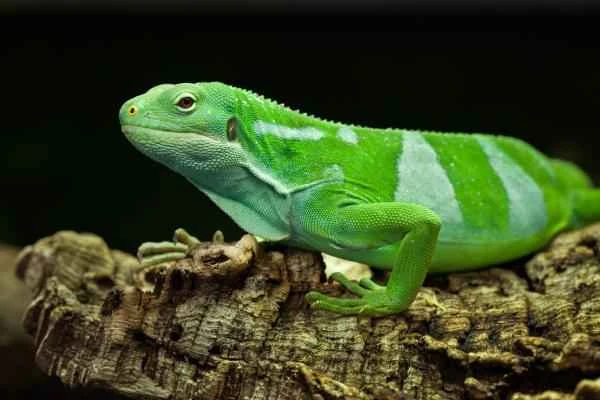
This is one of the smallest iguanas, reaching a maximum length of about 60 cm. Its body is bright green with prominent vertical dark stripes, and its tail is even darker, making it highly recognizable. It is a typical arboreal species, inhabiting the moist or dry forests of Fiji, Aiwa, and Vuaqava. Although it is also found in Tonga, it is considered an introduced species.
It is currently listed as an endangered species due to invasive alien species, deforestation, and illegal hunting.