Toucans are among the most visually stunning birds in the Neotropics (Central and South America): their brightly colored plumage and enormous, multicolored beaks make them instantly recognizable, prompting one to stop and ask, "What kind of bird is this?"
They belong to the family Toucanidae within the order Woodpeckers (in common classifications, toucans and the subgroup of Toucan/Toucan are often placed in different genera), and their typical characteristics include:
An oversized but not heavy beak (its internal structure is loose, making it much lighter than it appears).
"Clamping feet" (two toes pointing forward and two toes pointing backward, gripping branches very firmly)
Their diet is primarily fruit-based , but during the breeding season or when the opportunity arises, they will also eat insects, small vertebrates, and even bird eggs and chicks.
Playing an important role in the forest: spreading seeds and helping the forest regenerate.
The following article organizes 10 representative toucans and toucanets by “ identification points + distribution/habitat + size + diet + behavioral highlights ”, which better meets the needs of “browsing” users who want to quickly compare and expand their knowledge.
First, look at these 5 most useful clues for quickly identifying a toucan.
Examining throat color : yellow throat, white throat, gray chest... are often key to distinguishing species within the same genus.
Look at the color and pattern of the beak : orange-yellow beak, green beak, grooved beak, and yellow-black beak are highly recognizable.
Look at the color under the tail : Many species have a striking red color under their tail (the tuft of feathers below the tail).
Observe the emerging ecological zones : lowland rainforest, Amazon River Valley, Pacific wet rainforest, Andean cloud forest... the geographical scope can be immediately narrowed down.
Judging by size : the toucan is usually the "largest size", while the tucanet is mostly a "miniature but more delicate version".
10 common/representative toucans
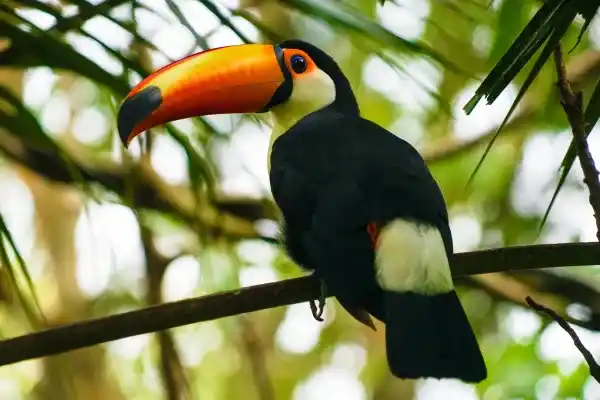
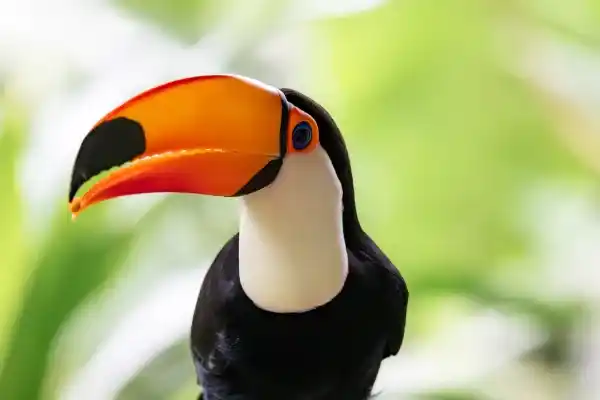
1) Toco (Tucán toco, Ramphastos toco)
Identifying features : Classic "toucan face" - black body feathers + white throat , the most striking feature is the oversized orange-yellow beak , the tip of which is often dark.
Distribution : Widespread across South America, from northern Argentina all the way to Brazil , and extending to surrounding areas.
Habitat : Prefers open environments more than many toucans: savanna, open woodland, forest edge, plantation, semi-arid zone , etc.
Size/weight : Often considered one of the “largest toucans”, its weight usually ranges from 0.5 to 1.0 kg .
Diet : Primarily fruits, but also insects, small vertebrates, and sometimes bird eggs or chicks.
Highlight : Its beak is like a "long-handled clamp," allowing it to pluck fruit directly from the branch without having to move its body onto a thin branch.
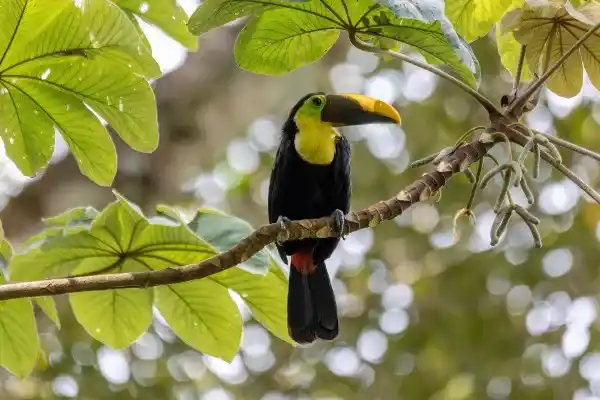
2) Yellow-throated toucan (Tucán garganta amarilla, Ramphastos ambiguus)
Distinguishing features : Overall dark in color, with a striking yellow throat and chest; red feathers are commonly seen under the tail; the beak is often bicolor .
Distribution : From southeastern Honduras southward, through Central America to northwestern South America, extending to Peru and some neighboring regions.
Habitat : humid rainforest, river valley corridor forest, evergreen mountain forest, etc.
Weight : Approximately 600–750 g .
Diet : Palm fruits and tropical tree fruits are their staple food, supplemented by nuts, insects, and occasionally small reptiles or bird eggs.
Highlights : In the jungle, you often "hear before you see"—the calls are loud and can travel far through the canopy.
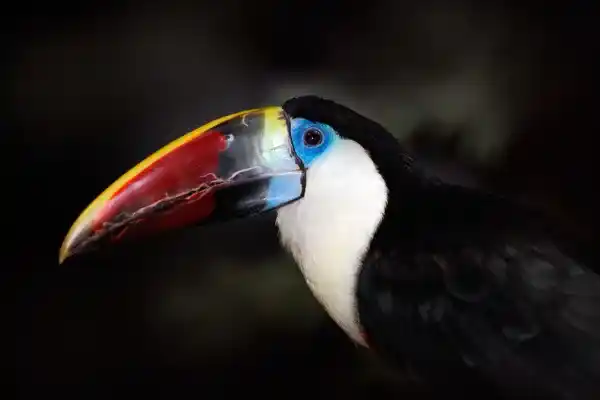
3) White-throated toucan (Tucán de garganta blanca, Ramphastos tucanus)
Identification features : predominantly black with large white patches on the throat and chest; often with reddish areas on the sides of the body; large beak with a yellowish tip.
Distribution : A typical representative bird of the Amazon basin, covering Venezuela, Colombia, Brazil, Ecuador, Peru, Bolivia and other regions.
Habitat : Lowland moist rainforest, riverbank forest , and occasionally found in the transition zone between woodland and sparse forest.
Body length/weight : Body length is approximately 50–61 cm , and weight is approximately 425–830 g (there are significant differences between regions and individuals).
Diet : Fruits, seeds, insects, small lizards; occasionally bird eggs or chicks.
Highlights : Seeing a large toucan with strong black and white contrast near a river or the canopy line is often the first choice.
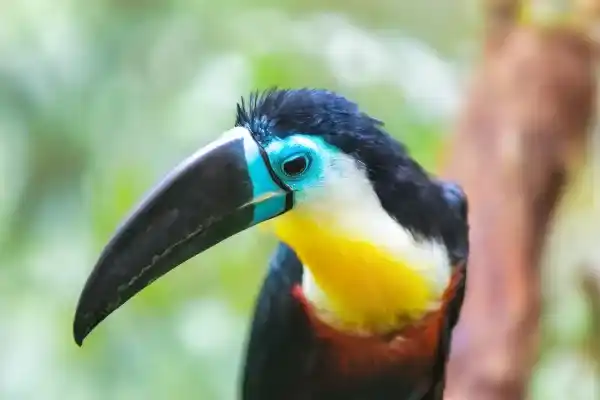
4) Grooved-beaked toucan (Tucán de pico acanalado, Ramphastos vitellinus)
Identification features : The throat is often golden/golden in color , and the skin around the eyes is bluish; the beak is relatively long, and grooves and patterns can be seen on the surface; the abdomen is often warm in color (reddish).
Distribution : Tropical rainforest regions, commonly found in Venezuela, Brazil, Trinidad, French Guiana, etc. (the range varies slightly for different subspecies).
Habitat : Moist lowland forests and forest edges , can be active in the canopy up to about 1,100 m .
Body length/beak length : Body length is about 48 cm , and the beak can reach about 14 cm .
Diet : Mainly palm fruits and figs, and during the breeding and brooding period, they will increase their protein intake from insects and small animals.
Key point : If you see "golden throat + blue eye circles + long beak with patterns", you can identify it very quickly.
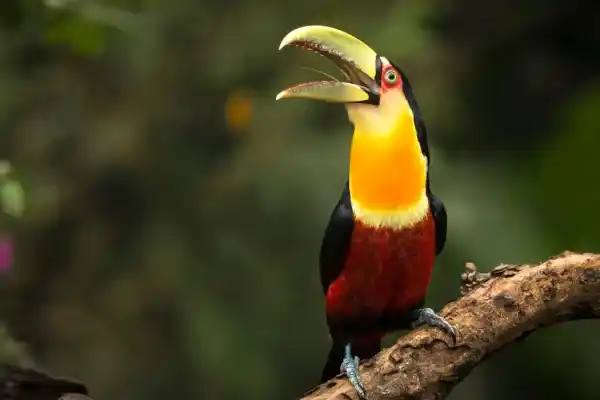
5) Red-breasted toucan/Green-billed toucan (Tucán de pecho rojo, Ramphastos dicolorus)
Distinguishing features : Smaller and more refined in size; black back, red abdomen, yellowish-orange bib on chest, and most notably, green beak .
Distribution : Southeastern Brazil, Paraguay, and northern Argentina .
Habitat : Closely related to the Atlantic Forest, it also frequently inhabits riparian forests and forest edges.
Body length/weight : Body length approximately 40–46 cm , weight approximately 265–400 g .
Diet : Fruits, nuts, and also insects and small lizards; may eat bird eggs or chicks when the opportunity arises.
Behavior : Commonly found in pairs or small family groups , and frequently active near the fruiting tree.
6) Chocó (Ramphastos brevis)
Identifying features : a very striking large yellow and black beak ; a yellow bib; a white rump/hips that contrasts sharply with the red undertail feathers; and skin around the eyes that may have a greenish tint.
Distribution : Mainly found in the extremely humid Chocó rainforest zone on the Pacific slope of Colombia and Ecuador .
Habitat : Primary rainforest canopy and forest edges, with a particular preference for extremely humid forests.
Body length : approximately 50 cm .
Diet : Primarily fruits, supplemented with insects and small vertebrates.
Behavior : They often forage in small groups , moving among the fruit trees like a "patrol team".
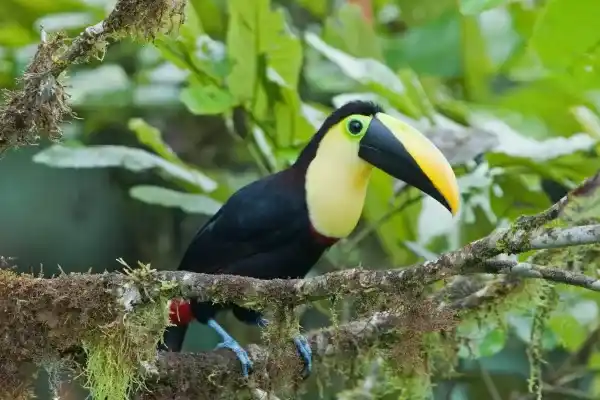
7) Green Toucan/Emerald Toucan (Tucancillo esmeralda, Aulacorhynchus prasinus)
Identification features : Miniature toucan: Overall green , with a smaller beak that is mostly yellowish-green with a dark base.
Distribution : From the mountains of Mexico southward, through Central America to Costa Rica and Panama , and extending further south to some mountainous fringe areas (the morphology varies in different regions).
Habitat : Mostly found in cloud forests , approximately 915–3,050 m ; may also descend to lower elevation wet forests.
Body length/weight : approximately 30–33 cm , weight approximately 150 g .
Diet : Mainly fruits, supplemented with insects and small lizards; occasionally eats bird eggs or chicks.
Highlights : It's more like a "small, emerald-green forest sprite," especially charming in the misty mountains.
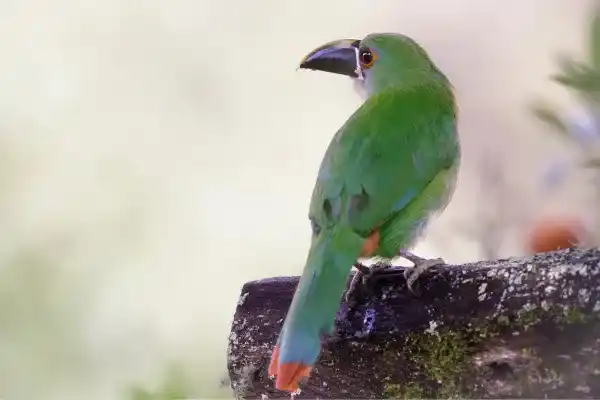
8) Yellow-browed toucan (Tucancillo de ceja amarilla, Aulacorhynchus huallagae)
Distinguishing features : green body plumage, clear yellow "brow line" above the eyes; blue band on the chest; chestnut-colored tail; grayish-blue beak, lighter at the base.
Distribution : Endemic to the Peruvian Andes , with few known distribution points.
Habitat : Cloud forest , at an altitude of approximately 2,100–2,350 m .
Body length/weight : approximately 37–44 cm , weight approximately 250–278 g .
Diet : Mainly fruits and berries from cloud and mist forests.
Highlight : If you are looking for "birds endemic to Peru", this is a very representative "locally exclusive species".
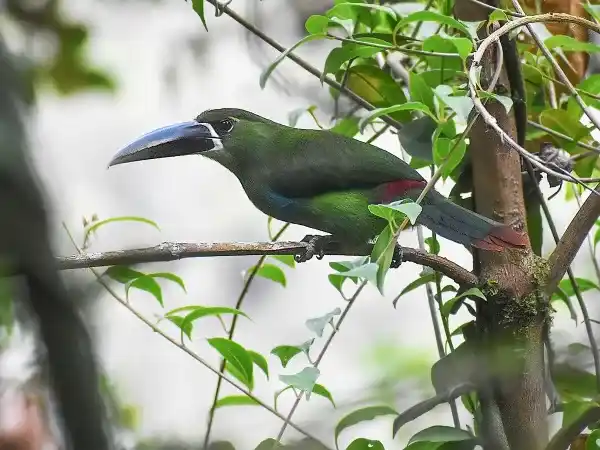
9) Blue-banded Toucan / Sky-blue Breastbanded Toucan (Tucancillo de franja celeste, Aulacorhynchus coeruleicinctis)
Identification features : predominantly green with blue and white eyebrow lines; whitish throat; blue chest band ; reddish waist and hips; gray beak with a lighter tip.
Distribution : Eastern slopes of the Andes Mountains, extending from central Peru to southern Bolivia .
Habitat : Moist mountain forests and cloud forests with dense vegetation.
Body length : approximately 40–44 cm .
Diet : Fruits, insects and other arthropods, and also some seeds.
Behavior : They are mostly solitary or in small groups, moving between the middle and canopy layers of the forest.
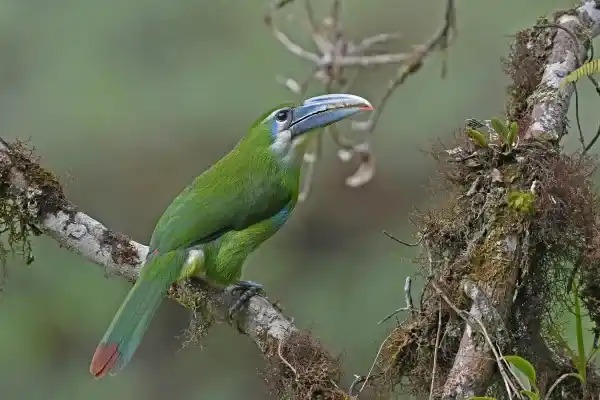
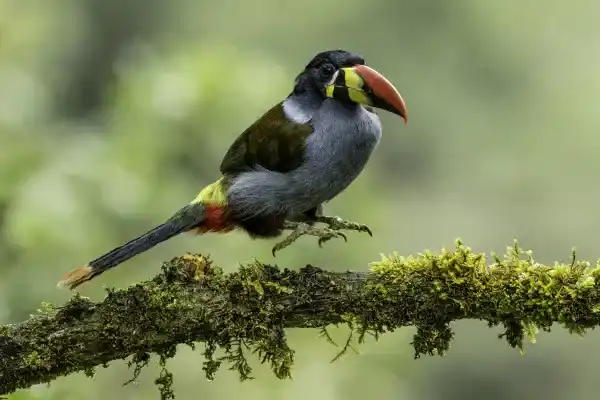
10) Grey-breasted Toucan (Tucán-andino de pecho gris, Andigena hypoglauca)
Identifying features : The mountain toucan's "advanced coloration": black head, chestnut back, light gray collar/grey chest ; beak is predominantly yellow with black and red stripes.
Distribution : From Colombia southward along the Andes to Ecuador, Peru and other places (more common on the eastern slopes).
Habitat : High-altitude mountain forests and forest edges, usually active at 2,200–3,650 m , close to the treeline.
Body length/weight : Body length approximately 46–48 cm , weight approximately 244–370 g .
Diet : Primarily eats berries and various mountain fruits, occasionally supplemented with invertebrates.
Highlights : It belongs to the "high-altitude lifestyle" and is more often found in cool, humid, and misty forests than the lowland toucan.
Quickly identify which one you're seeing:
Largest size, with an extra-large orange-yellow beak, commonly found in open areas and forest edges : Toucan
The yellow-throated toucan is striking, with a reddish undertail, and its distribution spans from Central America to northwestern South America .
Common in the Amazon, with strong black and white contrast, white throat and white breast : White-throated Toucan
Golden throat + blue eye-ring skin + grooved beak : Grooved-beak toucan
Green-billed + Red-bellied (Atlantic Forest area) : Red-breasted/Green-billed Toucan
Chocobo, with its extremely humid rainforest, large yellow and black beak, white rump, and red tail : Chocobo Toucan
Small, green toucans, mostly found in cloud forests : Green Toucan / Yellow-browed Toucan / Blue-banded Toucan
Andean high altitude, grey-breasted collar, and striped beak : Grey-breasted Mountain Toucan
Additional information: Why are toucans "so big in beaks yet so good at living"?
Feeding tools : Pick the fruit at the end of a thin branch, without risking putting your whole body on it.
Social interaction and recognition : Beak color and facial skin color are often used for identification and display among similar species.
Seed dispersal : After swallowing fruit, they move a long distance to expel seeds, making them important "seed spreaders" in tropical forests.
During the brooding period, birds need more protein , so they will hunt insects, lizards, and other predators more frequently to help the young birds grow quickly.
References
Dallas World Aquarium. https://dwazoo.com/
Animal Diversity Network. https://animaldiversity.org/
BirdForum Opus Contributor. (2025). Blue-banded Toucanet. BirdForum. https://www.birdforum.net/opus/Blue-banded_Toucanet
Khemraj, K. (2012). *Ramphastos vitellinus* – The Toucan with the furrowed beak. *The Online Guide to Animals of Trinidad and Tobago*. University of the West Indies. https://sta.uwi.edu/fst/lifesciences/sites/default/files/lifesciences/documents/ogatt/Ramphastos_vitellinus%20-%20Channel-billed%20Toucan.pdf#:~:text=TRAITS.%20An%20adult%20channel,Horne%20and%20Short%202001
Schulenberg, TS, & Parker, TA (1997). Notes on the Yellow Browed Toucanet Aulacorhynchus huallagae. Ornithological Monographs, 48, 717-720. https://www.researchgate.net/publication/271787022_Notes_on_the_Yellow-Browed_Toucanet_Aulacorhynchus_huallagae