The Arctic hare (Lepus arcticus) is a typical mammal adapted to extremely cold environments, widely distributed in the Arctic tundra region, and is an important species in cold-climate ecosystems. The Arctic hare is not only renowned for its strong cold resistance, but also plays a crucial role in the food chain as a seed disperser. This article will provide a detailed introduction to the Arctic hare's morphological characteristics, habitat, main diet, behavioral habits, and reproductive methods.
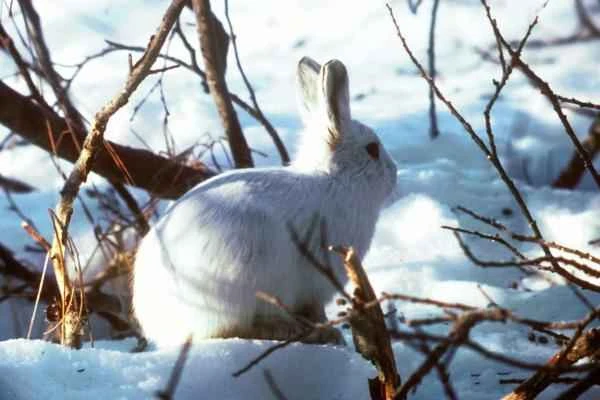
Morphological characteristics of the Arctic hare
Size and Relationship : Arctic hares belong to the order Lagomorpha and the family Leporidae. They are in the same family as domestic rabbits but are larger and have relatively shorter ears, making them more adapted to cold environments.
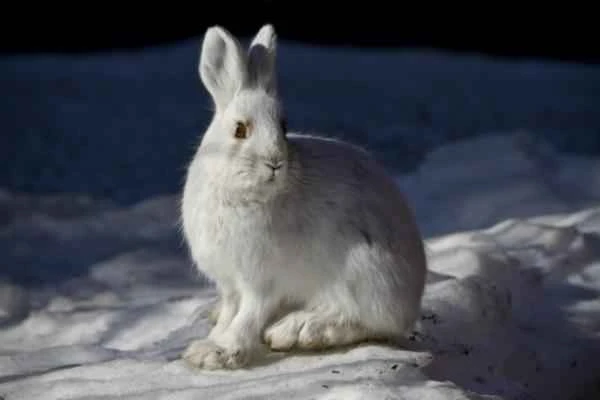
Coat changes : The Arctic hare's fur color changes with the seasons. In winter, its fur becomes thick and white, helping it to camouflage itself in the snow; in summer, it changes to a grayish-brown or grayish-blue coat, blending closer to the ground. The belly remains brownish throughout the year, and the ear tips are black, which helps with insulation.
Fat reserves : Its body fat accounts for 20% of its body weight, and its thick fur provides strong protection against the cold.
Cave-dwelling habits : They can dig underground caves to obtain a relatively warm environment and escape extreme cold.
Lifespan information : In the wild, lifespan is typically 3-5 years. Survival rate is low in captivity, and relevant data is limited.
Differentiated subspecies : There are currently four known subspecies, including L. arcticus arcticus, L. arcticus bangsii, L. arcticus groenlandicus and L. arcticus monstrabilis.
Arctic hare distribution and habitat
Arctic hares are mainly distributed in Greenland and northern Canada, including Ellesmere Island, Newfoundland and Labrador, at altitudes reaching up to 900 meters. During the breeding season, males, in particular, expand their range in search of mates. Their typical habitats include Arctic tundra, rocky highlands, and treeless grasslands, adapted to extremely cold climates of around -27°C and environments with significant snow cover.
Arctic hare's main food
Arctic hares are primarily herbivores, using their strong forepaws to dig for food under the snow. Their main food sources include:
Woody plants : such as rock cypress, blueberry, and dwarf willow (the latter accounts for about 95% of the food composition).
Summer offers a rich variety of foods : Summer increases the intake of moss, lichen, flowers, tender leaves, branches, roots, and large seaweed.
Occasionally carnivorous : They also occasionally feed on fish and small animals caught in traps.
Direct water intake : Replenishing water by eating snow.
Arctic hare behavior
Nocturnal and gregarious : Outside of the breeding season, they are mostly solitary and nocturnal, but occasionally they will engage in group activities, with the group size reaching more than a hundred individuals, and they take turns guarding and resting.
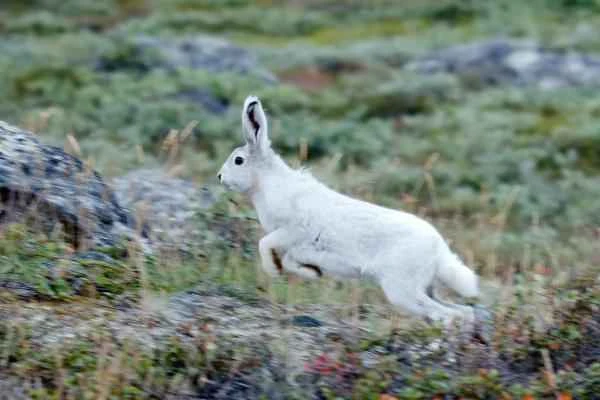
High-speed running and swimming ability : It can move quickly by jumping, and can run at a speed of up to 64 kilometers per hour. It also has strong swimming ability.
Unique escape technique : When startled, it jumps using its two hind legs and one front leg, leaving only three footprints on the ground, which helps to confuse predators.
Cave dwelling for warmth : They often dig snow caves or underground caves to resist the cold, thus keeping warm and foraging for food at the same time.
Arctic hare breeding methods
Breeding season : mostly in late spring and early summer, one litter per year, gestation period is about 50 days.
Sexual maturity : Sexual maturity is reached 315 days after birth (about one year).
Pairing and raising offspring : Male rabbits court each other through physical contact such as licking and scratching, and maintain a partnership until the offspring are born after a successful pairing.
Litter size : 2-8 kits per litter. The mother rabbit raises the kits alone after birth, while the male rabbit usually leaves to find a new mate.
Keywords: Arctic hare, Lepus arcticus, Arctic hare characteristics, Arctic hare distribution, Arctic hare diet, tundra animals, polar mammals, Arctic animal habits, Arctic hare reproduction
References
Betzler B. Arctic hare (Lepus arcticus). Accessible at: https://animaldiversity.org/accounts/Lepus_arcticus/
Integrated Classified Information System (ISIS). Accessible at: https://www.itis.gov/
Arctic hare (Lepus arcticus). Accessible at: https://www.mindat.org/taxon-2436696.html
International Union for Conservation of Nature (IUCN). Accessible at: https://www.iucnredlist.org/fr/species/41274/45185887