In July 1990, a research team led by Dr. Jin Fan, a young paleontologist from the Institute of Vertebrate Paleontology and Paleoanthropology of the Chinese Academy of Sciences, was trekking through mountains and rivers in the Chaoyang area of western Liaoning Province, extensively collecting fish fossils. Among the team was Zhou Zhonghe, a recent master's graduate, who was responsible for studying the sturgeon fossils discovered by the group. The scorching summer sun beat down relentlessly, but the young scientists persevered every day, sweating profusely. Less than 20 kilometers from the site of the discovery of the bird of China at the Three Pagodas, in a small ditch, Zhou Zhonghe discovered a seemingly insignificant fish fossil. However, this discovery was extremely important because it belonged to a species of sturgeon, the earliest ancestor of the modern Yangtze sturgeon.
After finishing his fieldwork, Zhou Zhonghe still kept the place where the Chinese paddlefish fossil was unearthed in mind. In mid-September, when the weather cooled down a bit, he returned alone to that desolate ravine, hoping to find more and better Chinese paddlefish fossils.
Incredibly, no more fossils of the Beluga family were found. However, the patient Zhou Zhonghe did not give up easily and continued his search day after day. Finally, his hard work paid off, and he unearthed two remarkably well-preserved bird fossils from the hard marl!
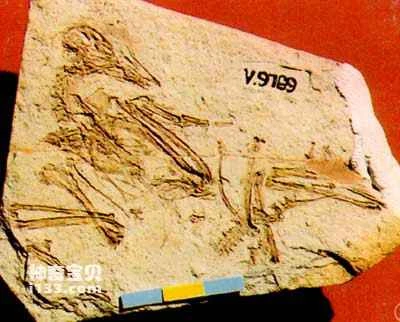
Huaxia Bird
These two fossils were later identified by Hou Lianhai, a paleontologist at the Institute of Vertebrate Paleontology and Paleoanthropology, as belonging to two different types of birds. One of the specimens was particularly complete, preserving the entire skull, thus becoming the most complete bird fossil known in the world at that time from the Early Cretaceous strata.
The Institute of Vertebrate Paleontology and Paleoanthropology of the Chinese Academy of Sciences attached great importance to this discovery and provided strong financial and personnel support for further excavation and research. In the following two years, an excavation team composed of researchers Zhou Zhonghe, Hou Lianhai, Jin Fan, and Zhang Jiangyong collected nearly 20 fossils from the same site, at least five of which preserved skull components. Research showed that these fossils included at least three different types, with the most complete fossil named *Sinoceras chinensis*, and other specimens including *Chaoyangornis* and *Sinornis*. The research also confirmed that *Sinoceras chinensis* and *Sinornis* were found in the same stratigraphic layer and at almost the same age, approximately 130 million years ago, making them the oldest known birds in the world at that time besides *Archaeopteryx*. The discovery of such a large variety and quantity of bird fossils, and their remarkable preservation, at such an early age was unprecedented.
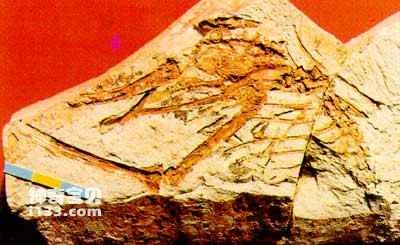
Sunbird
The unexpected discovery of bird fossils and the subsequent rapid expansion completely changed Zhou Zhonghe's life. He quickly shifted his research focus to ancient birds and achieved a series of results.
In June 1992, Zhou Zhonghe attended the Third Symposium on Ornithological Paleontology and Evolution held in Frankfurt, Germany. His paper presented at the conference generated a strong response from the attendees. At the request of the conference organizers, he also gave a more detailed presentation. Scientists from various countries highly praised these discoveries in western Liaoning, China. Many scientists considered the Chinese discoveries to be the most noteworthy highlight of the conference. After the conference, a reporter from a German broadcaster invited Zhou Zhonghe and several other scientists for a special interview. Later, Professor Olson of the Smithsonian Institution's Museum of Natural History wrote a letter to Dr. Hoffmann of the institute, remarking: "The discovery of Early Cretaceous bird fossils in China can perhaps be considered the most important bird discovery since the discovery of Archaeopteryx."