Amphipods (commonly known as "sea fleas") are a group of small crustaceans with an extremely wide distribution. They can be found in various water bodies and even terrestrial ecosystems around the world, and are a very important part of aquatic ecosystems. Through continuous evolution, amphipods have adapted to marine, freshwater, and even terrestrial environments. They exist in both free-living and parasitic forms, resulting in extremely high species diversity, and are often referred to as "insects of the sea."
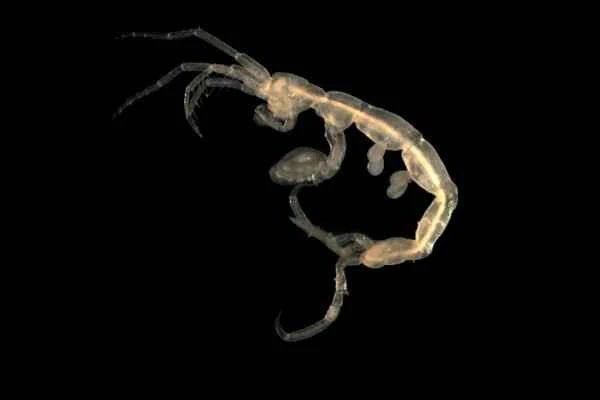
Want to know what amphipods are? Continue reading this article to learn about the definition, representative species, and main characteristics of amphipods.
Main characteristics of amphipods
Amphipods are a diverse group of crustaceans, alongside decapods and rostral feet. Approximately 10,000 species are known worldwide, with new species constantly being discovered. Their main characteristics include:
Small in size : usually no more than 10 millimeters, with a laterally compressed body, adapted to move in bottom environments.
No shell covering : Unlike many crustaceans, amphipods do not have a hard shell. Instead, they have plates covering their body segments.
Simple compound eyes : have a pair of simple eyes without eye stalks.
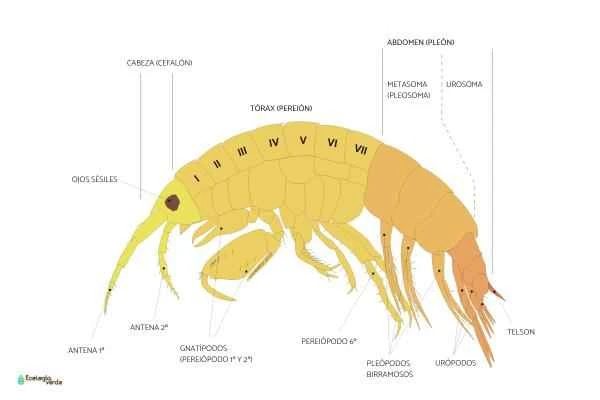
The body is divided into three parts : head (cephalon), thorax (pereion), and abdomen (pleon). Each segment of the body has appendages used for movement, feeding, breathing, and reproduction.
Unique thoracic and abdominal structure : The thorax has 7 segments, each with a pair of thoracic feet, some of which have gills; the abdomen has 6 pairs of appendages, the first 3 pairs are called pleopods, the last 3 pairs are called uropods, and the end has a distinct telson.
Important ecological functions : It plays a vital role in the flow of energy and matter in the food chain and is an important food source for many fish, whales and other crustaceans.
High nutritional value : Amphipods are easy to breed artificially and are an ideal source of live food for aquaculture.
Good indicator species : They are extremely sensitive to water pollution and are often used in environmental impact and toxicology studies.
Widely distributed globally : encompassing oceans, freshwater, saltwater, and land, including both planktonic and benthic forms.
High reproductive capacity : short life cycle, large population size.
Common representatives of amphipods
The amphipod order can be further divided into five suborders: Hyperiidea, Ingolellidea, Caprellidae, Gammaridea, and Corophiidae. Gammaridea and Corophiidae comprise 92% of the known species. Common representatives include:
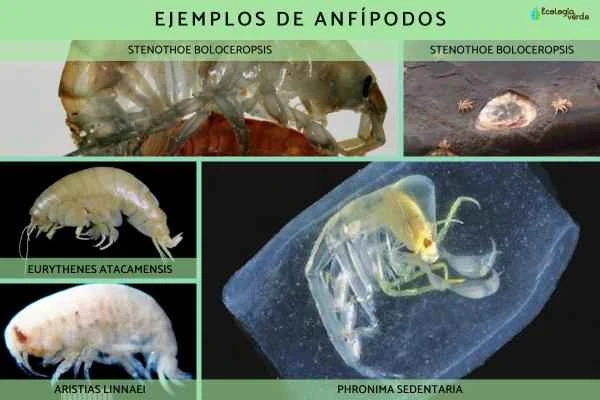
Stenothoe boloceropsis : A symbiotic amphipod that lives on sea anemones (Boloceropsis platei).
Whale lice (Cyamidae) : ectoparasites on the body surface of whales.
Atacama giant amphipod (Eurythenes atacamensis) : Found in the Atacama Trench, it is a scavenger and is said to be able to ingest microplastics.
Aristias linnaei : Found in the deep seas of Chile, it may be a symbiotic animal of sponges or corals.
Phronima sedentaria : This is a unique species of amphipod that lays its eggs inside a sea squirt, where the larvae grow.
Distribution and Habitat of Amphipods
Amphipods are widely distributed globally and exhibit diverse lifestyles, ranging from free-roaming to parasitic. They can be found in:
Marine ecosystems : such as the intertidal zone, deep sea, rocks, shells, coral reefs, and bottom sediment.
Freshwater and saltwater environments : such as lakes, streams, reservoirs, and groundwater bodies.
Terrestrial ecosystems : Rarely found in moist soil and mosses.
Special environments : Some can adapt to extreme environments, such as hot springs, marine hydrothermal vents, and even decompose the carcasses of marine mammals.
Amphipods can also establish relationships with other organisms, such as living in symbiosis with sea anemones, jellyfish, sponges, and coelenterates, or parasitizing fish and sea turtles.
Diet of amphipods
Amphipods have an extremely diverse diet, including:
Filter feeders : They feed on tiny organic particles and plankton in the water and are the most common type.
Gnawing : It scrapes biofilms from the surfaces of shells, algae, and rocks.
Scavenging : Deep-sea or benthic amphipods are mostly scavengers, capable of decomposing animal and plant remains.
Predatory : For example, Phoxocephalidae can prey on small animals such as corpora and nematodes.
Detritus diet : Feeds on decomposed organic matter and humus.
Parasitic : It feeds on host tissues, such as whale lice.
Amphipod Reproduction
Amphipods are dioecious, with most species reproducing only once in their lifetime. During the breeding season, females release pheromones to attract males, who then use specialized appendages to hold the female and fertilize her internally. The fertilized eggs are stored in the female's brood pouch until hatching. The larvae develop fully within the mother's brood pouch before becoming independent; their development skips the larval stage and is considered direct development. In some species, the larvae are protected by their parents during their larval stage.
literature
Chiesa IL., Alonso GM. (2014). Amphipods: Gammaridea and Corophiidea. Accessible at: https://www.researchgate.net/publication/311486887_Anfipodos_Gammaridea_y_Corophiidea
Häussermann V. and Vader W. (2015). A new species of Stenothoe (Crustacea: Amphipoda: Stenothoidae) inhabiting Boloceropsis platei (Anthozoa: Actiniaria) in Chilean Patagonia. Accessible at: https://www.researchgate.net/publication/276151222_A_new_Stenothoe_species_Crustacea_Amphipoda_Stenothoidae_living_on_Boloceropsis_platei_Anthozoa_Actiniaria_from_Chilean_Patagonia
National Museum of Natural History. (2015). A new crustacean discovered in Aisen. Accessible at: https://www.mnhn.gob.cl/noticias/un-nuevo-crustaceo-descubierto-en-aysen
National Museum of Natural History. (2015). An Introduction to Amphipods. Accessible at: https://www.mnhn.gob.cl/noticias/una-breve-introduccion-los-anfipodos
National Museum of Natural History. (2021). The scavenging mesopod of the Atacama Trench now has a name! Accessible here: https://www.mnhn.gob.cl/noticias/el-anfipodo-carronero-de-la-fosa-de-atacama-ya-tiene-nombre
Viñas MD., Colombo GA., and Padovani L. (2016). Hyperid frame-based classes. Dis