Capybaras (scientific name: *Hydrochoerus hydrochaeris*), also known as "water guinea pigs," "South American beavers," or "capibalas," are the largest living rodents. Naturally sociable, they inhabit the wetlands and grasslands of several South American countries. Not only are they gentle and endearing, but they are also renowned for their strong social skills and high affinity for water.
This article will provide you with a detailed introduction to the physical characteristics, living environment, diet, behavior, and reproduction of capybaras, helping you to fully understand this unique wild animal.

I. What kind of animal is a capybara? Physical appearance and physiological characteristics
Capybaras belong to the class Mammalia, order Rodentia, and family Caviidae. They are the largest rodents in the world. Here are 10 distinctive characteristics of capybaras:
Large size : Adult individuals can weigh over 55 kilograms and resemble a tailless "pig".
Barrel-shaped body : stout body, large head, wide mouth, and prominent nose.
The limbs are short and thick : the forelimbs have 4 toes and the hind limbs have 3 toes, with webbing between the toes, which helps with swimming.
Coarse and stiff fur : Covered in coarse brown fur, which has a certain degree of water resistance.
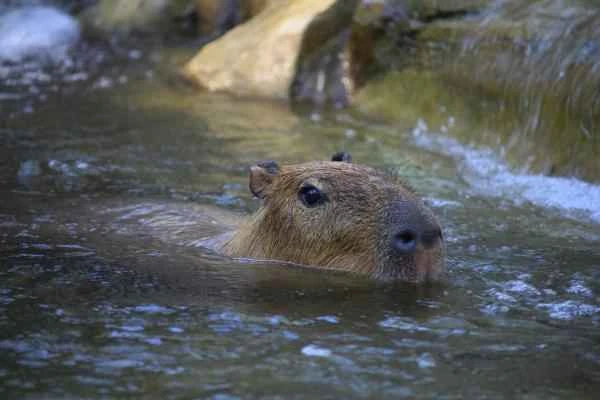
Organs are arranged high : the eyes, ears and nostrils are located on the top of the head, making it easy to observe the surrounding environment when exposed in water.
Males have a "scent gland" on their forehead : used to mark territory, which is the biggest difference between them and females.
The only rodent with sweat glands .
Incisors grow throughout life : they need to be constantly bitten and worn down.
Skilled at escaping by diving : They often use underwater to avoid predators such as jaguars and leopard cats.
Highly social : Known as "one of the friendliest animals", they enjoy living in groups.
II. Distribution and Habitat of Capybaras
Capybaras are native to South America and are found in countries such as Panama, Colombia, Brazil, Peru, Bolivia, Paraguay, Uruguay, and Argentina, with their southernmost point being Buenos Aires Province in Argentina.
Capybaras adapt to a variety of ecosystems, such as tropical rainforests, savannas, wetlands, swamps, and scrublands, but must meet the following three key habitat conditions:
Abundant water resources : located near rivers, lakes, or swamps to meet their needs for swimming, cooling off, and escaping predators.
Abundant herbs provide them with a plentiful food source.
Dry, secluded areas : for them to rest and reproduce.
Due to human activity and illegal hunting, capybara populations have declined in some areas, especially due to hunting for their meat and leather.
III. What do capybaras eat? Their diet revealed.
Capybaras are typical herbivores , and their name means "king of the meadows" in Guarani. Their main diet includes:
Aquatic plants
Various grasses and herbaceous plants
young leaves of shrubs
Bark, fruit, flowers and seeds
Capybaras are also known as "ecological fertilizer factories" because their urine is rich in nitrogen, which can quickly return nutrients to the soil and help the ecosystem's nutrient cycle.
In addition, as prey for a variety of carnivores (such as jaguars, caimans, and pythons), capybaras also play an important role in maintaining the balance of the food chain.
IV. Behavioral Characteristics of Capybaras
Capybaras are highly social animals , typically living in small groups of 6-30 individuals, including a dominant male, several females, calves, and secondary males. Their behavioral habits include:
Strong territoriality : Different groups will fight for territory.
They are accustomed to moving in formation : when acting in groups, they often move in "Indian columns".
They seek refuge from the heat during the day and hunt for food at dawn and dusk : they soak in water during the hottest periods.
If it is located near areas of human activity, it will become nocturnal.
There are various ways to communicate, including:
jump
Hair standing on end
Whistling, gurgling
When startled, it makes a shrieking sound similar to a dog's bark.
V. How do capybaras reproduce?
Capybaras can breed year-round, but primarily in spring and summer. Both males and females reach sexual maturity at 1.5 to 2 years old, and they are polygynous (one male can have multiple females ). The breeding process is as follows:
During estrus, females release body odor and whistle to attract males.
Males will follow and gently touch the female's genitals as a sign of affection.
If the female accepts, she will voluntarily enter the water to mate.
Each litter typically produces four pups, and has the following characteristics:
His birth weight was approximately 2 kilograms.
Hairy all over, eyes open;
Able to walk within a few hours;
Solid foods can be started after a few days;
The female nurses standing up, often in bushes.
Conclusion: Why should capybaras be of interest?
Capybaras are not only the world's largest rodents, but also an important part of the ecosystem. Their aquatic nature, social interaction, and ecological value are increasingly attracting the attention of ecologists and animal lovers.
References
The National Academy of Sciences of Argentina (Argentinat). Access URL: https://www.argentinat.org/taxa/74442-Hydrochoerus-hydrochaeris
Arteaga MC, Jorgenson JP. (2007). Locomotion and diet of the Colombian Amazon capybara (Hydrochoerus hydrochaeris). *Mammalogy Neotropical* 14(1):11-17. Accessed at: http://www.scielo.org.ar/pdf/mznt/v14n1/v14n1a02.pdf
BioWeb. Access URL: https://bioweb.bio/faunaweb/mammaliaweb/FichaEspecie/Hydrochoerus%20hydrochaeris
Argentine mammal classification. Access link: https://cma.sarem.org.ar/es/especie-nativa/hydrochoerus-hydrochaeris
Geographic Information System. Access link: https://sib.gob.ar/especies/hydrochoerus-hydrochaeris