Introduction: Why do people search for "slow loris"?
People searching for "slow lorises" are usually driven by curiosity and interest in the distinctive appearance of these small, wide-eyed primates. Their search intentions may include:
General Information and Identification
Understanding behavior and habitat
Exploring why slow lorises are considered poisonous
Explore their role in the ecosystem
Concerns about conservation status and the illegal pet trade
Clarifying the Rumors and Facts about Slow Loris on Social Media
This article provides a comprehensive, scientific, and ethical exploration of the world of the slow loris.
What is a slow loris?
Taxonomy and Classification
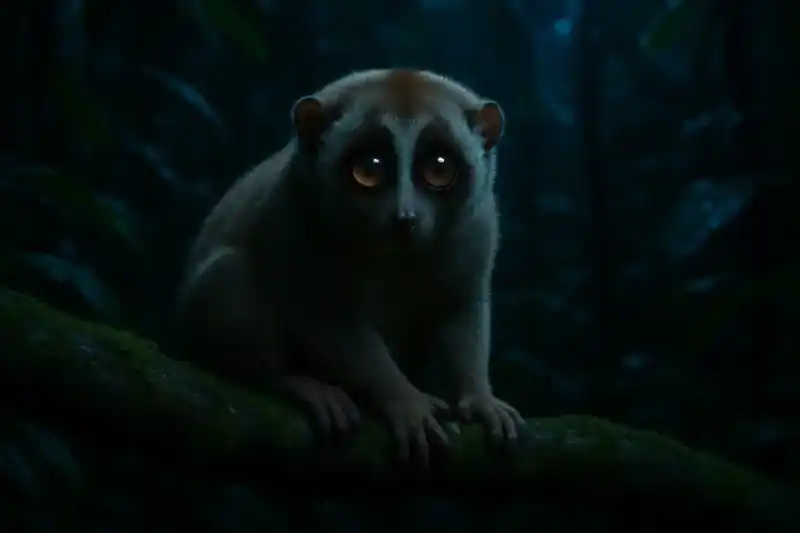
The slow loris is a small, nocturnal primate belonging to the family Slow Lorisidae. The word "loris" refers to two main groups:
Slow Loris (Loris genus): native to India and Sri Lanka
Slow loris (Nocturnal monkey): Distributed throughout Southeast Asia
They belong to the suborder Slobopsida, which also includes lemurs and infant monkeys.
Physical characteristics
Large, forward-facing eyes for night vision.
Hands and feet grasped with the opposite thumb
Short or missing tail
Facial markings and soft, thick hair
Action: Slow, cautious, silent
Unique adaptability
Night vision
Slow lorises possess a highly developed reflective membrane (a layer of reflective eye membrane), which enhances their night vision, crucial for hunting insects and navigating through trees in the dark.
Poison bite
The slow loris is one of the few venomous mammals that secretes a toxin from a gland in its upper arm. This toxin mixes with saliva to form a toxic secretion used for:
Defend against predators
Intraspecific competition
Protect future generations
stealthy movement
Their slow and cautious movements make them difficult for predators to spot. When startled, they freeze and can move precisely through the tree canopy.
Habitat and Distribution
Geographical distribution
Slow lorises are distributed in:
Indonesia (Sumatra, Java, Borneo)
Thailand
Malaysia
Cambodia
Vietnam
The distribution range of the slender slow loris is limited to:
Southern India
Sri Lanka
Habitat preference
Slow lorises thrive in tropical rainforests, bamboo forests, and plantations. They are arboreal animals and rarely descend to the ground.
Diet and eating behavior
Omnivorous
Slow lorises are opportunistic foragers. Their diet includes:
Insects and small vertebrates (geckos, birds)
resin and sap
Nectar and fruit
bird eggs
Special feeding
They have a comb (a set of lower incisors and canines) used to comb and scrape the sap off the bark.
Social Behavior and Reproduction
Solitude and Territoriality
Slow lorises are typically solitary unless they mate or their mothers raise their offspring. They use scent marking to mark their territory.
Voice communication
Although slow lorises are usually quiet, they can produce loud calls:
mating
warning sign
Mother-child interaction
Reproductive characteristics
Pregnancy period: approximately 5-6 months
Number of offspring: Usually 1-2 pups
Young hiding: Mothers hide their young while foraging for food, a behavior rarely seen in primates.
Preserve the status quo
threaten
Habitat loss due to logging, agriculture and development
Illegal wildlife trade for exotic pets and traditional medicines
Their teeth are often cruelly extracted when they are used for travel photos .
IUCN Red List
Most slow loris species are listed as vulnerable, endangered, or critically endangered. Example:
Javan slow loris (Nycticebus javanicus): Critically Endangered
Bengal slow loris (Nycticebus bengalensis): Vulnerable
Legal protection
Appendix I of the Convention on International Trade in Endangered Species of Wild Fauna and Flora (CITES): Prohibition of International Trade
National laws of India, Indonesia and other countries
Slow loris in culture and media
Social media misunderstandings
Videos of slow lorises being tickled or kept as pets are widely circulated. While these videos may seem cute, they often obscure the following facts:
Stress and discomfort
illegally trafficked animals
Misinformation about whether they are suitable as pets
Traditional beliefs
In parts of Southeast Asia, slow lorises are used in folk medicine for treating asthma, providing psychological protection, or as aphrodisiacs—which fuels poaching.
Ethical Issues of Keeping Slow Loris as Pets
Non-domesticated animals
Slow lorises are wild animals with complex needs. In captivity, they suffer from the following problems:
malnutrition
Psychological stress
Respiratory problems caused by unsuitable environment
extract a tooth
To prevent snakebites, traffickers often trim or remove the snakes' teeth, a painful, disfiguring, and sometimes even fatal act.
Protection efforts and how you can help.
Wildlife rescue and conservation
Similar organizations:
International Animal Rescue
Little Hot Face Project
Friends of Wildlife Thailand (WFFT)
Dedicated to the rehabilitation of rescued slow lorises and raising public awareness.
What you can do
Do not buy slow lorises or support the trade in exotic pets.
Report illegal wildlife sales
Support environmental non-governmental organizations
Let more people understand the real needs of slow lorises.
Conclusion: Protecting the mysterious slow loris
With their large eyes and quiet demeanor, the slow loris is an evolutionary marvel and an ecological treasure. But behind its popularity lies the dark reality of exploitation and population decline. By understanding its biology, respecting its needs, and supporting ethical conservation efforts, we can help ensure this unique primate thrives in the wild—where it belongs.