Saber-toothed cats were widely distributed throughout the Neogene and Quaternary periods in both the Old and New Worlds. They were a long-lasting group of carnivores, first appearing in the Middle Miocene and coexisting with humans until the early Holocene before becoming extinct. Evidence suggests that the extinction of these ferocious predators may be attributed to humans' growing power eventually defeating them and even using them as prey. Similar to modern large cats, large saber-toothed cats had a hunting advantage; some were nearly the size of lions or tigers, such as the adult *Smilodon populator*, which could weigh over 400 kg. However, early saber-toothed cat fossils were mostly fragmented, leaving many mysteries surrounding their size variations and evolutionary processes. Only in recent years have several complete saber-toothed cat skulls been discovered in Europe and China, with *Machairodus horribilis* being the largest known saber-toothed cat. Significant morphological differences exist among the skulls of saber-toothed cats. Some types are highly specialized, such as *Homotherium* and *Smilodon*, while others are closer to modern large cats, specifically members of the Pantherinae subfamily. The discovered fossil material of saber-toothed cats depicts the mosaic evolution of this group and portrays their morphological and ecological diversity during adaptive radiation.
Deng Tao et al. reported in the latest issue of *Vertebrata PalAsiatica* a large skull of a saber-toothed tiger, representing a male, collected from the Late Miocene (7.25–5.3 million years ago) red clay of *Tripterygium latatum* in Wudu, Gansu. The skull has a apical length of 415 mm, exceeding all previously known saber-toothed tiger skulls, and its weight was calculated to be 405 kg. Its anatomical features provide new evidence that even among the largest saber-toothed carnivores, different hunting methods exist, and reveal another mechanism leading to the mosaic evolution of functional and morphological diversity in saber-toothed tigers.
Combined with the skull fossil of a slightly smaller, possibly female, saber-toothed tiger discovered in Baode, Shanxi, from the same period, the fossils in Wudu indicate that this saber-toothed tiger subdued prey in the woodlands or grasslands of northern China during the Late Miocene using its unspecialized throat-stabbing technique. Its large size would have allowed it to hunt common large ungulates, but the insufficient distance between its upper and lower canines limited the variety of prey it could hunt.
Large body size influences many aspects of an animal's structure and function. Among extant carnivores, almost all species weighing over 21 kg hunt prey of similar or larger weight, a strategy aligned with energy conservation. Since saber-toothed cats were generally robust animals, they are thought to have specialized in hunting larger prey than modern large cats. Differences in carnivorous hunting and feeding behaviors are often reflected in their skull and tooth morphology, showing convergent evolution in mammals and leaping saber-toothed dinosaurs. Larger predators correspond to larger prey, so did the enormous size of the saber-toothed cat indicate that it would necessarily hunt very large prey? Or did it possess a unique hunting mechanism?
Indeed, several features indicate that saber-toothed cats used their canines to penetrate the throat and cause massive blood loss to kill prey, a behavior inferred from more advanced saber-toothed cats. These features include: high-crowned, flat, and serrated upper canines, a form of saber teeth well-suited for piercing the flesh of prey rather than for crushing the nape of the neck or suffocating the throat; enlarged mastoid ridges, with slightly raised mastoids in the anteroposterior direction and a median ridge at the base of the head indicating muscle attachment positions consistent with canine stabbing behavior; and an elongated and sloping occipital region, which, when the jaws are closed, allows the anterior teeth (incisors and canines) to generate greater force than carnassial teeth through the movement of the temporalis muscle.
On the other hand, significant differences exist among saber-toothed carnivorous mammals, indicating behavioral and ecological diversity. If throat-stabbing was the primary hunting technique of saber-toothed cats, then hunting large prey would require a greater mouth opening; for example, the jaws of saber-toothed cats could reach 120°. However, Deinosaurus possessed well-developed anterior and posterior articular processes, making the glenoid fossa connecting the skull and mandible very deep, similar to modern pantherines such as lions and leopards. Therefore, its mouth opening was limited to a moderate level of about 70°. Furthermore, the tilted occiput of Deinosaurus indicates that the fibers of the temporalis muscle are strongly tilted like those of primitive felines, while in more advanced saber-toothed cats, the direction of these muscle fibers became more vertical. The tilted temporalis muscle of Deinosaurus limited its extension on the dorsal side of the head, correspondingly reducing the head movement required for canine stabbing maneuvers. Although the exceptionally well-developed mastoid ridges of Deinosaber provided a larger area for the attachment of the atlas-mastoid muscles, and indicated that these muscles were more powerful than those in the Pantherinae subfamily, their effectiveness was less than that of the more advanced saber-toothed cats. Therefore, functional morphology suggests that Deinosaber's hunting mechanism differed from that of the more specialized saber-toothed cats, but rather resembled in some respects modern lions and leopards, as well as primitive early cats, limiting it to hunting relatively small prey.
The highly mosaic evolution of saber-toothed cats is manifested in the refinement of their canine killing behavior, aimed at killing their prey more effectively to reduce fight time and avoid situations such as broken teeth and escape. The canines of *Deinodon* are flat like those of *Machairodus giganteus* and *M. aphanistus*, and therefore also brittle and easily broken. To compensate for this deficiency, *Deinodon* possesses robust incisors, especially the third incisor, similar to hyenas, arranged in a gentle arc. These incisors serve to assist the canines in controlling the prey's struggle during a hunt.
The hunting behavior of *Deinodon* differed from that of modern large cats, as well as from more advanced saber-toothed cats such as *Ceratodon serpentina* and *Smilodon*. The Late Miocene mammal fauna of Wudu included forest animals such as *Apex* and *Clawed Beast*, as well as typical open-field animals. Among them, the short-limbed, slow-running *Hipparion platyodus* was likely a primary prey of *Deinodon*. *Eostyloceros* and *Cervavitus* were too small and too fast for *Deinodon*, while giraffe-like animals such as *Samotherium* and *Honanotherium* were too large, and their hooves could easily injure predators.
The key advantage of the initial development of saber-shaped teeth lay in the effectiveness of stabbing, which resulted in massive blood loss rather than suffocation of the prey, regardless of its size. Later, more advanced saber-toothed cats, with mouths wider and more specialized musculoskeletal structures than Deinosaurus, evolved the ability to hunt larger prey. Although Deinosaurus possessed the largest skull of all saber-toothed cats, its mixed primitive and advanced morphological features did not exhibit the hunting techniques of more advanced types like Smilodon and Scimitarus, thus limiting it to hunting relatively small prey. Throughout the history of saber-toothed cats, hunting behavior clearly evolved independently multiple times, adapting to changes in environment and prey.
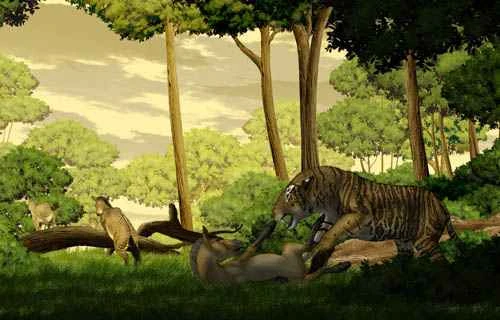
Figure 1. A scene of a saber-toothed tiger hunting (illustrated by Chen Yu)
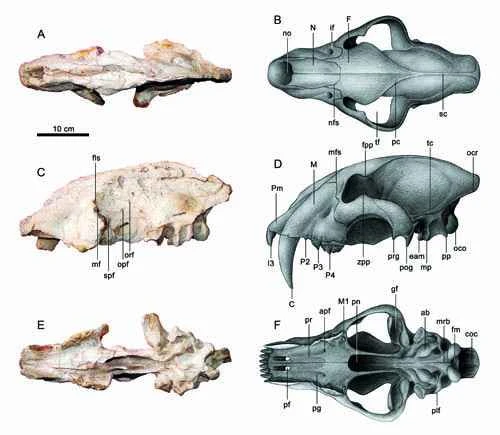
Figure 2. Fossilized skull of a saber-toothed tiger and its corrected reconstruction (illustrated by Chen Yu)
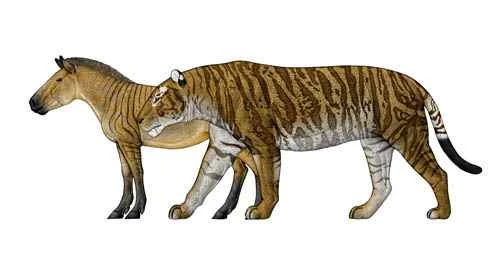
Figure 3. Size comparison between the saber-toothed tiger and its main prey, the three-toed horse (illustrated by Chen Yu).
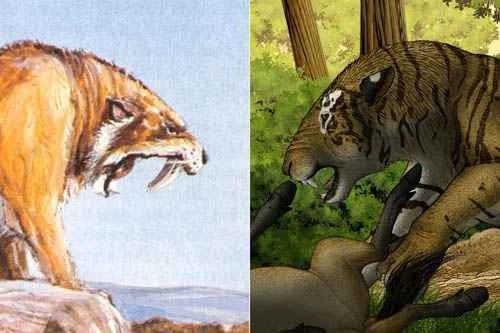
Figure 4. Comparison of the degree of mouth opening between Deinosaurus and Smilodon (illustrated by Michael Long) (Image provided by Deng Tao)