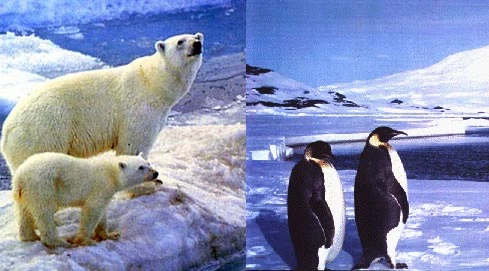
This riddle is probably familiar to everyone, and the answer is not complicated: there are no penguins in the Arctic, and similarly, there are no polar bears in the Antarctic.
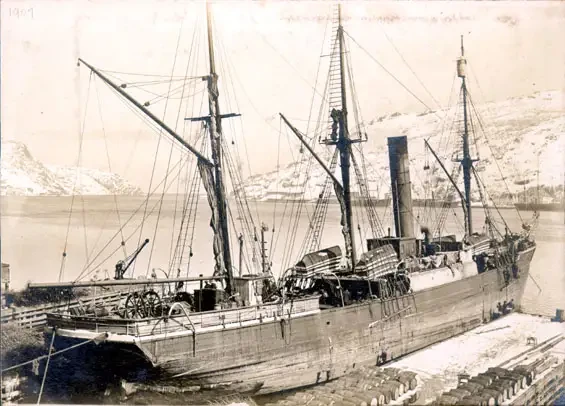
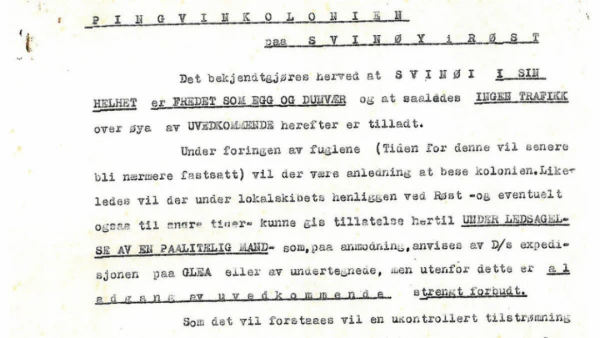
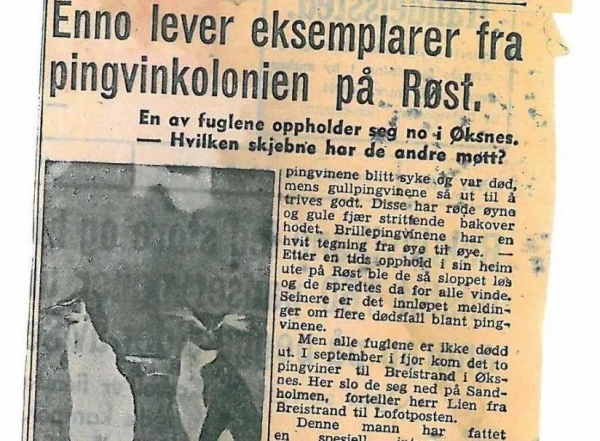
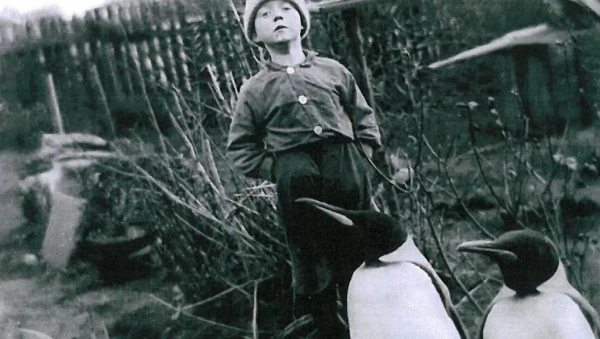
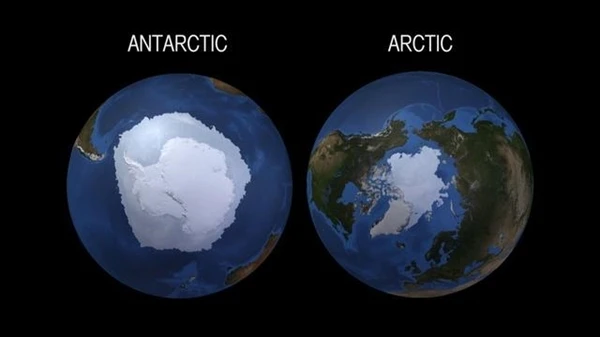
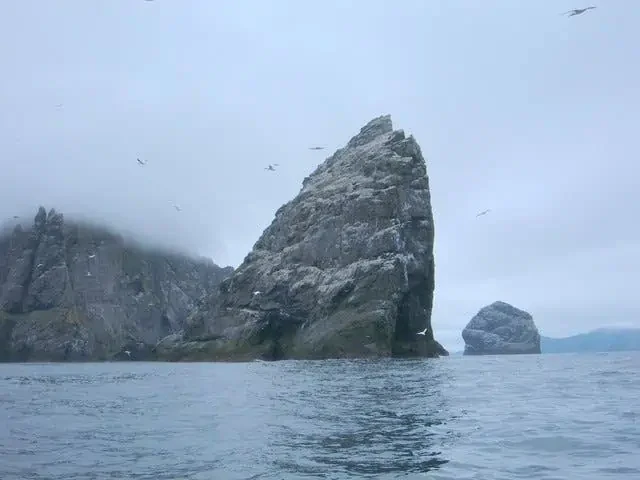
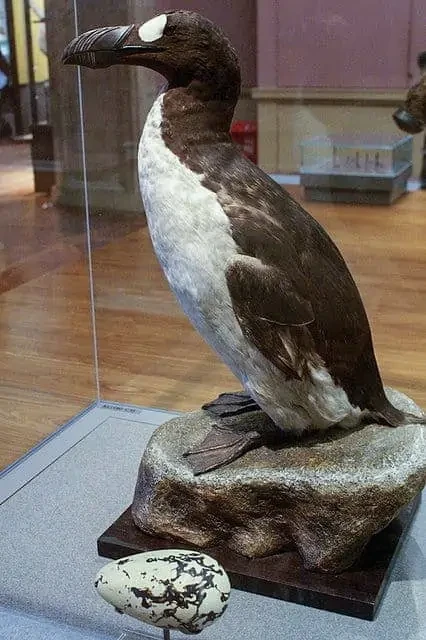
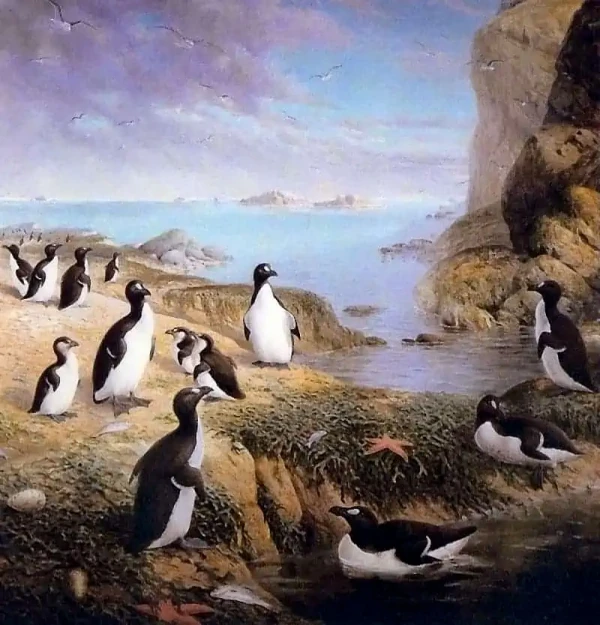
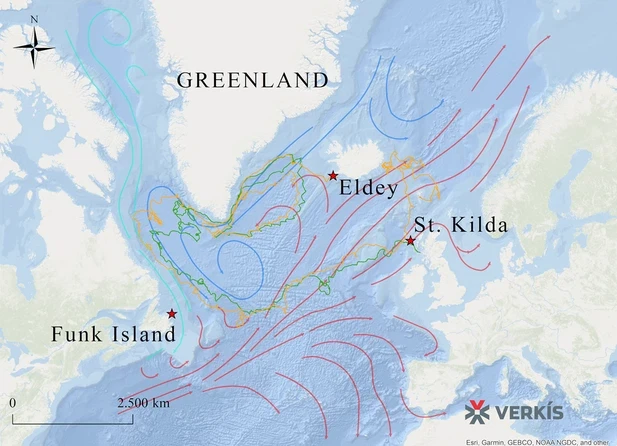
Polar bear and penguin image source: pbs.org This answer is generally correct, but what many people may not know is that Antarctic penguins once traveled to the Arctic with adventurers. Furthermore, over 100 years ago, there was a seabird in the Arctic that looked very much like a penguin, also known as the "Arctic penguin." Passengers who traveled to the Arctic with the Neptune In the 1930s, an explorer named Lars Christensen came to Antarctica, where he encountered the world's largest penguins—the emperor penguins. It's worth noting that this man was not only adventurous but also a shrewd businessman with a knack for marketing. Upon seeing these penguins trudging through the ice, Christensen immediately realized that a money-making opportunity had arrived. Image source: discover.hubpages.com On the return voyage, he hid nine emperor penguins on the Neptune and took them to the cold Lofoten Islands in northern Norway. The reason for choosing the Lofoten Islands was simple: predators like polar bears and Arctic foxes couldn't reach these islands, making it relatively safe to raise penguins there. It must be said that the emperor penguins enjoyed a relatively peaceful time there. People built fences on the islands, and during the penguins' nesting season, the authorities issued notices prohibiting people from going ashore. Image source: nrk.no (Image of a notice from authorities prohibiting people from going to the island) Indeed, Christensen achieved success. Due to extensive media coverage, these "Antarctic visitors" received widespread attention and earned him a considerable income. Having tasted success, Christensen decided to go for an even bigger deal. In 1938, two years after his initial import of penguins, he brought in another 60 penguins from the Southern Hemisphere. To keep the novelty off, this time he chose two different penguin species: the Macaroni penguin and the Gentoo penguin. Local media reports on the introduction of emperor penguins. Image source: nrk.no These penguins were initially kept in enclosures, but as people's enthusiasm for penguins waned, Christensen felt he was not making any profit; the penguins were eating more than he was earning, which made him restless. What else could we do if we couldn't afford to keep them? We just released them. These travelers from the south were now free. Despite the fact that Norway's climate is just as cold as their homeland, these flightless seabirds met a tragic fate after being released into the wild. A little boy feeding penguins. Image source: nrk.no Although both Antarctica and the Arctic are icy and snowy, their vastly different geographical environments result in completely different ecosystems. Antarctica is land surrounded by ocean, while the Arctic is ocean surrounded by land. In Antarctica, penguins have virtually no natural predators as long as they don't go into the water ; they are only vulnerable to being hunted by seals and killer whales underwater. In fact, outside of Antarctica, penguins' other habitats also lack powerful land predators. For penguins accustomed to their comfortable environment to suddenly arrive in the Arctic is like lambs to the slaughter; at the very least, polar bears won't ignore these slow-moving prey. Image credit: NASA ( Antarctica and Arctic) According to reports, the penguins were last seen in 1954, marking the end of their brief Arctic journey, much like the disappearance of the last great auk 110 years earlier, a truly lamentable event. In the 18th century, on a small island off the coast of Scotland, basalt cliffs gleamed in the sunlight, while the icy seawater pounded against them. Floating in the waves were large, black-and-white birds, waiting for the right moment to land. Although they had wings, they could not fly. These birds were called the Great Auk . If they were still alive today, some would surely mistake them for Arctic penguins. Stacan Armin, Scotland, a former habitat of the Great Auk. Image source: zmescience.com The last great auk was killed by three fishermen in 1844, and its carcass was sold to a museum. For a flightless seabird that was hunted to extinction by humans, this seemed like a tragic but fitting end. Around 5 million years ago, the Great Auk was already roaming the Arctic, long before the appearance of ancient humans. The Great Auk was about 75-80 centimeters tall and could weigh up to 5 kilograms. It had a black back and a white belly. Its appearance and behavior were very similar to penguins, but the two were not related. Image of a Great Auk specimen. Source: zmescience.com Because the Great Auk went extinct so early, modern scientists have never actually observed its behavior and life in the wild. However, based on research on its relative, the Rake-billed Auk, scientists have gained some understanding of the behavior of this flightless seabird. The Great Auk's natural predators were likely orcas, polar bears, or white-tailed eagles , but almost none of these predators ventured to the islands where the Great Auk lived. Of course, this is not absolute. During the Little Ice Age from the 16th to the 19th centuries, intense glacial activity and expanding glaciers made it easier for polar bears to approach the Great Auk, which led to a decline in the Great Auk's population. However, the Great Auk's adaptability allowed them to survive until humans entered their territory, thus sealing the tragic fate of this species. Image source: zmescience.com (Image of Great Auks covering the island) Archaeological and historical records show that humans have a long history of hunting great auks. In prehistoric times, the Beo-Tukes of North America, the Inuit of Greenland, and even the Neanderthals hunted great auks. In the 16th century, European sailors began intensive hunting of great auks in the fishing grounds of Newfoundland. In the late 18th century, the trade in great auk feathers further intensified hunting, and the scarcity of great auks further fueled the desire of private collectors and museums to collect them. Finally, the Great Auk faced extinction. Undoubtedly, human hunting was a major cause of the great auk's extinction, but some argue that its population may have declined due to environmental changes. However, a recent study on the great auk suggests that even without environmental changes, human hunting was sufficient to drive this great bird to extinction. There's no need to shift blame; humans are the murderers. In a 2019 study published in the journal *eLife*, scientists investigated the impact of human hunting on the extinction of the Great Auk by integrating genetic and ocean current data, as well as historical hunting records. Specifically, researchers collected remains of the Great Auk within its distribution range, extracted DNA to sequence its mitochondrial genome, inferred the species' historical population dynamics, and deployed GPS-equipped drift pods in its former range to predict potential migration routes. Image source: References ( possibly showing the great auk's possible migration route) If environmental changes had a significant impact on the survival of the Great Auk, it would be reflected in its genetic information. In fact, scientists have found that the Great Auk experienced a population decline during the Pleistocene (more than 40,000 years ago), but the population subsequently recovered, and its effective population size did not experience a significant decline afterward, which means that the environment had a negligible impact on its extinction. Furthermore, scientists estimated the potential impact of hunting on the extinction of the great auk. The results showed that hunting just 210,000 great auks annually and collecting fewer than 26,000 eggs could have led to their complete extinction within 350 years. The intensity of human hunting of the great auk may have far exceeded 210,000 per year. Historical records indicate that during one hunting expedition near the coast of Fink Island, 1,000 great auks were captured and killed by two fishing boats within half an hour. The role of humans and environmental change in causing species extinction has long been a subject of debate, but there is no doubt that humans bear an undeniable responsibility for the extinction of the Great Auk, and blaming the environment is clearly an extremely irresponsible act. A British Royal Navy sailor named Aaron Thomas once wrote the following sentence: "If you're here for their feathers, you don't have to bother killing them. Just pluck the best feather and let these poor 'penguins' drift with the current." Is it wrong for birds to have feathers?