The largest spider on Earth is the wolf spider. Wolf spiders are a collective term for species in the order Araneae and family Lycoridina. They have eight black eyes arranged in three rows (4-2-2). Their legs are stout, spiny, and end in three claws. They are named for their ability to run and jump, their venom, their agility, and their ferocity. Wolf spiders have hair-like markings on their backs, resembling wolf fur, and eight eyes. Some wolf spiders are highly venomous, capable of killing a sparrow, while larger ones can kill a person.
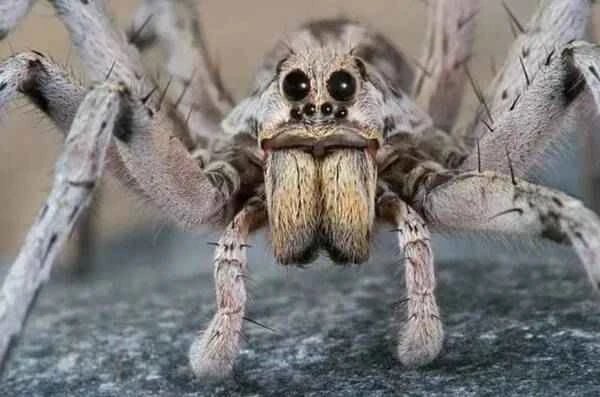
There are over 1500 species of wolf spiders worldwide. They are medium to small in size, ranging from 3 to 25 mm in length. Most are prowlers hunting, while a few spin webs. They are active on the ground, field ridges, ditches, farmland, and plants. When at rest, they hide under rocks or in soil crevices; some species are burrowing. They usually forage during the day, but in warmer regions, they also forage at night. They have large predatory appetites and are important natural enemies of pests in farmland.
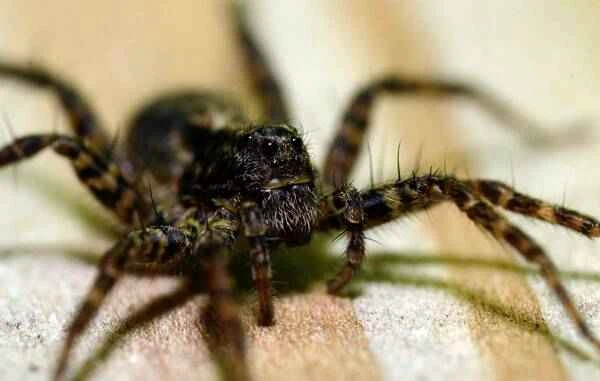
Common species include wolf spiders, water wolf spiders, leopard spiders, and badger spiders. Water wolf spiders are often seen in paddy fields or along riverbanks. The *Pseudo-ringed leopard spider*, a species of the leopard spider genus, is a dominant species in Chinese paddy fields, consuming large quantities of insects and playing an important role in pest control. Burrowing wolf spiders distributed in Xinjiang are highly venomous and harmful to humans and livestock.
Wolf spiders are fierce in nature, but their primary prey is various insects. They will also eat their own kind when extremely hungry. Despite their ferocity and cannibalistic tendencies, wolf spiders often show a tender side towards their offspring. Most wolf spiders diligently care for their offspring. To ensure their young are well-fed, the mother wolf spider often endures hunger, refusing to eat anything.
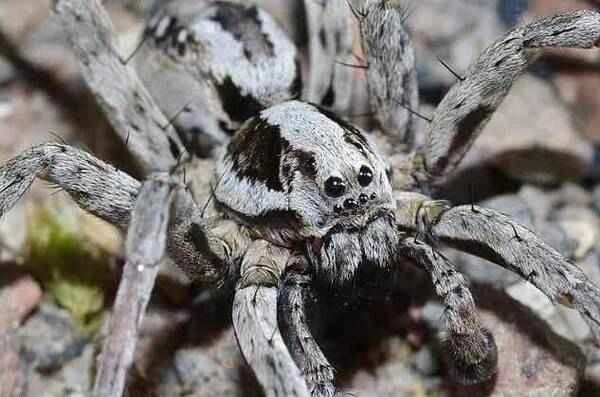
The venom extracted from the body of the valuable tarantula can be used to develop next-generation painkillers. Scientists around the world hope that the deadly venom collected from the spider's body will be used to alleviate patients' pain.