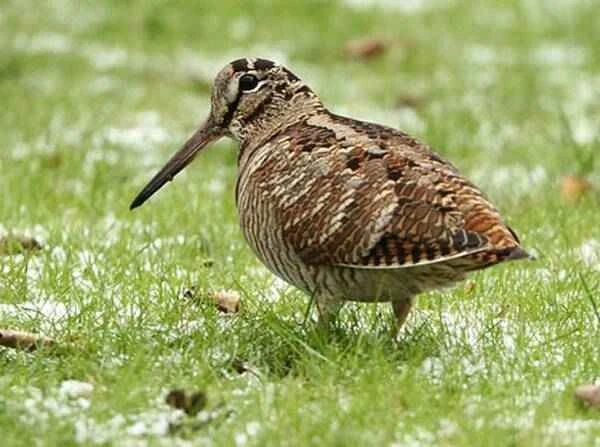
The slowest-flying bird on Earth, the Gouldian wader, has a plump body, a long, straight beak, and short legs. It resembles a sand snipe in appearance, but has a wider, dark brown horizontal bar from the crown to the nape of its head. Compared to most sand snipes, its plumage is more rust-red, especially the rust-red rump and tail, which are quite noticeable in flight. Furthermore, in flight, it is significantly larger than a sand snipe, with broad, blunt wings and heavy flapping motions.
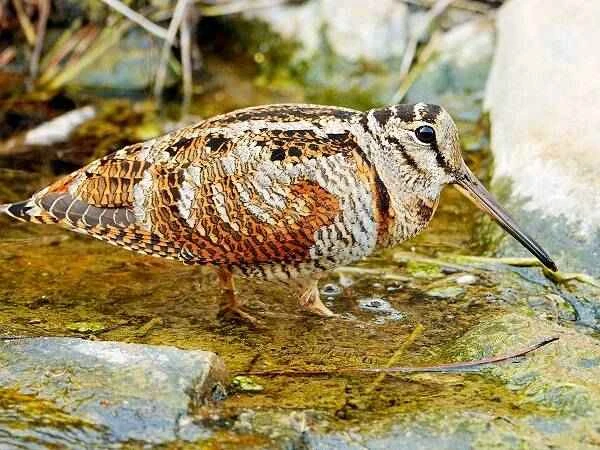
The Woodcock is a monotypic species. It breeds from north-central Europe to Xinjiang, Northeast my country, and northern Japan, as well as from Pakistan to northern Myanmar. It migrates and winters from Europe to North Africa, Japan, the Korean Peninsula, most of my country, and Southeast Asia.
The Woodcock breeds in damp deciduous and mixed forests, migrating and wintering in more open woodlands. However, it is also commonly seen along the coast during migration. It is nocturnal, hiding on the ground during the day, though occasionally observed being active during the day. When disturbed, it crouches down, making it difficult to spot. If disturbed too closely, it will run away or take low flight. It forages at night, feeding on worms and other small insects.
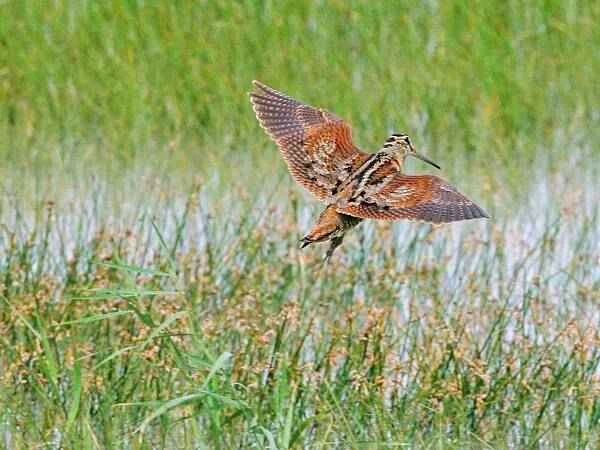
The Woodcock is primarily a winter visitor in China, with some summer visitors. It migrates to the Changbai Mountains in Northeast China as early as late March or early April, and southwards from early September to late October. It is mostly nocturnal. During the day, it often hides in forests or grasslands, only foraging at night and dusk near lakes, rivers, rice paddies, and marshes. It remains hidden during the day. Except for its courtship flights over forests at dusk, it is rarely seen during the day. When threatened, it is forced to rise from the ground, but often flies only a short distance before disappearing back into the grass or bushes. In flight, its beak points downwards, and it flies quickly and nimbly, constantly changing direction as it weaves through the trees, but its flight appears clumsy and unsteady. It is solitary, usually living alone and disliking flocks. It rarely calls, only calling when taking off.