Phylogenetic studies of squamomorphs show that the Jurassic period was a crucial time for the evolution of squamomorphs. During this period, squamomorphs rapidly evolved into several major clades. However, the fossil record of squamomorphs in the Jurassic is quite limited, with records found only in a few fossil sites in North America and Eurasia—such as the Morrison Formation in the United States, the Solnhofen Limestone in Germany, and the Karatau Formation in Kazakhstan.
In China, the Cretaceous period boasts a rich and diverse fossil record of lizards, including species such as *Yabeinosaurus*, *Dalinghosaurus*, *Liushusaurus*, and *Xianglong* from the Jehol Biota of the Early Cretaceous, *Mimobecklesisaurus* from Gansu, and *Pachygenys* from Shandong. The Late Cretaceous is rich in lizard fossils and diverse genera and species (15 in total) from Inner Mongolia, Henan, and Jiangxi. In contrast, the Jurassic lizard fossil record is extremely scarce. Currently, only two regions have yielded fossils: two unnamed juvenile lizard specimens from the Yanliao Biota; and a small amount of fragmented lizard material from the southern edge of the Junggar Basin in Xinjiang, as well as several three-dimensionally preserved lizard skeletons from the central part of the basin, but these have not yet been reported in detail.
Recently, Dong Liping, Wang Yuan, and others from the Institute of Vertebrate Paleontology and Paleoanthropology, Chinese Academy of Sciences, published a cover article in the international journal *Geodiversitas*, reporting on a beautifully preserved Jurassic lizard specimen. They named it *Hongshanxi xiei*, taking the genus name from the famous Hongshan Culture of China, dating back five to six thousand years, and the species name in honor of Mr. Xie Jingguo, who made significant contributions to the conservation of paleontological fossils in Jianping County, Liaoning Province. The specimen comes from the Guancaishan fossil site in Jianping County, Liaoning Province. The Guancaishan fossil site is considered to be contemporaneous with the Daohugou Formation (165 Ma) or slightly younger (157 Ma). Numerous salamander specimens have been found at this site and in the surrounding strata, including several specimens of *Chunerpeton tianyiensis* exhibiting polydactylous and polylimbic deformities, representing the first discovery of a Mesozoic tailed salamander, previously reported by Wang Yuan et al.
Using traditional paleontological methods and high-precision flat-panel CT scanning, researchers compared *Hoyalcerta sanzi* with other Jurassic-Cretaceous lizard species worldwide. *Hoyalcerta sanzi* exhibited a unique combination of morphological features, such as a significantly longer, fused frontal bone with a trifid posterior margin, long lateral posterior processes that interlock with the parietal bone, a short parietal bone, and osteoderms only around the eyes and lower temporal region on the skull. Its forelimbs and hindlimbs were also long. The only species with similar frontal and parietal morphology to *Hoyalcerta sanzi* was found at the Early Cretaceous Las hoyas site in Spain, but *Hoyalcerta sanzi* had a very slender mandible and far more dentary teeth than *Hoyalcerta sanzi*. Different phylogenetic analysis settings yielded different phylogenetic positions for *Hoyalcerta sanzi*—either at the basal level of squamates or at the basal level of the traditional suborder "Gastroglossum"—indicating that the phylogenetic positions of early squamous species were influenced by the phylogenetic relationships between various major squamous groups.
Original link: https://doi.org/10.5252/geodiversitas2019v41a16

Photo of the holotype of the Xie's Red Mountain Lizard (JCM-HS 0001) (Photo provided by Dong Liping)
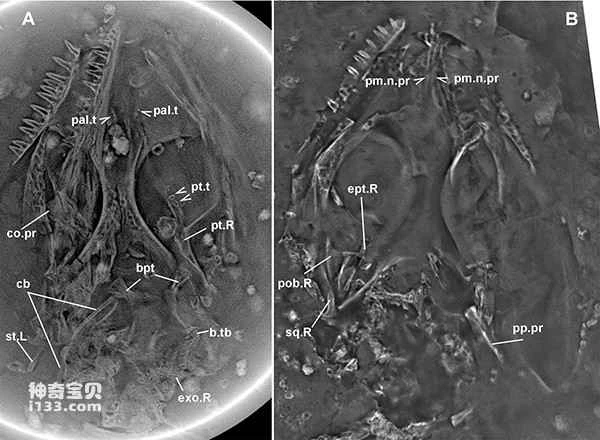
High-precision flat-panel CT scans revealed previously unexposed skull skeletal features of the red mountain lizard (Image provided by Dong Liping).
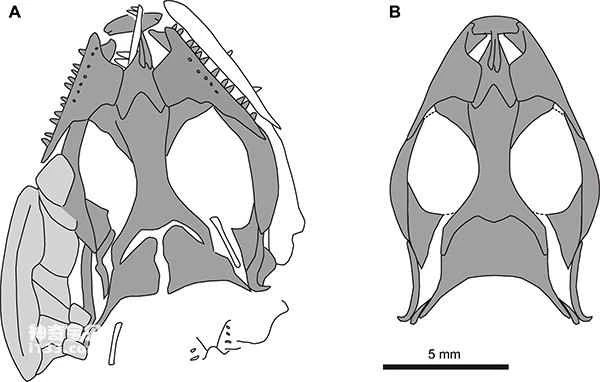
Comprehensive line drawing of the holotype skull of the red mountain lizard and its reconstruction line drawing (Image provided by Dong Liping)