Peru's Pacific coast, influenced by the Peru Current/Humboldt Current and upwelling , is extremely nutrient-rich, making it one of the most important coastal ecosystems in South America. It is home to both native Peruvian species and migratory seabirds and cetaceans that arrive during breeding or feeding seasons. Below is a summary of the most common and representative marine animals you'll encounter along the Peruvian coast, grouped by species, with easy-to-read notes on size, habits, diet, and common habitats.
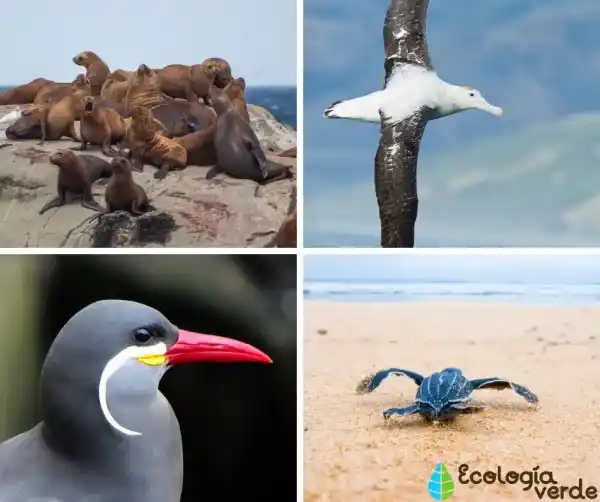
Table of contents
Humpback whale (Megaptera novaeangliae)
South American sea lion (Otaria flavescens)
Leatherback turtle (Dermochelys coriacea)
Humboldt penguin (Spheniscus humboldti)
Albatross (Diomedeidae)
Inca Tern (Larosterna inca)
More Peruvian coastal animals: a list of whales, dolphins, and seabirds.
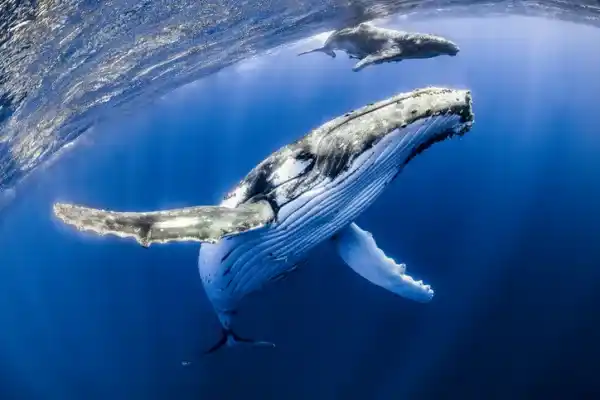
Humpback whale (Megaptera novaeangliae)
Key identification points : It can exceed 12 meters in length and weigh about 36 tons ; its exceptionally long pectoral fins and dorsal nodules make it easily identifiable.
Behavioral highlights : They are often seen leaping, flapping their tails , and then plunging heavily into the water after taking a deep breath, making them one of the most spectacular whale species to watch off the coast of Peru.
Diet : It mainly feeds on small fish and krill , and often hunts them together.
Habitat : Nearshore waters, continental shelf edges, and surface water masses with strong upwelling, seasonally approaching the coast.
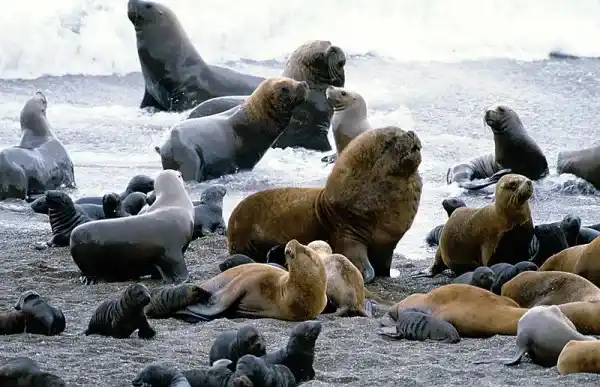
South American sea lion (Otaria flavescens)
Key identification points : Males have thick "mane" (brownish-red) on their necks and are significantly larger than females; males weigh about 300 kg , while females are mostly around 140 kg .
Social structure : They live in groups, and it is common to see groups of more than ten coming ashore to sunbathe, rest, or reproduce.
Habitat : Rocky shores, sea caves, offshore reefs, and near harbor docks.
Diet : Diverse fish, cephalopods (squid and octopus), and crustaceans.
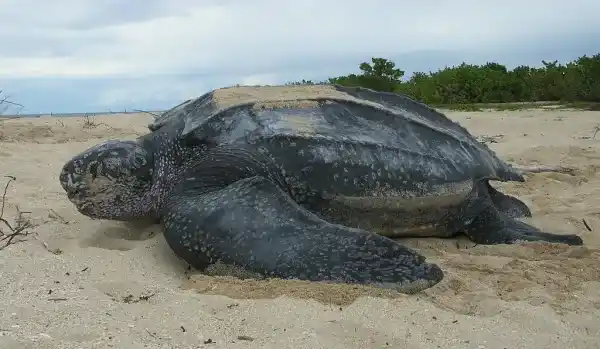
Leatherback turtle (Dermochelys coriacea)
Key identification points : It is the largest living sea turtle , reaching up to 2 meters in length; its carapace is leathery and lacks hard scales.
Ecological characteristics : A typical gigantothermy reptile, which maintains a relatively stable body temperature by relying on its huge body size and blood vessel regulation.
Diet : Prefers gelatinous planktonic organisms such as jellyfish .
Habitat : They alternate between offshore and nearshore areas, and female turtles will come ashore to lay their eggs on suitable beaches.
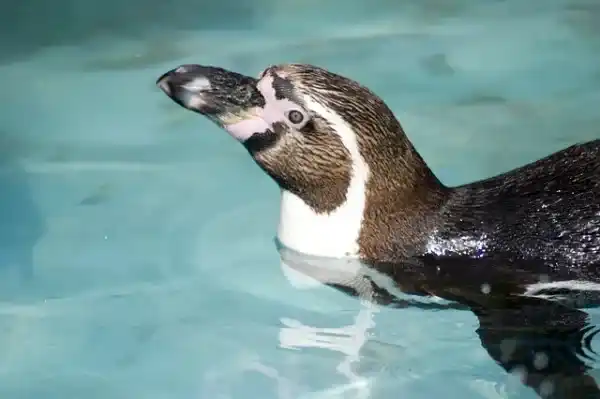
Humboldt penguin (Spheniscus humboldti)
Identity : A native Peruvian seabird that is not good at flying , named after the Humboldt Current (Peru Current) .
Key identifying features : black and white stripes with a black stripe on the chest; relatively small body size and streamlined shape , which is conducive to high-speed underwater swimming.
Diet : It mainly feeds on small migratory fish and small squid .
Habitat : Rocky shores, caves, and island cliffs near cold water upwelling.
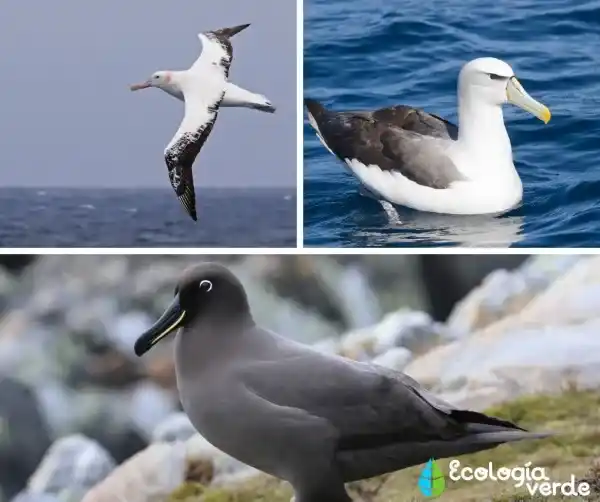
Albatross (Diomedeidae)
Highlights : With the longest wingspan of any seabird , it can glide dynamically with the help of sea breezes for long-distance cruising; it often glides and forages off the coast of Peru.
Common species :
The wandering albatross, *Diomedea exulans* (with an extremely large wingspan)
White-fronted albatross Thalassarche salvini (commonly written as Thalassarche (cauta) salvini in literature)
Smoky Albatross (Phoebetria fusca)
Diet : Surface-dwelling fish, squid , and scavengers.
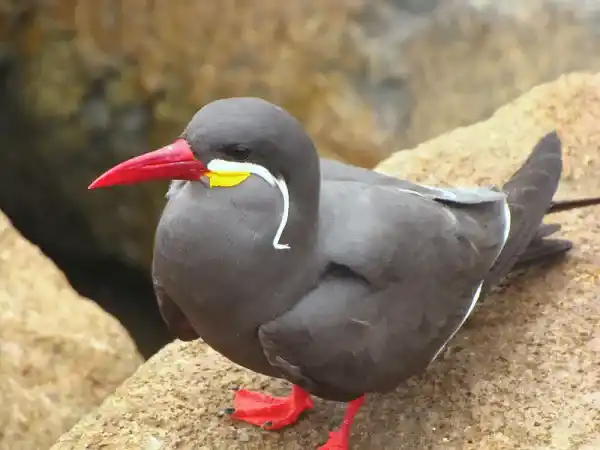
Inca Tern (Larosterna inca)
Key identifying features : A seabird endemic to the Peru-Chile coast; grey plumage, bright red feet and beak, yellow cheek patches , and distinctive "white mustache" feather lines.
Habitat : Sea cliff crevices, caves and seabird islands; patrols the skies above the coast, preying on small schools of fish .
Behavior : Often flocks with large seabirds, and is greatly affected by wind force and upwelling strength.
More Peruvian coastal animals: a list of whales, dolphins, and seabirds.
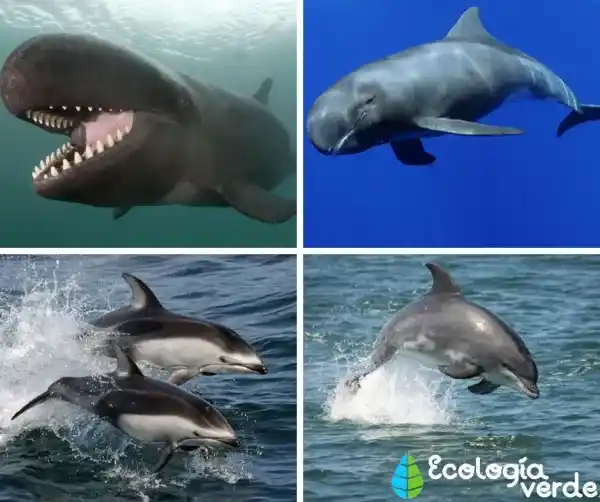
Cetaceans (mammals)
False killer whale ( Pseudorca crassidens ) (black body, fast-moving)
Pygmy killer whale Feresa attenuata
Pacific white-sided dolphin Lagenorhynchus obliquidens (white patches on its sides)
Bottlenose dolphin ( Tursiops truncatus) (common nearshore, highly social)
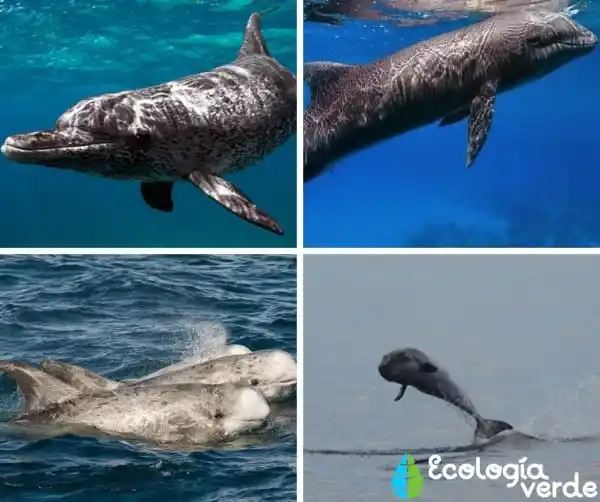
Tropical spotted dolphin, * Stenella attenuata * (side spot).
Melon-headed whale Peponocephala electra (with a blunt head)
The Riso dolphin , Grampus griseus (often has scratches on its body).
The dwarf sperm whale Kogia breviceps (resembling a small sperm whale)
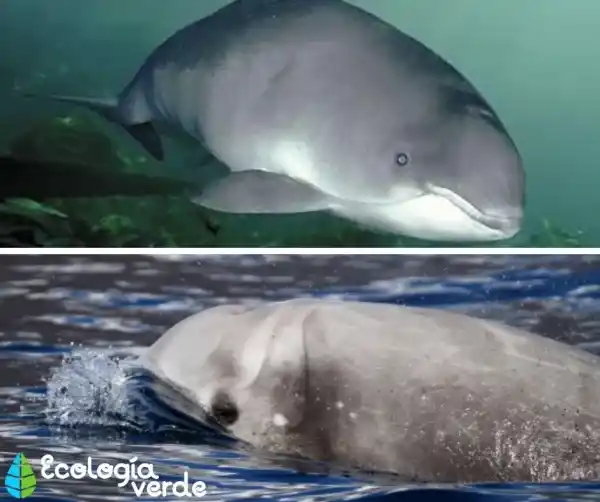
Bryde's porpoise/Black porpoise (Phocoena spinipinnis ) (a porpoise endemic to the Peru-Chilean coast)
Cough's beaked whale ( Ziphius cavirostris) (deep-diving type, often found in open seas)
seabirds
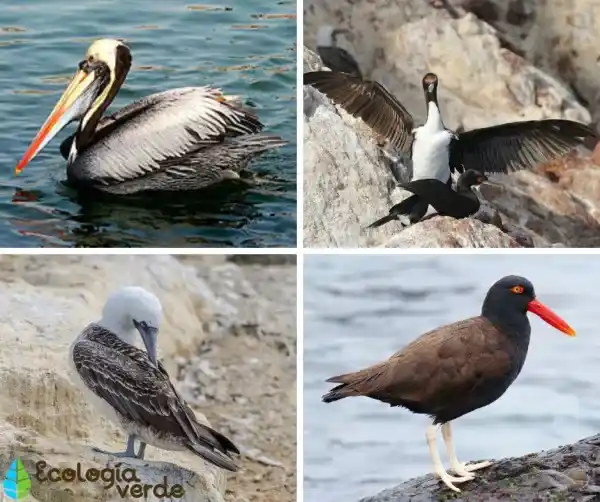
Peruvian Pelican ( Pelecanus thagus) (Giant pelican, spectacular sight of a group swooping down to hunt).
Guanna warship cormorant Leucocarbo bougainvillii (classic resident of "Guinea Island")
Peruvian gannet Sula variegata (swooping down to catch fish in flocks)
Black Oyster Predator ( Haematopus ater) (rocky shore-feeding shellfish)
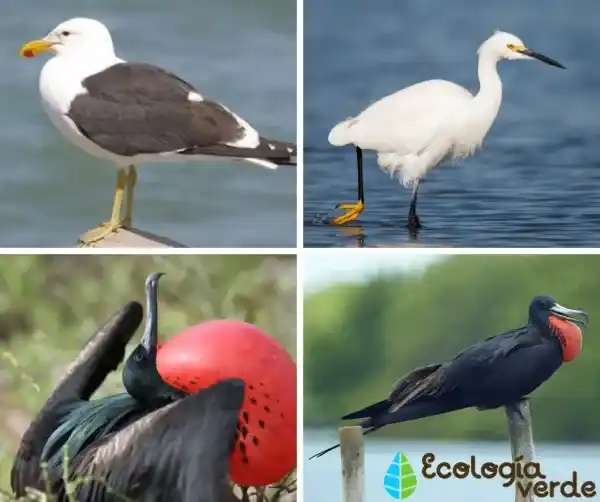
Seagull (Antarctic gull/Sea gull Larus dominicanus )
Snowy heron ( Egretta thula) (wading in shallow waters to forage)
Frigatebird Fregata minor and Frigatebird Fregata magnificens (glide with the wind and are good at snatching food in the air )
Tips (for reader comprehension and viewing)
Why is the Peruvian coast so rich in marine life? — Cold currents and upwelling bring deep, cold water and nutrients to the surface, leading to a surge in plankton → abundant schools of small fish → attracting seabirds and whales .
Observation etiquette : Maintain a safe distance from marine mammals and sea turtles; do not feed or touch them; for whale watching/bird watching, prioritize compliant vessels and low-distraction routes .
Fisheries and Conservation : Various seabirds, whales, dolphins and sea turtles are threatened by accidental capture, marine debris and habitat degradation ; measures such as the establishment of seabird island protection areas, fishing bans and improved fishing gear have been implemented locally.
References
Salzwedel, H. & Landa, A. (1997). Resources and dynamics of upwelling ecosystems in Peru. Peruvian Institute of Marine Research.
Schulenberg, T. et al. (2008). Birds of Peru. Princeton University Press.
Arias-Screiber, M. & Rivas, C. (1998). Distribution, size, and structure of populations of Peruvian coastal sea lions (Arctocephalus australis and Otaria byronia). IMARPE Digital Resource, pp. 17–32.