Polar bears are the largest carnivores in the Arctic region, and therefore the undisputed rulers of the Arctic. Just as penguins are the symbol of Antarctica, the polar bear is the representative of the Arctic.
From an ecological balance perspective, if massive creatures like polar bears roamed the grasslands, they would not only pose a significant threat to the already small populations of reindeer and musk oxen, but also compete with wolves for food, potentially driving the wolves into starvation. Perhaps due to careful consideration and ingenious arrangement by nature, or perhaps because polar bears disdain associating with wolves, their central habitat is on the ice sheets. There, large numbers of walruses and seals thrive, and apart from a very small number of predatory whales, they have virtually no natural predators. Their large, obese bodies require a powerful and voracious predator to consume them, and the polar bear found its perfect place. Thus, the polar bear established its undisputed dominance in this vast, icy world, becoming the ruler of this white kingdom, no longer needing to venture onto land to compete with the pitiful wolves for food. Nevertheless, the polar bear remains a terrestrial animal.
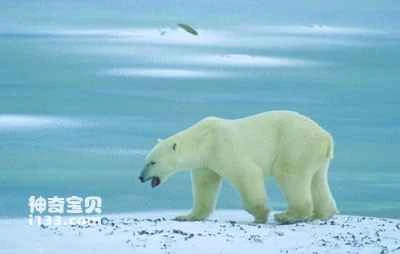
Polar bears are among the largest land predators in the world, found in the Arctic Ocean and other islands, as well as along the coasts of Asia, America, and adjacent regions. In the Arctic, polar bears can be found year-round. However, they are rarely seen during the harsh winter due to a unique habit they possess—hibernation. They can go for extended periods without food, and their breathing rate is extremely low. But unlike most animals that hibernate, they don't bury their heads in their sleep; instead, they remain in a semi-conscious state, ready to be startled awake in an emergency. Therefore, their hibernation is called partial hibernation or winter sleep.
Recent research has also shown that polar bears can not only hibernate but also estivate. Canadian animal experts captured several polar bears in Hudson Bay in the fall and found that their paws were covered with long fur, indicating that they had been inactive for a long time and had spent that period in estivation.
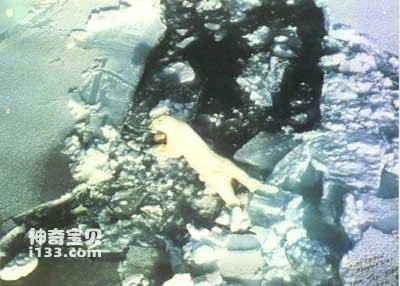
Polar bear leaping between ice floes
Polar bears are covered in thick, white fur, even on their ears and paws, with only a small patch of black on their noses. Their fur has an extremely complex, hollow structure, providing excellent insulation. Therefore, polar bears can walk easily on ice floes without fear of the Arctic's frigid temperatures. Polar bears have streamlined bodies and are excellent swimmers. Their large paws act like oars, allowing them to paddle powerfully in the icy Arctic Ocean, using their forelegs to propel themselves forward while their hind legs act as a rudder, enabling them to swim forty to fifty kilometers at a stretch. Polar bears have claws like iron hooks and incredibly sharp teeth; a single paw strike can shatter a human skull, separating the head from the body. Polar bears can run at lightning speeds, reaching speeds of up to 60 kilometers per hour, but this speed is limited to short sprints. So, if you are attacked by a polar bear in the Arctic, you can try to negotiate a long-distance race; the polar bear will undoubtedly lose.
Polar bears are carnivores, primarily feeding on seals. Every spring and early summer, packs of seals lie on the ice basking in the sun, while polar bears carefully observe their prey. They then cleverly use the terrain to their advantage, gradually approaching the seals. Once within effective hunting range, they pounce like arrows released from a bow. Despite the seals' constant caution, by the time they realize what's happening, it's too late. The bear's massive paw strikes with lightning speed, instantly splattering their brains onto the ground.
In winter, polar bears display astonishing endurance by waiting for seals for hours on end near the ice cap's breathing holes, completely focused and motionless, like a snowdrift. They even cover their noses with their paws to avoid scaring the seals away with their scent and breathing sounds. The moment the long-awaited seal peeks out, the waiting polar bear swiftly and powerfully strikes the seal's head. Before the poor seal can even comprehend what's happening, its brains splatter, and it dies instantly.
Polar bears also have a method for dealing with seals lying on ice floes. They utilize their swimming prowess to silently approach the seals from the water, sometimes even pushing an ice floe for cover. After catching the seal, they enjoy a meal and then sail away. The polar bear's cleverness also lies in its indifference when encountering seals while swimming; it acts as if it doesn't see them. It knows that in the water, it is no match for the seal, and rather than engage in a life-or-death struggle that would ultimately be futile, it's better to let the seal go and conserve its energy.
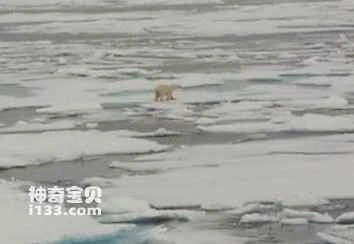
Polar bear discovered during China's first Arctic expedition.
Polar bears have an exceptionally sensitive sense of smell; they can detect the scent of burning seal blubber from 3.2 kilometers away. In the spring of 1992, the Inuit people caught many whales and disposed of their entrails in garbage dumps around Barrow, then buried them. After the sea froze in the fall, polar bears, drawn by the scent, came to the village in large numbers, seriously threatening the safety of the people. Various methods were used to drive them away, such as helicopter noise and firecrackers, but with little success. For the few polar bears that were particularly audacious and posed a serious threat to human life, they had to be shot. Sometimes, polar bears would sneak into the camp of the Arctic scientific station, rummaging through tents, kitchens, and warehouses, attempting to taste human food; at other times, polar bears were extremely docile and adorable, showing great interest in the activities of the people at the scientific station, often following behind them or lying on the ice at a distance, watching them work.
For the Inuit, polar bears are their most feared enemy. Before the advent of firearms, a polar bear attack almost always resulted in death. To prevent panic in the event of an unexpected encounter with a polar bear, here's a brief overview of its characteristics when attacking. Generally, aggressive polar bears appear agitated and will intermittently exhale harsh breaths from their nostrils. At this time, caution is advised, and attempts should be made to scare the bear away. The simplest method is to shout loudly and continuously throw ice blocks or stones at it, accompanied by the sound of metal being struck. Never run away from a bear; this is the most foolish action and plays right into the polar bear's hands. It will chase after you at incredible speed, launch a vicious attack, and with a single swipe of its paw, your head will be severed. Therefore, when conducting research or work in areas where polar bears are present, it is best to carry a firearm to prevent accidents. As for the polar bear, moving slowly and casually, stretching its head forward, sniffing around with an air of leisure, there's no need to be alarmed, because it means no harm. Of course, it's always best to be cautious when dealing with unpredictable wild animals.
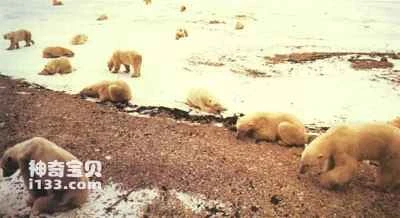
Polar bears, which are accustomed to acting alone, sometimes gather together.
Springtime in the Arctic (March and April) is the mating season for polar bears, generally lasting about two weeks, sometimes up to a month. Sexually mature female polar bears (4 years and older) and male polar bears (5 years and older) may meet by chance, or perhaps by a special connection, and after meeting, they stroll together on the crystal-clear ice sheet. Of course, not all females are satisfied with the males. In such cases, the males often resort to violence, and a fight ensues. However, the weaker female is no match for the larger, stronger male, and in the end, the female is not only badly injured but also forced to submit and become the bride against her will. In a sense, while the actions of the male polar bears may seem somewhat brutal, they are extremely beneficial to the reproduction of their entire species.
The indigenous people of the Arctic region hold polar bears in high esteem and reverence, yet they still hunt them. It is said that in ancient times, the Inuit had a custom where the dead or the sick were sent to the wilderness where polar bears frequently roamed. There, they would sit solemnly, waiting for the polar bears to come and eat them. They understood that only if the polar bears survived would their descendants have enough to hunt and enough food to survive. When an Arctic native hunts a polar bear, they hold a grand ceremony. For example, the Inuit of Alaska often perform a "bear dance" to celebrate a successful hunt; the Inuit of Greenland wear shoes trimmed with bear mane as a sign of respect and honor; most notably, the Inuit of Siberia, when dismembering a polar bear, first removes the heart, then cuts it into pieces and throws them behind them to appease the spirit of the deceased.

Looking up at the sky and howling in sorrow
People hunt polar bears for their skin and meat. Polar bear meat is one of the most important food sources for the Inuit, and bear skins are everyday items used by the local residents to make fur clothing, shoes, and socks, providing them with the best insulation against the cold.
In the Arctic, the Inuit people hunt polar bears using only bows and arrows and spears. Their population is small, and the number of bears they capture is also limited, posing little threat to the polar bears' survival. However, driven by greed, bear-hunting ships from other regions have emerged and regularly enter the Arctic Ocean to hunt them extensively, causing a sharp decline in the polar bear population. It is estimated that there are currently no more than 20,000 polar bears left in the Arctic. On average, there is only one polar bear for every 700 square kilometers of ice surface. Furthermore, with the development of Arctic oil resources, advanced icebreakers, aircraft, and submarines have entered the Arctic, severely threatening the survival of polar bears.
Therefore, Arctic countries signed an international convention for the protection of polar bears between 1973 and 1975. The convention stipulates strict control over the buying, selling, and trafficking of natural bear skins and their products.