I. The Story of the Mantels
In a small town called Lewis in Sussex, southern England, lived a country doctor named Mantel 180 years ago. Mr. Mantel was filled with curiosity about nature and had a particular fondness for collecting and studying fossils. Besides practicing medicine, he often took his wife on hikes and wading trips to find and collect fossils, their footprints covering every nook and cranny of the surrounding area where rock formations were exposed. Over time, Mrs. Mantel also became a "friend of nature" and a skilled fossil collector.
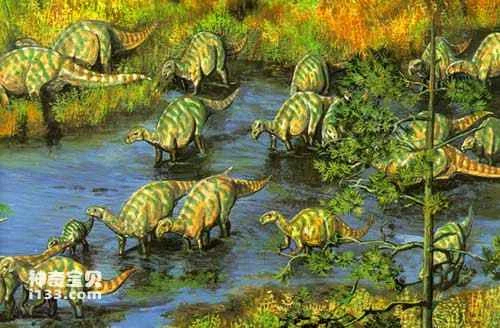
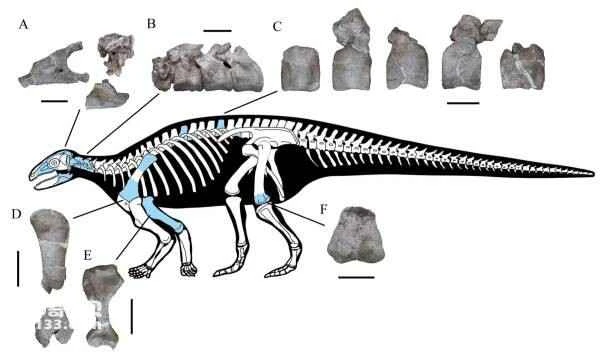
Iguanodon
One day in March 1822, the weather was very cold, but Mr. Mantel still went out to see patients as usual. His wife waited at home for her husband's return, constantly worrying that he might catch a cold. Later, Mrs. Mantel couldn't sit still any longer, so she took a coat from her husband and went out to meet him in the direction he was going to see patients. She walked along a road under construction, the newly carved steep walls on both sides exposing layers of rock. She habitually observed the newly exposed rock layers as she walked, when suddenly something shiny caught her attention. "What are these?" she muttered to herself, walking closer to examine them more closely. Wow! They were strangely shaped fossilized animal teeth. These fossilized teeth were enormous; Mrs. Mantel had never seen teeth so large before. The excitement of the discovery made Mrs. Mantel forget about bringing her husband the coat. She carefully removed the fossils from the rock layers and took them home.
Later that evening, Mr. Mantel returned home. He was astonished when his wife presented him with the newly collected fossils. He had seen many fossilized teeth of ancient animals, but none resembled such large and unusual teeth.
Shortly thereafter, Mr. Mantel found many more teeth and related skeletal fossils near the site where the fossils were discovered. In order to determine what animal these fossils belonged to, Mr. Mantel took them to the French naturalist Juliette Cuvier, asking this scholar, who was then the most famous in the world, to identify them.
To be honest, Cuvier had never seen such fossils before, and none of the books and papers he had read written by his predecessors mentioned them. However, based on his considerable knowledge of zoology, Cuvier made a judgment: he believed the teeth were from a rhinoceros, the bones from a hippopotamus, and that they were not very ancient.
Mr. Mantel was highly skeptical of Cuvier's identification, believing his conclusions to be too hasty. He decided to continue his research. From then on, whenever he had the chance, he went to museums around the world to compare specimens and consult materials.
Two years later, he met a naturalist at the Royal College Museum in London who was studying a modern lizard from Central America—the iguana. Mr. Mantel brought the fossils to the Royal College Museum and compared them with the iguana teeth collected by the naturalist. They were remarkably similar. Overjoyed, Mr. Mantel concluded that these fossils belonged to an extinct ancient reptile, and named them "iguana teeth."
Later, as more and more fossil materials were discovered, human understanding of these ancient animals deepened. We learned that the so-called "iguana tooth" was actually a member of a diverse family of dinosaurs; it was indeed a reptile like the iguana, but its kinship with the true iguana was much more distant than with other dinosaur species! However, according to the rules of biological nomenclature, the Latin name of this earliest scientifically recorded dinosaur remained unchanged, still meaning "iguana tooth." Its Chinese name, however, was translated as *Iguana*.
Therefore, please remember: Iguanodon is the earliest scientifically documented dinosaur. Also, don't forget the name Mantel and his nature-loving wife.
II. The Story of Prot
Mrs. Mantel's discovery of dinosaurs is indeed romantic, and Mr. Mantel's rigorous and pragmatic approach to exploring the attribution of dinosaurs truly marked the first step in humanity's scientific study and understanding of dinosaurs.
However, in history, humans have discovered dinosaur fossils long ago, but due to limited knowledge at the time, they were unable to interpret these fossils correctly.
Dinosaur fossils were discovered in Wucheng County, Sichuan Province, more than 1,000 years ago during the Jin Dynasty in my country. However, people at that time did not know that they were the remains of dinosaurs, but instead regarded them as the bones left behind by the legendary dragon.
A researcher named Haslted from the University of Reading in England, after extensive research and consulting numerous sources, recently announced his discovery of the following fact: In 1677, an Englishman named Prott wrote a natural history book about Oxfordshire. In this book, Prott described a huge leg bone fossil discovered in a quarry in the parish of Carlovilla. Prott drew a fine illustration of the fossil and pointed out that the thigh bone belonged neither to a cow, horse, nor elephant, but to a giant even larger than them.
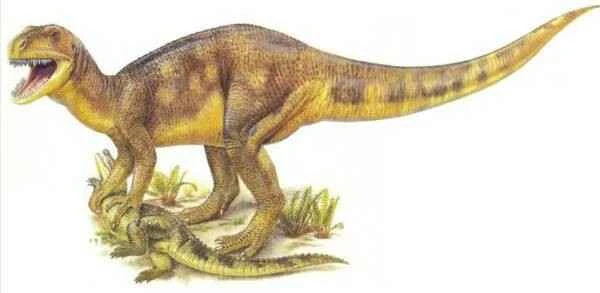
Although Plott did not recognize the fossil as belonging to a dinosaur, nor did he associate it with reptiles, the specimen he documented and illustrated was later identified by paleontologists as the femur of a dinosaur called Megalosaurus. This fossil was discovered 145 years before the Mantels' discovery of Iguanodon. Therefore, Haseltted believes that Plott was the first discoverer and recorder of dinosaur fossils.
III. Megalosaurus – “The Giant Lizard of the Quarry”
Although ancient Chinese people discovered dinosaurs as early as the Jin Dynasty, they thought they were the bones of the legendary dragon; Mr. Plott discovered and described Megalosaurus as early as 1677, but mistakenly thought they were the remains of giants; the Mantels discovered Iguanodon fossils in 1822, but did not publish them until 1825.
While Iguanodon was being identified, British geologist John Buckland published the world's first scientific report on dinosaurs in 1824, reporting on a fossilized mandible of a Megaloceros found in a quarry. Buckland believed it to be a new type of reptile, and the Latin meaning of "Megaloceros" is "large lizard of the quarry".