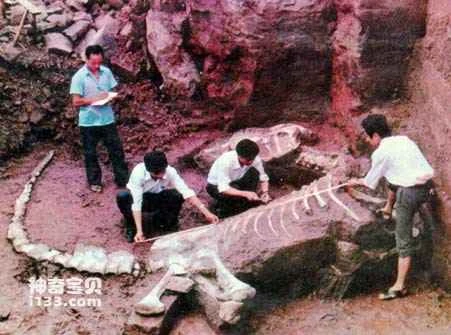
The Dashanpu fossil site, located in Zigong City, Sichuan Province, my country, is renowned for its rich and well-preserved dinosaur fossils, leading some scientists to aptly call it a "dinosaur cemetery." How did this "dinosaur cemetery" form? This enigmatic question has intrigued many scientists. They have studied the issue from different perspectives and reached some conclusions. While these conclusions don't fully unravel the mystery, they offer valuable insights for our ultimate understanding. Below are three theories.
1. The theory of burial in situ :
This theory was proposed by Xia Zhijie, a professor of petrology at Chengdu University of Geology, based on petrology and the burial characteristics of dinosaur fossils.
Geologically, the burial strata of the Dashanpu dinosaurs belong to the Shaximiao Formation, a terrigenous clastic sedimentary deposit, mainly composed of purplish-red mudstone, interbedded with multiple layers of light grayish-green medium- to fine-grained sandstone and siltstone, representing alternating fluvial and lacustrine facies. This means that during the Middle Jurassic period, 160 million years ago, the Dashanpu area was crisscrossed by rivers and dotted with lakes. This natural environment, coupled with the mild climate at the time, made it a veritable "paradise" for dinosaurs, with herds of various dinosaurs living on this lush lakeside plain. However, it is highly likely that due to consuming plants with high arsenic content, a large number of dinosaurs died from poisoning and were quickly buried in the relatively calm sandy shallows. They were buried in situ before they could be moved, thus creating the abundant and well-preserved taphonomic features of the dinosaur fossils in this region.
This theory is unique because it conforms to the principles of taphonomy, but it still feels like it lacks sufficient evidence. What was the average background level of arsenic in the plants in the Dashanpu area at that time? What level of arsenic could have caused the sudden death of dinosaurs? Was the sampling used to analyze arsenic content representative? These questions still require further in-depth research.
2. The theory of burial in another location :
This theory holds that the dinosaurs in Dashanpu died elsewhere and were transported to this area for burial. The evidence includes: (1) If they were buried in situ, most of them should undoubtedly be complete or relatively complete individuals. However, the opposite is true. Although more than 100 dinosaur fossils have been excavated and collected in this area, only about 30 of them are complete or relatively complete, accounting for only about one-fifth of the total. (2) Looking at the fossil site, in addition to the characteristics of rich burial and good preservation that make them easy to find, there is a common phenomenon that is not easily noticed. The fossils near the upper part or the surface are more broken and scattered. Most of them are dinosaur limb bones, and they look like they have been eroded and broken after being transported. At the same time, the closer to the upper rock layer, the more small fossils there are. For example, fish scales and various teeth are found all over the fossil site. The vertebrae of pterosaurs, stegosaurs and plesiosaurs are also very scattered, and there is a distribution pattern of more and less from south to north. The lower rock layer is almost entirely composed of large sauropod dinosaurs, which are not well preserved and are obviously the result of being transported. (3) The discovery of the gravel layer is an important basis for studying the sedimentary environment. The gravel found in Dashanpu is located at the bottom of the fossil layer. Judging from its characteristics, it is a product that has been transported and may be closely related to the formation of the dinosaur fossil group.
3. Synthesis :
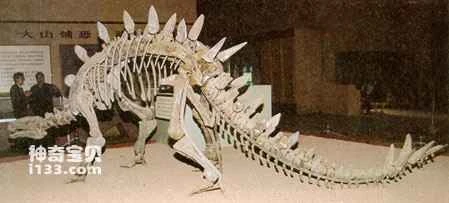
Stegosaurus of Dashanpu
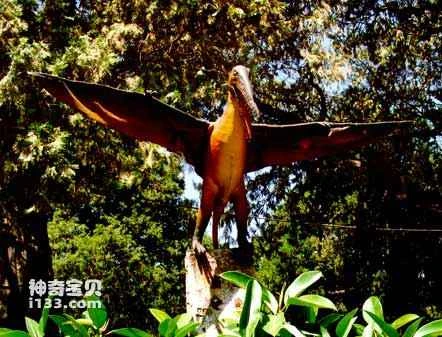
pterosaurs of Dashanpu
Most scientists believe that the majority of fossils in the Dashanpu Dinosaur Cemetery were transported and buried, while a small portion were buried in situ. Therefore, it is a dinosaur cemetery formed by a combination of these two factors. Why is this area so rich in dinosaurs and other vertebrates? If only dinosaurs were buried here, both theories might be easier to understand. However, besides dinosaurs, there are also flying pterosaurs, aquatic plesiosaurs, labyrinthine amphibians, and others, each with distinct habitats. Geological studies have shown that Dashanpu was a floodplain during the Middle Jurassic period. These ancient reptiles, like modern animals, may have exhibited a clear selectivity in their habitats. Among the dinosaurs, the gentle sauropods often lived in groups on the lower lakeside plains; stegosaurs preferred to inhabit the fern-covered forests slightly higher up from the lakeshore; ornithopods, with their agile and nimble morphology and excellent running ability, were active on higher plateaus. Other vertebrates, such as pterosaurs, could only fly low among the lakeside forests. Dinosaurs and these vertebrates had vastly different living environments and habits, so why were they buried together in one place? It's likely they were moved from different locations. But why are there so many complete fossil skeletons? This is clearly a product of in-situ burial. Ultimately, all these phenomena seem to have only one explanation: the Dashanpu "Dinosaur Cemetery" was formed by a combination of in-situ and ex-situ burial.