On April 21st of this year, Science, one of the world's two most authoritative scientific journals, published a research paper by Professor Russell and other paleontologists from the University of North Carolina, reporting their latest discovery and study of the heart fossil of a small, bipedal, herbivorous dinosaur belonging to the Ornithopoda suborder, the Echizothorax.
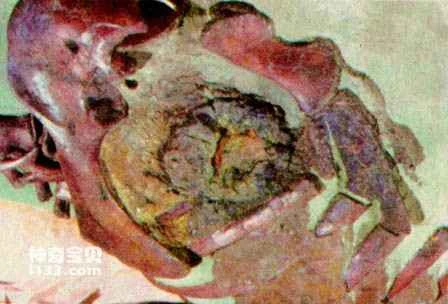
Dinosaur heart fossil
Professor Russell's research team used CT scans to explore the 3D structure of this fossil heart, discovering that the *Ichthyosaurus* heart had two ventricles and two atria. This heart structure is similar to that of birds and mammals, but different from that of reptiles such as turtles and lizards. This suggests that *Ichthyosaurus* possessed physiological functions similar to those of birds and mammals. Professor Russell therefore definitively concluded that dinosaurs were a group of active, warm-blooded animals with high metabolic rates.
Since the physiological characteristics of dinosaurs were rediscovered in the 1970s, a heated debate has raged for a decade. The debate centers on whether dinosaurs were a group of dull, slow-moving cold-blooded animals (also known as poikilothermic animals) or a group of warm-blooded animals (also known as homeothermic animals) with high metabolic rates and agile movements.
A leading figure in the camp that dinosaurs were warm-blooded is Dr. Buck of Yale University, whose main arguments are threefold. First, all dinosaurs stood upright on their legs, unlike other cold-blooded reptiles that lay prone on all fours. Second, the bone structure of dinosaur skeletons is similar to that of warm-blooded mammals. Third, in modern ecosystems (such as the African savanna), the ratio of predators (e.g., lions) to prey (e.g., antelopes) is a constant, and statistics on the North American dinosaur fauna show that the ratio of predators to prey approximates this constant.
Those who still believe dinosaurs were cold-blooded have also presented their arguments. First, upright posture cannot be used as a reason for warm-bloodedness, because marine mammals such as whales and seals are not upright, yet they are all warm-blooded. Second, some sea turtles have skeletal structures similar to those of mammals, yet they are cold-blooded. Third, Buck's statistics on the predator-prey ratio in the North American dinosaur fauna are arbitrary, therefore the constants he derived are inaccurate.
The discovery of the dinosaur heart fossil now confirms Dr. Buck's assertion. This is the first time scientists have used high-tech methods in the direct study of paleontological fossils, employing CT scan tomography to study the organ fossils of this dinosaur that lived 66 million years ago. Professor Retsuji Setoguchi of Kyoto University in Japan commented, "The images clearly show that this dinosaur's heart already possessed an independent pulmonary circulatory system, providing strong evidence for the warm-blooded dinosaur hypothesis."
It is extremely rare for the soft tissues of ancient animals to be preserved as fossils. The discovery and study of this dinosaur heart fossil reminds paleontologists that if advanced technologies and methods are used to conduct multidisciplinary research in paleontology, it could very well lead to groundbreaking progress in paleontological research.