According to the five-kingdom classification system of organisms, plants and animals, as two higher-level classification orders of organisms, evolved from different phyla of another order—the protists—and are in a parallel relationship with the latter.
This classification system highlights the hierarchical relationships between the major biological orders, from simple to complex and from lower to higher levels.
However, it also has its shortcomings. In particular, it does not reflect the systematic relationship and historical origins of the two most fundamental and advanced groups of modern life—animals and plants.
In fact, the ancestral types of both plants and animals can be found not only in protists, but they also share certain similarities in their ancestral types within primitive organisms. This similarity can still be found in a modern primitive organism—the Euglena.
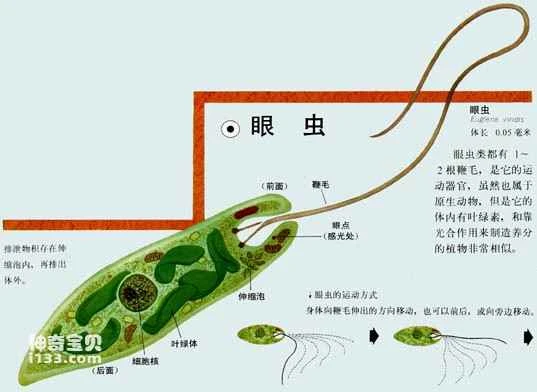
Euglena or Euglena
Euglena are single-celled protozoa that live in water. Their bodies are elongated spindle-shaped or cylindrical, with a notch at the front from which a flagellum extends. The reaction force generated by the flagellum's movement in the water propels the body. Below the notch is a red eyespot with photosensitive function (the euglena gets its name from this eyespot). If placed in water containing organic matter, Euglena can absorb organic "food" from the water through its cell membrane, leading a heterotrophic lifestyle similar to animals. These properties lead zoologists to consider Euglena a type of "protozoa." However, Euglena cells also contain chloroplasts containing chlorophyll, enabling them to perform photosynthesis and produce their own nutrients. Therefore, botanists consider it a type of "protoplant"; because its cells lack a cell wall, botanists have given it another name—Euglena.
Euglena's "animal-plant duality" leads many scientists to believe that animals and plants share a common ancestor—it is very likely a single-celled protozoan similar to Euglena, living in ancient aquatic environments. During the long process of evolution, some molecules within these organisms, along with changes in their genomes, enhanced the structures and functions of locomotion and feeding, while gradually "losing" the structures and functions of photosynthesis, ultimately transforming their lifestyle into a completely heterotrophic one. Other molecules, along with other changes in the genome, transitioned towards a completely autotrophic lifestyle. The former represents the emergence of the earliest animals, and the latter represents the appearance of the earliest plants.
The earliest protozoa and protoplants were both single-celled, and subsequently, they evolved into multicellular organisms.
In the field of paleontology, our understanding of the time of divergence between plants and animals is constantly being updated with the continuous discovery and accumulation of fossils, the advancement of new research ideas and methods, and the mutual influence of interdisciplinary collaboration.
As early as when Darwin published "On the Origin of Species" in 1859, he also pointed out the difficulties of the then theory of evolution with a realistic scientific attitude, one of which was the famous "Cambrian Explosion".
The so-called Cambrian Explosion refers to the discovery by scientists in strata dating back 570 million to 500 million years ago of a seemingly sudden emergence of numerous fossil animal groups, including sponges, coelenterates, annelids, mollusks, arthropods, brachiopods, echinoderms, and primitive chordates. Based on these discoveries, some scientists believe that these animals appeared on Earth in an explosive process, and that this explosion also marks the beginning of the divergence between flora and fauna. Therefore, they speculate that the divergence between flora and fauna occurred around the beginning of the Cambrian period, approximately 600 million years ago.
In 1949, paleontologist Sparig discovered numerous skeletonless marine invertebrate fossils in the Ediacaran region north of the Adelaide Mountains in southern Australia and dated this fossil fauna to the Early Cambrian. However, ten years later, paleontologist Glasnan, after careful and meticulous study of this fauna, reached three remarkable conclusions: (1) No Cambrian genera or species were found among the coelenterates, annelids, or arthropods in this fossil fauna; (2) The microfossil composition in this fossil fauna was completely different from that of the Cape of Good Hope; (3) The Bunt Rock layer, which buried this fossil fauna, was 1,000 meters thick and was not continuous with the Cambrian strata overlying it (this is called unconformity in stratigraphy), therefore the Bunt Rock layer should belong to a different geological period than the Cambrian. At the International Geological Congress held in 1960, the scientific community officially named this fossil fauna the Ediacaran Fauna. Subsequent dating using various methods determined the Ediacaran fauna to be between 680 and 620 million years ago. In 1974, the International Union of Geological Sciences classified the Ediacaran fauna as a Late Precambrian fauna. This pushed back the timeline of the large-scale appearance of invertebrates on Earth, thus suggesting that the divergence between flora and fauna occurred much earlier than 600 million years ago.
Just as the Ediacaran fauna was being correctly re-understood, breakthroughs were also made in the discovery and study of plant fossils, primarily those formed from eukaryotes. In 1969, Claude discovered fossils of single-celled green bacteria and golden algae that lived 1.3 billion years ago in the Baker Springs Formation in eastern California, USA; in 1971, Scheff and his colleagues discovered some plant fossils belonging to dinoflagellates, red algae, and green algae that lived 900 million years ago in the Bitter Springs Formation in Australia.
Since the mid-1970s, the discovery of Precambrian animal and plant fossils has been increasing. On the one hand, the number and locations of discovered fossil assemblages have both increased. For example, the Ediacaran fauna has been discovered in Late Precambrian strata in Southwest Africa, North America, the United Kingdom, Scandinavia, the former Soviet Union, and China. The number of genera in the fossil assemblage has grown from the initial 5 to 19, and by the early 1980s, 56 genera had been identified. On the other hand, new fossil assemblages are frequently discovered. For instance, Chinese scholars have discovered abundant trichomes and annelid fossils in Late Precambrian strata in the Huainan region of Anhui Province. The clarity and preservation of the specimens and their internal structures are extremely rare both domestically and internationally. Seven genera of trichomes dating back 740 million years and annelid fossils dating back 840 million years have been identified.
Both brachiopods and annelids are higher invertebrates. Therefore, scholars believe that animals had a long history of development before this, and thus believe that the divergence between animals and plants began more than 1 billion years ago.
Since the 1970s, scholars have studied the molecular structure of proteins. Proteins are compounds composed of amino acids, with many amino acid molecules linked together in chain-like polypeptides to form proteins. A protein molecule consists of one or more polypeptide chains. The sequence of amino acids on the polypeptide chain constitutes the primary structure of the protein molecule. The primary structure of a protein—the sequence of amino acids—not only determines the secondary, tertiary, and even quaternary structures of the protein molecule, but differences in primary structure can also reflect genetic differences and phylogenetic relationships between different species.
To date, scientists have elucidated the primary structures of hundreds of protein molecules, and the established molecular evolutionary system largely aligns with traditional classification systems. This demonstrates that the molecular evolution and morphological evolution of biological species are essentially consistent. In 1982, molecular biologist Lyusnicaus chose to study hemoglobin and myoglobin, which are present in most invertebrates and all vertebrates, indicating that invertebrates appeared at least 1 billion years ago. Other scholars' research on cytochrome C suggests that the differentiation of plants and animals on Earth occurred even further back, 1.3 to 1.2 billion years ago.