Both herbivorous and carnivorous dinosaurs needed their senses to find food. How did they locate delicious plants to eat while remaining vigilant in tracking predators? How did they find their herbivorous prey when it was camouflaged or hidden? Which senses were most helpful to different types of dinosaurs?
Herbivores' senses
line of sight:
The eyes are located on the sides of the head, allowing for a wide field of vision.
Vision may be color-dependent, like that of birds and most extant reptiles.
smell:
The enlargement of the olfactory lobes (the part of the brain responsible for smell) in some people indicates that smell is an important sense.
The sense of smell is used to locate plants or to find predators or potential mates.
hearing:
Small herbivores may hear higher frequencies, which is useful for locating predators and other warning signals from dinosaurs.
Large herbivores may hear lower frequencies, which is useful for long-distance communication.
The appearance of the outer ear is similar to that of the outer ears of extant birds and reptiles.
The senses of carnivores
line of sight:
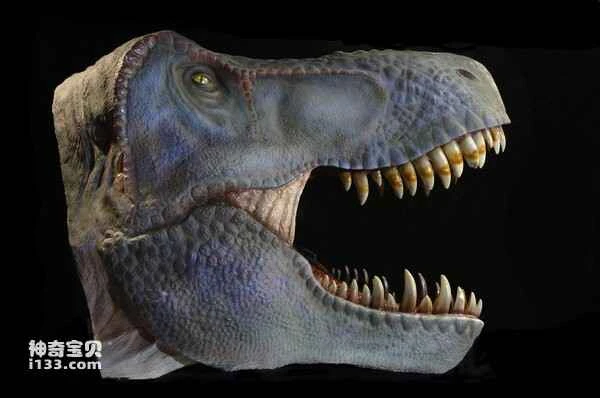
Some have relatively large, forward-facing eyes used to judge the distance to their prey.
Vision may be color-dependent, like that of birds and most extant reptiles.
smell:
The enlargement of the olfactory lobes (the part of the brain responsible for smell) in some people indicates that smell is an important sense.
The sense of smell is used to find prey and detect predators or potential mates.
hearing:
The appearance of the outer ear is similar to that of the outer ears of extant birds and reptiles.
The structure and large size of the middle ear cavity indicate that some theropods could hear low-frequency sounds, which was useful for detecting prey at a distance.
How did the vision of carnivorous dinosaurs differ from that of herbivorous dinosaurs?
Theropod dinosaurs generally had forward-looking eyes. This resulted in a relatively wide visual range for the frontal binoculars (where the eyes work together to produce a single image), while the visual range for the lateral monoculars was narrower. They may also have had stereoscopic vision, meaning their eyes were able to determine the precise distance to objects or prey (a concept known as depth perception).
Most herbivorous dinosaurs had their eyes located on the sides of their heads. This resulted in a wide range of monocular vision (where the eyes work independently to produce two separate images) and a very narrow range of binocular vision in front.