Sinosauropteryx lived during the Early Cretaceous period, approximately 140 million years ago. Initially, its fossils were thought to be those of a primitive bird, but paleontologists later confirmed it to be a small carnivorous dinosaur. Its earliest skeleton was about 1 meter in length, with short, stout forelimbs and sharp claws, and relatively long hind legs adapted for running. Sinosauropteryx had a fringe-like fibrous structure on its spine and body surface, which was a layer of primitive down. This structure may have been the precursor to feathers. It did not function as a flier; its primary function was to protect its skin and maintain body temperature.
In 1996, a groundbreaking discovery was made in Shangyuan Township, Liaoning Province, China: the world's first dinosaur with downy hairs (fibrous skin derivatives) was found! This dinosaur had a large head, a body size similar to a chicken, short forelimbs, and long, stout hind limbs; its sharp teeth indicated it was an active predator. Besides its downy hairs, it also had an exceptionally long tail composed of up to 58 caudal vertebrae. Its skull was not yet fused, and it had four cervical vertebrae and thirteen vertebrae. Its tail was almost 2.5 times the length of its torso, classifying it as a theropod. The discovery of the Sinosauropteryx fossil is one of the most important discoveries in the history of dinosaur fossil research over the past 100 years, with immeasurable significance not only for the study of bird origins but also for the study of dinosaur physiology, ecology, and evolution.
When large numbers of dinosaurs disappeared from the stage of history in the Late Mesozoic Era, people believed that these once-dominant reptiles had come to an end. In fact, dinosaurs did not become extinct; one or more groups of them were attempting to leave the land and evolve into the air. Pterosaurs were among the first to possess wings for flight, although these wings lacked true feathers. Pterosaurs had broad sternums and keel-like protuberances like birds, but they could not fly long distances and were not yet the conquerors of the air, disappearing from the earth before becoming true aviators. So, who were the conquerors of the air?
Birds appeared.
The origin of birds remains one of the major unsolved mysteries in science. Over a century ago, paleontologists discovered *Archaeopteryx* in Germany. To further unravel the secrets of bird origins, paleontologists have made tireless efforts, but to date, only ten *Archaeopteryx* fossils of varying preservation have been discovered. These have become the sole basis for humanity's narrative of bird origins. Did birds evolve from dinosaurs? How did birds evolve and develop? The limited material available with *Archaeopteryx* makes comprehensive and in-depth research difficult.
The discovery of Sinosauropteryx provides new evidence for the evolution from reptiles to birds. Chinese paleontologists have pointed out that Sinosauropteryx retained some characteristics of small theropod dinosaurs while also possessing some basic bird features, representing an intermediate link in the evolution from dinosaurs to birds. Sinosauropteryx's "feathers" were flat and had shafts. These feathers differ in structure from those of modern birds, representing an initial stage of early bird evolution, making it older and more primitive than Archaeopteryx from Germany.
Sinosauropteryx has skeletal features similar to dinosaurs: a large head, teeth, numerous tail vertebrae, and agile movement, but it did not yet possess the ability to fly. However, based on the important characteristic of being covered in primitive feathers, it might be classified as a bird rather than a dinosaur, since reptiles are covered in shields or scales. Birds are covered in feathers to conserve body heat and facilitate flight.
The strata in Beipiao, Liaoning Province, that preserve fossils such as Sinosauropteryx record rare events that occurred during geological history. Because the occurrence and discovery of such geological phenomena are very rare, they are extremely precious.
The discovery of the Sinosauropteryx fossil and its value will naturally attract increasing attention from the scientific community. With in-depth research on Sinosauropteryx, the secrets of bird evolution and development are being gradually revealed.
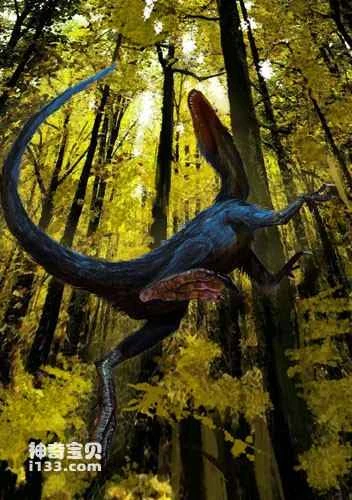
Chinese name: Sinosauropteryx
Latin name: Sinosauropteryx
Era: Early Cretaceous
Fossil origin: Liaoning, China
Physical characteristics: 1.3 meters in length
Diet: Carnivorous
Type: Theropod
Definition: Bird-like dinosaurs from China