Viewers of Disney's animated blockbuster "Dinosaur" will surely remember the two ferocious carnivorous dinosaurs. They moved stealthily through the rocky forest, hunting down weakened herbivores. The scene where they appeared during a storm was truly terrifying; the stark white lightning illuminated their red skin, and their short horns added to their imposing presence.
The ferocious beast featured in this film is the Carnotaurus, a well-known theropod dinosaur that lived in South America during the Late Cretaceous period. It was a giant predator at the top of the food chain in the local biosphere. Carnotaurus fossils have been discovered in many locations in South America, particularly in Patagonia, Argentina, where the skeletons are remarkably complete, some even preserving skin imprints, suggesting that its scales must have been quite magnificent in life.
Carnotaurus had a massive head, with a striking pair of prominent bony, horn-like appendages above its eyes. What was the purpose of such adornment? Opinions have long varied. The prevailing theory is that these horns, besides serving as a mark to intimidate rivals during mating, might have been used in competition for mating rights, similar to horn-butting among modern herbivores. Furthermore, these horns were also extremely important weapons against powerful predators.
Carnotaurus was as long as three small cars. Its skull structure indicates well-developed head muscles, but its jaw and lower jawbone were not as strong as those of other giant carnivorous dinosaurs. Some paleontologists even believe that such a lower jaw would not only make it difficult to compete and fight with other ceratopsians, but would also make it difficult to hunt large herbivorous dinosaurs. Surprisingly, although Carnotaurus had a huge mouth, its teeth were small and closely spaced. This strange feature has led paleontologists from various countries to speculate extensively about its lifestyle.
Besides its unusual teeth, the Carnotaurus's forelimbs were also peculiar. Compared to its enormous size, the forelimbs were pitifully small and extremely underdeveloped. Even the Tyrannosaurus Rex, known for its short forelimbs, was stronger than them. Therefore, many people who saw it for the first time thought that these extremely short claws grew directly from the elbows. However, the Carnotaurus's two long and powerful hind legs made it much more agile than some other large carnivorous dinosaurs. It could pounce on its prey quickly and seize them before they could react.
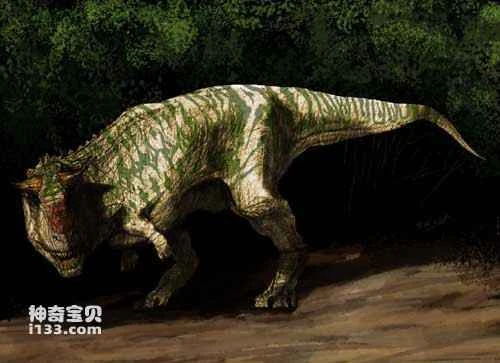
Chinese name: Carnivorous Carnotaurus
Latin name: Carnotaurus
Age of existence: Late Cretaceous
Fossil origin: South America
Physical characteristics: 7.5 meters long
Diet: Carnivorous
Type: Theropod
Definition: A lizard that resembles a cow.