Giganotosaurus was a giant theropod dinosaur. Initially, paleontologist Coria estimated its length at around 12.8 meters, comparable to the largest known Tyrannosaurus rex, "Sue." However, the subsequent discovery of another Giganotosaurus with an even larger lower jawbone suggested a total length of 14.3 meters, a skull length of 1.8 meters, and a weight of 8 tons, rightfully claiming the throne of theropod dinosaurs. Compared to Tyrannosaurus rex, while Giganotosaurus was larger, its teeth were much smaller. Tyrannosaurus rex had large, thick, banana-shaped teeth capable of easily biting through bones; Giganotosaurus's teeth were thinner, like sharp knives, excellent for cutting. Coria speculated that when hunting, Giganotosaurus only needed to take a large, decisive bite to its prey to bleed it to death.
Recently, paleontologists combined the biomechanics and paleontology of vertebrates, and by studying the femur strength and movement of Giganotosaurus, from its body's recovery from a swinging state to a balanced state, and the range of motion allowed by its hip joint, they concluded that Giganotosaurus's fastest speed was 14 meters per second, or about 50 kilometers per hour.
So, how was this terrifying monster discovered? In July 1987, amateur prospector and fossil hunter Carlolini was driving a rented, dilapidated car, searching for fossils in the sand dunes of the lower Limai River area. Unfortunately, the old car suddenly broke down, forcing Carlolini to get out and fiddle with it. Inadvertently, he spotted a huge bone protruding from the ground nearby. Carlolini was overjoyed, believing it to be the same creature as Argentinosaurus, since Heredia's ranch wasn't far from the area.
After repairing his car, Carolini unearthed the fossil in one go and took it to the National University of Comayor to find paleontologists Salgado and Coria, requesting them to identify it. The paleontologists were overjoyed at first glance; before them lay a fossilized theropod dinosaur tibia—the enormous carnivorous dinosaur they had dreamed of had actually delivered itself to their doorstep. That very day, Carolini brought the three paleontologists to the fossil site, and they quickly began the formal excavation.
In 1995, Coria and others named the skeletons "Giganotosaurus kauri," dedicating the species name to Carolini in gratitude. At a press conference, Coria declared that Giganotosaurus was likely the largest known theropod dinosaur, possibly exceeding the size of the Tyrannosaurus Rex of North America.
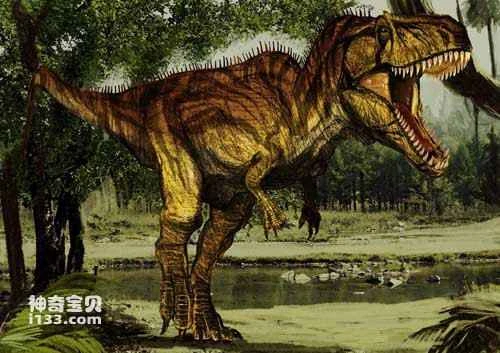
Chinese name: Giganotosaurus
Latin name: Giganotosaurus
Era: Early Cretaceous
Fossil origin: Argentina
Physical characteristics: 13.5–14.3 meters in length
Diet: Carnivorous
Type: Theropod
Meaning: The giant lizard of the south