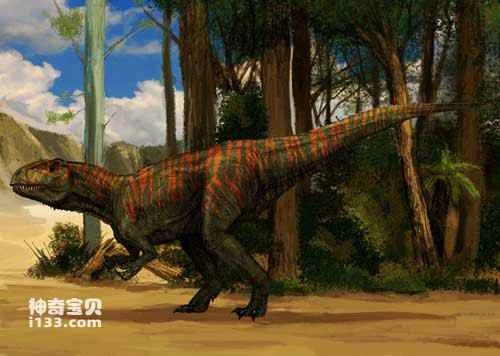
Allosaurus (also known as Fragile Allosaurus), which lived in the Late Jurassic period, was the largest carnivorous dinosaur of its time. They were 12 meters long, 5 meters tall, and some weighed over 1.4 tons. They walked on two tall, robust hind limbs with three clawed toes on each foot, a three-toed structure somewhat resembling a bird's foot. Allosaurus had a thick, long tail, but relatively short forearms. If two adults stood on each other's shoulders, the person on top could just see the teeth in Allosaurus's mouth, a testament to its immense size.
Allosaurus individuals exhibit significant variation, with most known individuals ranging from 7 to 10 meters in length, though some reaching up to 12 meters. Syn-Allosaurus was particularly large and robust, potentially weighing 3 to 5 tons, more than twice the weight of a typical Allosaurus. Mega-Allosaurus may have been even larger, with some speculating its length reaching nearly 14 meters. Others argue that Mega-Allosaurus's cervical vertebrae differed from other Allosaurus and classify it as a separate genus, "the largest sauropod." Still others believe this individual conforms to the growth patterns of Allosaurus and should not be classified into its own genus. The classification of the largest Allosaurus requires further research. Additionally, some fossils discovered in Australia have also been classified under the genus Allosaurus, dating approximately 45 million years later than their North American counterparts. It is possible that a branch of Allosaurus reached the southern continent and persisted until the Early Cretaceous.
Although the famous Tyrannosaurus Rex was larger than Allosaurus, Allosaurus possessed stronger, more robust forelimbs, better suited for hunting herbivorous dinosaurs. Each hand had three fingers with sharp claws, each measuring 15.2 centimeters in length. Therefore, some paleontologists believe that Allosaurus was the most powerful carnivorous dinosaur in Earth's history.
Like other theropod dinosaurs, Allosaurus's skeleton exhibited a light, hollow structure reminiscent of birds. Allosaurus had a large head, 91.4 centimeters long, whose skull was composed of several separate, interlocking modules, allowing it to easily swallow large chunks of meat. Furthermore, the most prominent feature of Allosaurus's head was the pair of symmetrical horns growing between its eyes.
Allosaurus was a ferocious predator, and they often hunted in packs. With its massive jaws, powerful hind legs, and robust tail, Allosaurus could easily sweep away any prey. However, fresh prey wasn't always readily available for Allosaurus, so they sometimes ate the carcasses of animals killed and eaten by other carnivores.
Chinese name: Allosaurus
Latin name: Allosaurus
Age of existence: Late Jurassic
Fossil origin: North America, Australia
Physical characteristics: 12 meters long
Diet: Carnivorous
Type: Theropod
Meaning: A lizard that is different from others