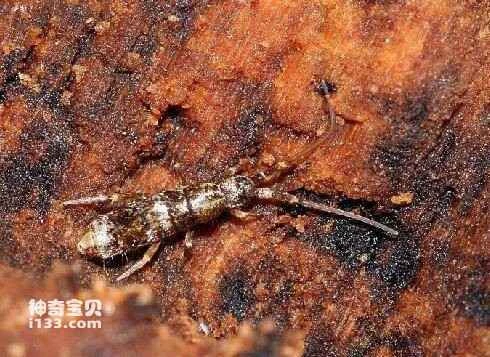
The oldest insect fossil is a wingless collider found in Middle Devonian strata dating back 350 million years. This insect's body is clearly divided into three parts: head, thorax, and abdomen. The presence of the thorax, the center of locomotion, clearly represents the birth of this new type of arthropod. Another primitive wingless insect called *Tailsaurus* was found in Carboniferous strata, but it was initially recorded as a crustacean until 80 years later in 1958 when it was recognized as a primitive insect. At that time, the Soviet scientist Shanov found a similar species in Permian strata near Moscow; these fossils are very similar to modern *Tailsaurus*. Later, scientists discovered more insect species in Early Carboniferous strata in Mexico and Permian strata in Europe, some very small, others exceeding 30 millimeters in size.
What animals did these primitive insects evolve from? Scientists speculate that the hypothetical ancestor of insects was a worm-like animal with isomorphic body segments, each segment having a pair of appendages. During the evolution of this ancestor into insects, the anterior segments merged and fused to form the head, and the appendages on these segments evolved into antennae and mouthparts. The three segments immediately following the head remained independent, but each segment developed a pair of powerful locomotor organs—legs—and later two pairs of wings, forming the locomotion center of the insect's thorax. The segments at the back of the thorax changed little, but the appendages generally degenerated, with only the appendages on the last abdominal segment evolving into cerci and ovipositors.
Tracing the hypothetical ancestors of insects further back, scientists believe their origins can be traced back to an ancient group of terrestrial arthropods. Arthropods existed on Earth as early as the Precambrian period, approximately 1 billion years ago. Initially, they lived in shallow seas distributed along coastlines. Later, they evolved in two opposite directions: one group ventured into the open ocean and deep seas, evolving into the crustaceans such as shrimp and crabs that are so abundant in modern oceans; the other group left the ocean to explore entirely new, unclaimed terrestrial ecosystems, evolving into the myriapods such as centipedes and centipedes, as well as spiders such as spiders, scorpions, and ticks, and insects that are ubiquitous today, ultimately successfully conquering the arid land. Among them, insects, from their very emergence, displayed extremely strong vitality, rapidly developing on Earth.