Fossil evidence suggests that the earliest winged insects appeared in the Late Carboniferous period, approximately 300 million years ago. At that time, tall, dense forests covered the land, but the tree species were completely different from modern trees. They were mainly tropical ferns, such as horsetails, lycophytes, and various woody ferns. Modern ferns are small plants, but in the distant Paleozoic era, ferns could grow into towering trees, some reaching heights of up to 40 meters.
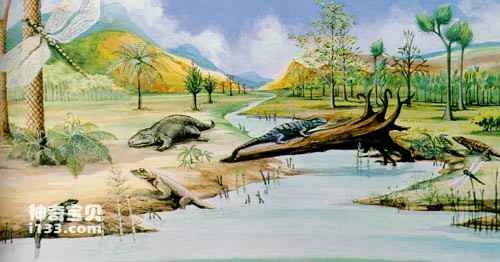
Carboniferous landscape
Winged insects emerged in this environment. They flew in swarms through the forest, and their species quickly became more and more diverse. In fact, these tall trees were the very environment in which insects acquired their wings, because only after insects climbed trees and adapted to arboreal life did they have the need and the possibility to develop wings.
Although the earliest fossils of winged insects were discovered in the Late Carboniferous period, various facts suggest that the origin of winged insects occurred in the Late Devonian or Early Carboniferous period. The presence of coal seams in Devonian strata indicates the existence of forests at that time. Insects living in these forests initially used their lateral thoracic projections to glide between trees; then, through natural selection, these projections gradually expanded generation after generation, allowing insects to glide farther and farther. Finally, these projections evolved into wings capable of free flight.
The development of wings was one of the most important events in the evolutionary history of insects. The emergence of wings brought about significant changes in the structure of the insect's thorax, muscular system, and the entire organism, spurring the development of the nervous system and signifying the increasing complexity of insect behavior. The acquisition of wings enabled insects to adapt to a wider variety of environments, thus opening up a broader living space. With the aid of flight, insects could disperse, migrate, mate, forage, and evade predators over a wider area. At that time, amphibians had already moved onto land, and winged insects could more effectively escape the predation of amphibians, scorpions, and spiders. All of this laid a solid foundation for the subsequent flourishing and development of the insect class.
In the evolutionary history of life on Earth, insects were the first animals to acquire the ability to fly, at least 50 million years earlier than reptiles and birds. Remember, the Earth is vast...