In the early Eocene, a small animal called *Archaeodon* diverged from the tarsiers. Its talus, in addition to having a proximal trochlea similar to that of perissodactyls, also had a distal trochlea-like structure instead of being flat. This double-trochlea talus laid the foundation for a more advanced ungulate—the even-toed ungulates. In the years that followed, even-toed ungulates diversified into a vast and diverse family divided into five major groups: *Palaeodontia*, *Curculodontia*, *Sus*, *Gymnopoda*, and *Ruminants*.
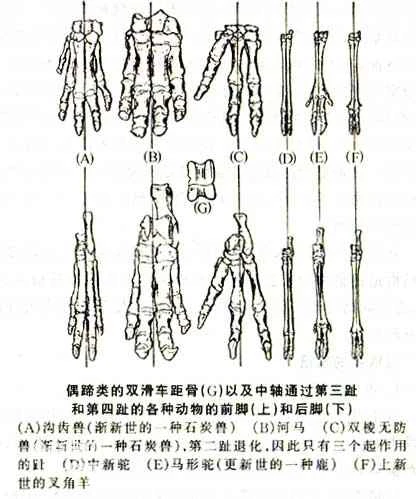
Even-toed ungulate foot bones
Most modern ungulates belong to the even-toed ungulates, named so primarily because they have an even number of toes on both their fore and hind feet—two or four. Furthermore, the central axis of their foot passes between the third and fourth toes, and their body weight is distributed on these two toes. Compared to the declining odd-toed ungulates, even-toed ungulates remain vibrant and prosperous, mainly thanks to a series of advanced traits they possess.
Even-toed ungulates have two trochlear surfaces on their talus, allowing for greater freedom of extension and flexion of the hind limbs, thus making them better at jumping than perissodactyls. In later-appearing, more advanced even-toed ungulates, the ulna and radius of the forelimb are often fused, and the fibula of the hind limb is often reduced to a small piece attached to the tibia; the metacarpals and tibiae of the third and fourth toes are also often fused into a canthus. Furthermore, even-toed ungulates lack a third trochanter on the lateral side of the femur, unlike perissodactyls. These characteristics all contribute to their mobility.
The success of even-toed ungulates is largely due to advancements in their digestive systems. On one hand, their teeth have diversified into a wide range of patterns, from low-crowned to high-crowned, and from mound-shaped to mound-lunate to crescent-shaped, allowing different even-toed ungulates to adapt to a diverse diet, ranging from omnivorous to herbivorous, and from feeding on tender leaves to consuming hard grasses and hay. On the other hand, these advanced even-toed ungulates—the suborders of Gynostemma and Ruminants—developed compartmentalized stomachs. After being bitten by teeth, plant matter first enters the rumen and reticulum, where it is digested into soft masses and partially broken down by symbiotic bacteria. These masses are then regurgitated back into the mouth, thoroughly chewed, and re-swallowed into the omasum and abomasum for further digestion. This complex process allows Gynostemma and Ruminants to quickly swallow large amounts of plant matter in a short time, then slowly and thoroughly chew it in a safe place. In the late Cenozoic era, carnivores became more effective hunters due to their larger size or the development of social behaviors such as herding and hunting prey. At this time, the adaptations brought about by the ruminant behavior of advanced even-toed ungulates enabled them to be far superior to perissodactyls.