Although Andersson had noticed as early as 1921 some white, sharp-edged vein quartz fragments at the site where Peking Man fossils were later unearthed (later known as "Location 1"), and although such flakes were frequently found after large-scale excavations at Location 1 began in 1927, they did not receive enough attention because people's knowledge of stone tools was very limited at the time.
After the discovery of the first complete Peking Man skull, stone tools once again attracted people's attention. At the very site where that world-shaking skull was unearthed, Pei Wenzhong discovered a quartz block with signs of artificial percussion.
At the start of the excavation work in 1931, while clearing loose deposits on the ground in preparation for systematic excavation, a layer rich in quartz fragments and debris was discovered. In July, during the excavation of another site called "Pigeon Hall," another layer rich in quartz fragments was discovered.
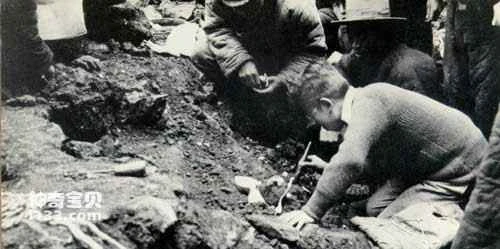
Jia Lanpo's excavation at Zhoukoudian
That year, Mr. Jia Lanpo joined the excavation team at Zhoukoudian. He was very interested in the quartz fragments and humbly learned excavation techniques from the technicians. His eagerness to learn not only enabled him to quickly master the excavation techniques but also continuously improved his research and organizational management skills. Coupled with his diligence and intelligence, he gradually grew from a general staff member who had never formally attended university into one of the most famous prehistoric archaeologists in China and even the world—in the 1980s, he became an academician of the Chinese Academy of Sciences; in the 1990s, he was appointed a foreign associate of the National Academy of Sciences of the United States. This was truly a miracle.
After careful research by Pei Wenzhong, Jia Lanpo, and many other Chinese and foreign scholars, it has been confirmed that these quartz stones are indeed stone tools—tools used by Peking Man when he conquered nature hundreds of thousands of years ago.
Most of the stone tools found in Zhoukoudian are small stone flakes. The raw materials were mainly river pebbles, which were common on the riverbanks outside the cave at that time and consisted of vein quartz, sandstone, quartzite, and flint. There were even crystals that could sometimes be found on granite hillsides several kilometers away.
The people of Peking used pebbles as hammers, employing different methods to break stone flakes depending on the raw material, and then used the pebble hammers for finishing. Sometimes they also used wooden sticks or sticks made of animal horn for finishing. The finishing method focused on one side, and most of the time they worked from the split side to the back.
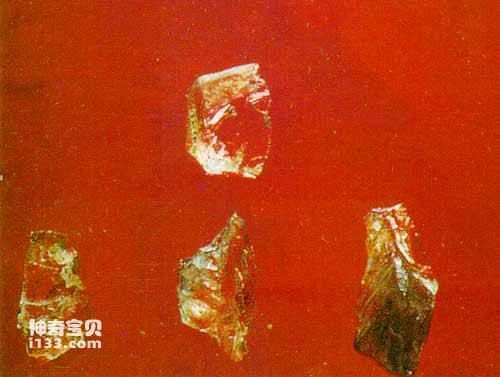
Scraper made by Peking Man
Peking Man's stone tools came in various types, each serving a different purpose. They used oval river pebbles, chiseling edges from one or both sides to create chopping tools for felling timber and making hunting clubs. They also crafted scrapers of various shapes (disc-shaped, straight-edged, convex-edged, concave-edged, and polygonal-edged) from stone flakes of different sizes. Large concave-edged scrapers were used for scraping hunting clubs, while smaller scrapers were used as knives in daily life. Among Peking Man's stone tools, the pointed tools were the most sophisticated. Although only about the size of a finger joint, their production process and methods were quite standardized, demonstrating a certain level of skill. Pointed tools could be used to cut and skin animal hides, remove tendons from bones, and even dig out insects burrowing into tree trunks.
Stone hammers and anvils were tools for making stone tools, much like hammers and anvils are used for blacksmithing. The marks left on the stone hammers indicate that Peking Man was right-handed, meaning they already exhibited right-handedness, suggesting that their brains had developed a left-right imbalance similar to that of modern humans.
These stone tools of various sizes and shapes demonstrate that our ancestors, Peking Man, had evolved to a considerably advanced stage of intelligence and mastered highly skilled stone toolmaking techniques. It is precisely because of this that they were able to continuously withstand the various trials of nature and ultimately develop step by step into an important part of the human family today—the yellow race (or Mongoloid race), including us Chinese.