Ladybugs are a general term for small, brightly colored beetles belonging to the family Coccinellidae in the order Coleoptera. They are often spotted with red, black, or yellow spots. Other names include "little fat lady," "matchmaker," "flower lady," "heavenly beetle," "golden beetle," and "golden beetle" (though "golden beetle" actually refers to another type of beetle). Some species are even colloquially called "stinky beetle" because their secretions have a foul odor (but this is also a misnomer). There are over 5,000 species of ladybugs worldwide, with more than 450 species inhabiting North America.
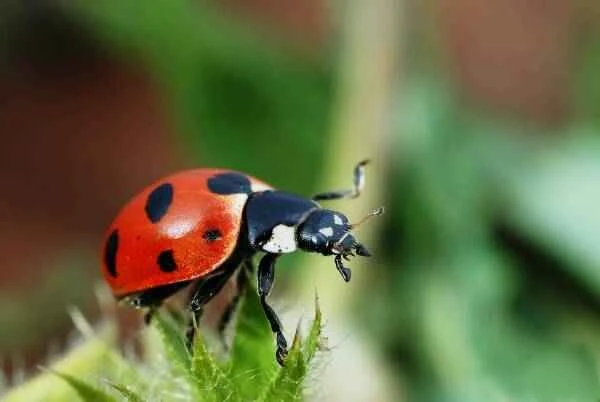
Adult ladybugs range in length from a few millimeters to 1 centimeter, with a hemispherical body shape and short legs and antennae. Their body colors are vibrant, including black, blue, red, orange, yellow, and brown, and the patterns vary depending on the species. However, the most common is the smooth-bodied, red-and-black seven-spotted ladybug. Despite their distinctive appearance, ladybugs are often confused with other insects. However, their behavior differs from that of other insects. This article investigates colorful insects that resemble ladybugs and how to distinguish them.
1. Cockroaches that mimic beetles
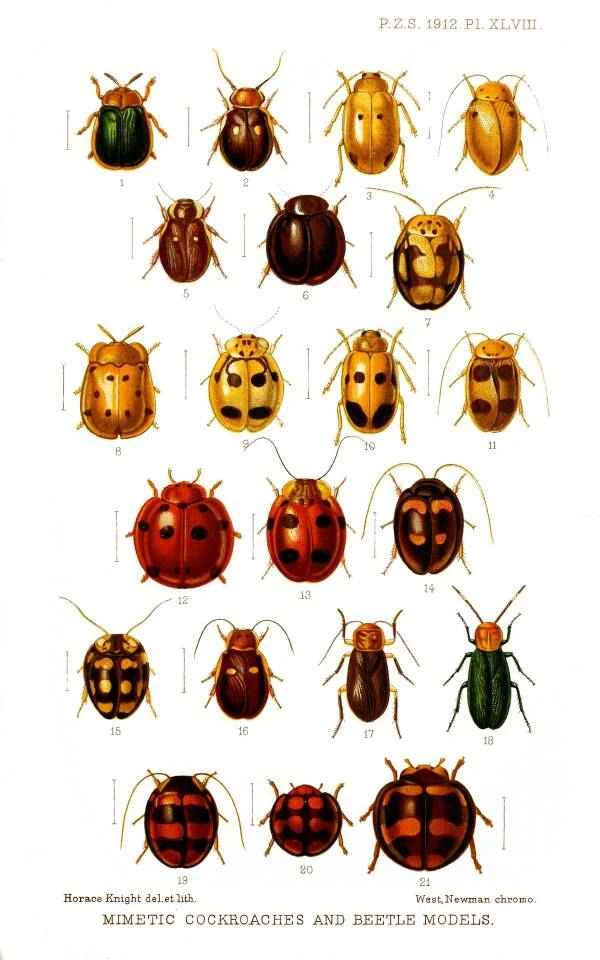
While many cockroaches are brown or black, some, particularly those in the genus *Prosoplecta*, resemble ladybugs. Like the seven-spotted ladybug, many *Prosoplecta* cockroaches have red bodies with black spots. Additionally, some Asian cockroaches in this genus have bright orange bodies similar to ladybugs.
2. Spiders that mimic ladybugs
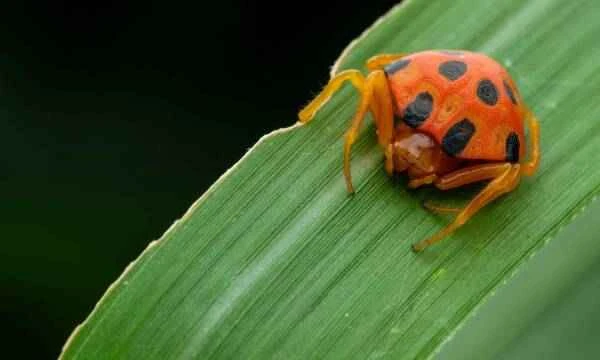
Ladybug spiders, such as the Tsushima ladybug, are also very similar to ladybugs. Their bodies are orange-red or yellowish-orange dome-shaped with black markings, while their heads are yellowish-orange and unmarked. Ladybugs, on the other hand, have black heads. Furthermore, while most ladybugs have black legs, these ladybug-mimicking spiders have yellowish-orange legs.
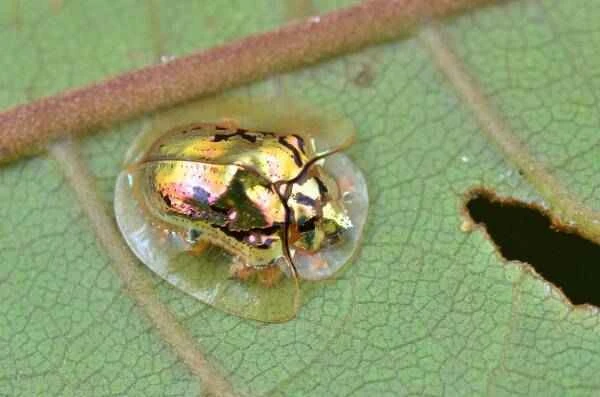
3. Golden Tortoise Beetle
The golden scarab beetle is a species of beetle in the family Chrysomelidae. These beetles are named for their mirror-like golden bodies, but they can also be reddish-brown with black spots. They are very similar in shape and size to ladybugs. Their distinctive golden color changes depending on their environment. For example, they may turn reddish-brown during mating. Color changes can also be observed when these beetles ingest water or sense danger.
4. Spotted tortoise beetle
The mottled tortoise beetle is another species in the family Chrysomelidae. Unlike ladybugs, these beetles do not have a dome-shaped body. Their similarities are usually associated with their small heads and the striped markings on their shiny golden backs. Mottled tortoise beetles are common in Central and North America.
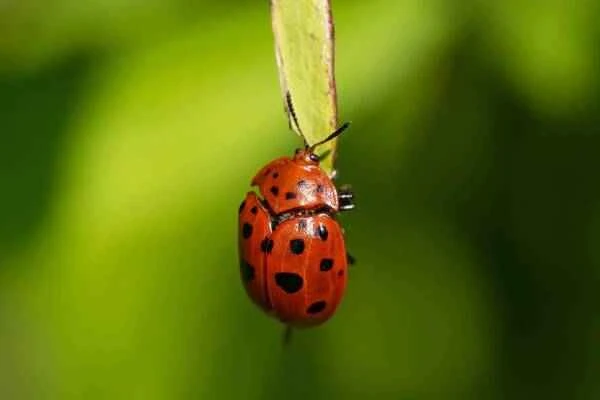
5. Argus tortoise beetle
The Argus beetle, also known as the milkweed beetle, is a species of leaf beetle in the family Chrysomelidae. Its name comes from Argus Panoptes, a multi-eyed creature from Greek mythology. Native to North America, it is one of the largest leaf beetles, known for its yellowish-red or deep yellow body with black spots on its back. The Argus beetle's body shape, size, and dorsal markings are very similar to ladybugs. However, the Argus beetle can extend its head like a turtle, which distinguishes it from ladybugs.
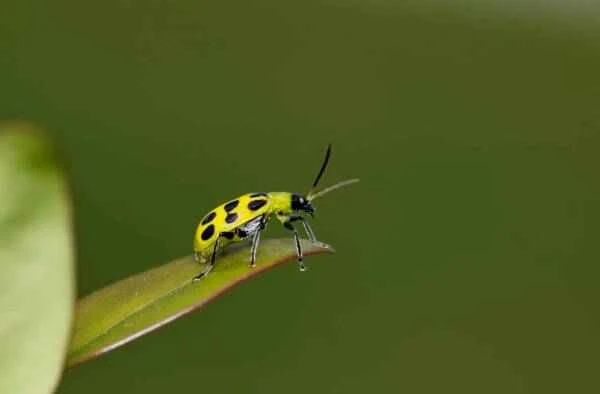
6. Spotted cucumber beetle
The spotted cucumber beetle resembles the yellow ladybug, being yellowish-green with black spots. Its small black head further mimics the body features of most ladybugs. However, unlike the dome-shaped ladybug, the spotted cucumber beetle rarely grows longer than 0.2 inches. In contrast, some ladybug species can reach 0.7 inches in length.
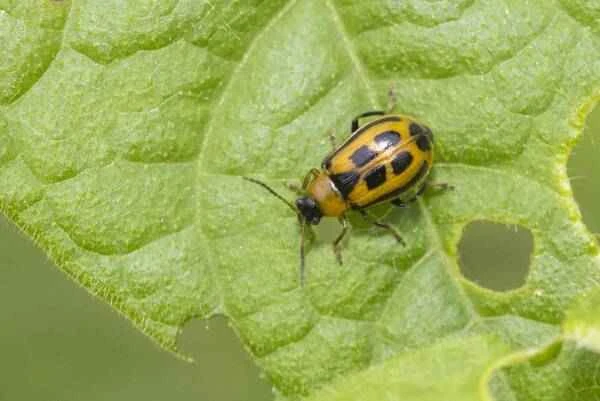
7. Bean leaf beetle
The bean leaf beetle is a species of beetle in the family Chrysomelidae, commonly found in legume, alfalfa, and soybean crops. It has golden and black spots, which is why it is often confused with many ladybug species. The bean leaf beetle has four black spots on its back, and there is also a spotless variant. However, unlike ladybugs, whose heads are usually spotted, the bean leaf beetle's head is always black.
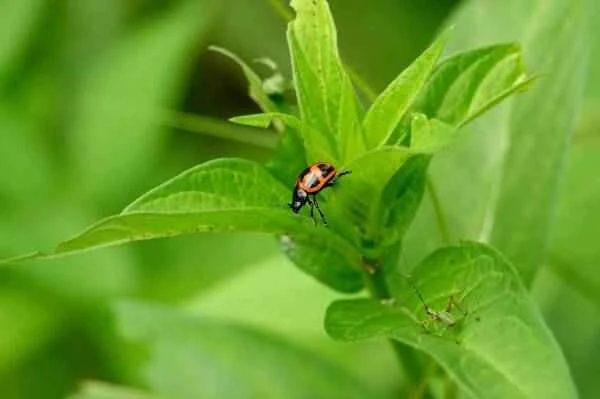
8. Swamp milkweed leaf beetle
The swamp milkweed leaf beetle is another leaf beetle in the family Chrysomelidae. Due to its similar dome-shaped body and orange or red and black spots, it is often confused with the red ladybug. Furthermore, the swamp milkweed leaf beetle and the ladybug are similar in size.
However, upon close inspection, you can distinguish between the two species by observing their black markings. Most swamp milkweed leaf beetles have much larger spots than ladybugs.
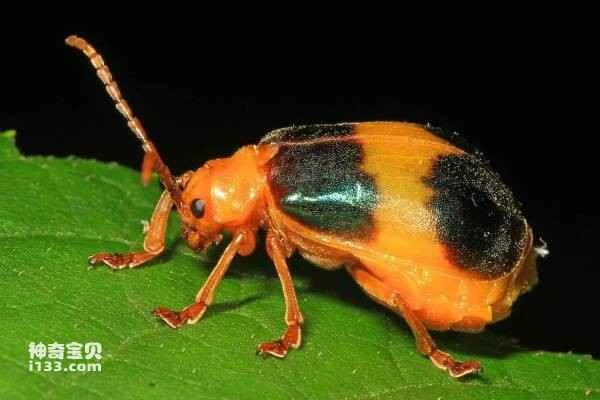
9. Larger elm leaf beetles
The larger elm leaf beetle is the only species of the genus *Monocetus* found in the United States. It is commonly found in forests. Like ladybugs, this species has a yellow-orange body and four large black markings. Although they are similar in shape to ladybugs, the larger elm leaf beetle is more pear-shaped than dome-shaped.
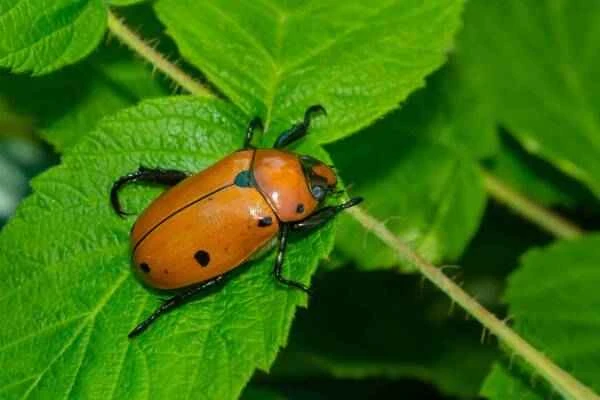
10. Grape beetle
The grape beetle, also known as the spotted June beetle or spotted grape scarab beetle, is a ladybug-like scarab beetle. It is grayish-yellow with four small black markings on each side. Like most ladybugs, the grape beetle also has entirely black legs.
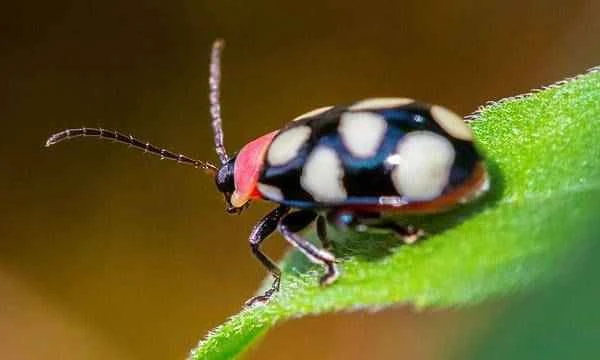
11. Eight-spotted flea beetle
The eight-spotted flea beetle is a small insect belonging to the Chrysomelidae family, commonly found in North America, Central America, and the Caribbean. Its body is black with white spots, almost resembling a ladybug. Furthermore, like most ladybugs, the eight-spotted flea beetle has a spot on its head, usually with only one white mark. Also, its body is longer than that of the dome-shaped ladybug.