Whales, the giants of the ocean, are hailed as the largest mammals on Earth. Their enormous length and weight are incredible. So, do you know which whales are the largest in the world? This article will list the top ten giant whale species: blue whale, fin whale, bowhead whale, right whale, sperm whale, humpback whale, gray whale, sei whale, killer whale, and banded whale. It's worth noting that the blue whale is not only the largest whale but also the largest animal in the world, the largest known mammal on Earth. So how big are the other whales? Let's find out!
1. Blue whale (33 meters)
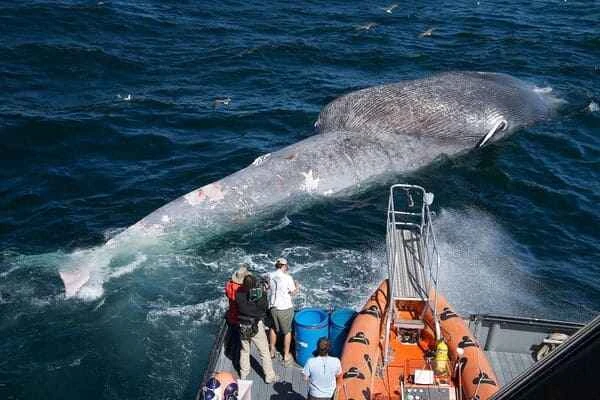
Blue whale that died in a ship collision
The blue whale is not only a giant among whales, but also the largest living animal, and the largest known mammal. Its body length typically ranges from 22 to 33 meters, and its weight is approximately 150,000 to 180,000 kilograms. To put it simply, its weight is equivalent to the combined weight of 25 African elephants, or the combined weight of 2,000 to 3,000 people. The sheer size of the blue whale is unimaginable; its tongue alone weighs 2,000 kilograms, its skull about 3,000 kilograms, its liver about 1,000 kilograms, its heart about 500 kilograms, and its circulatory volume a staggering 8,000 kilograms.
2. Fin whale (25 meters)
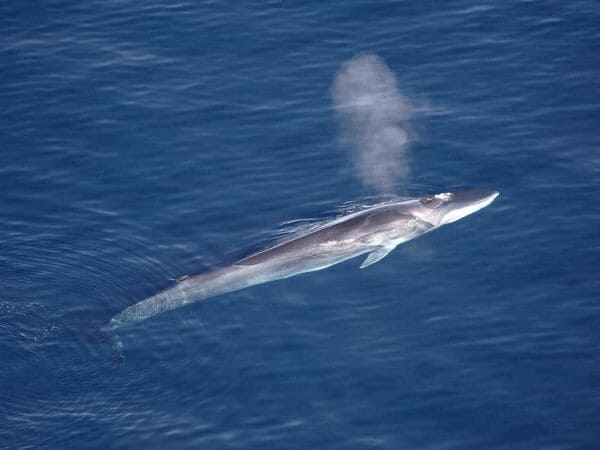
The fin whale, also known as the long-finned whale, is an aquatic mammal belonging to the genus *Baltic whales*. It is the second largest whale in the world and the second largest living animal after the blue whale. Fin whales have a spindle-shaped body, averaging about 25 meters in length and weighing about 70 tons. The largest individuals, both females and males, can reach a length of 26.8 meters and a weight of 86.1 tons. In comparison, the average length of females caught in China is 20.3 meters, and the average length of males is 18.4 meters. Fin whales typically live alone or in groups of two to three, migrating to colder waters to feed in the summer and moving to warmer waters to breed in the winter. They are mainly distributed in the Antarctic Ocean.
3. Bowhead whale (21 meters)
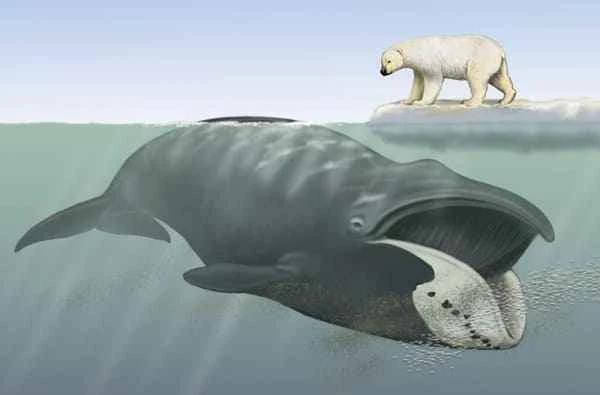
Bowhead whales are approximately 21 meters long and weigh up to 190,000 kilograms, with females being larger than males. They are dark-colored, lack a dorsal fin, have a narrow upper jaw, and an arched lower jaw. Bowhead whales possess baleen plates up to 3 meters long, among the longest of their kind. They use these baleen plates to filter small animals from the water, and they often reflect a green fluorescence in sunlight. Bowhead whales have powerful voices used to communicate with each other during migration, foraging, and socializing. Some of their long, repetitive calls may be among their mating signals. Some individuals can even live to be 150 to 200 years old.
4. Right whale (18 meters)
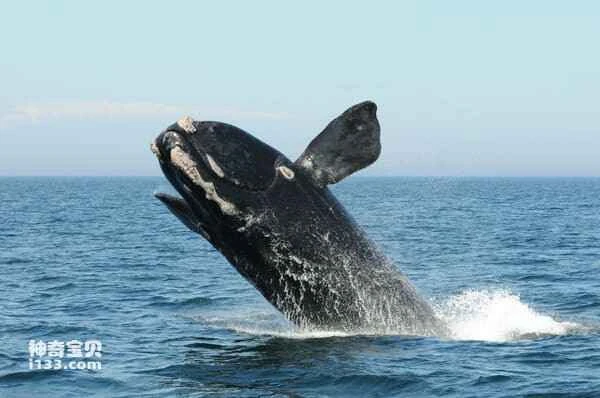
Right whales are a group of cetaceans belonging to the order Cetacea, suborder Baleen whales, and family Right whale family. They have a spindle-shaped body, a smooth, hairless surface, and adults can reach up to 18 meters in length and weigh up to 100 tons. Their bodies are mostly black, with a distinctive hardened skin on their heads, giving them a rough, spotted appearance. Right whales are large, with short, stout bodies and heads slightly more than a quarter of their body length. Their baleen plates are very long and soft, with 220 to 260 plates on each side, reaching up to 2.9 meters in length; both the plates and the baleen hairs are black. Right whales are mainly distributed in the Pacific and Atlantic Oceans, and can also be found in the South China Sea, East China Sea, and Yellow Sea of China.
5. Sperm whale (18 meters)
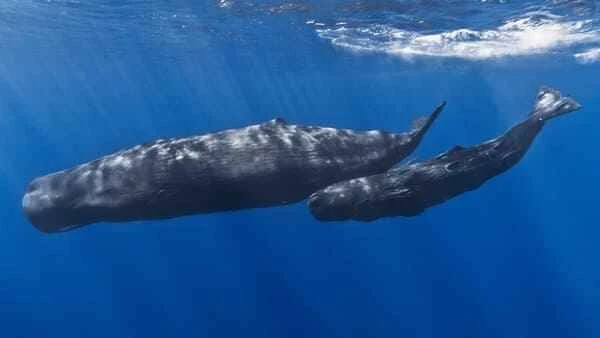
Sperm whales are massive toothed whales, reaching lengths of up to 18 meters and weighing over 50 tons. Their body structure is characterized by an exceptionally heavy and broad head relative to their body, possessing the largest brain in the animal kingdom, while their tail is relatively light and small, giving them a shape resembling a giant tadpole. This proportion makes them unique and striking in appearance. Sperm whales are widely distributed in ice-free waters worldwide, from the equator to the polar regions. They possess exceptional diving abilities, holding the record for the deepest and longest dives among mammals.
6. Humpback whale (18 meters)

Humpback whales, while not the largest whales in the world, are still enormous and imposing in the ocean. They are massive and stout, with adult males averaging about 12.9 meters in length and females about 13.7 meters, the largest recorded female reaching 18 meters, and weighing between 25 and 30 tons. Humpback whales are renowned for their breaching maneuvers, exceptionally long forepaws, and complex calls. They typically live in pairs or in single-person groups, are docile, and prefer migratory migrations, although they are relatively slow swimmers. Their primary diet consists of small crustaceans and schooling small fish. They inhabit the world's major oceans, including the Yellow Sea, East China Sea, and South China Sea.
7. Seychellois (15-16 meters)
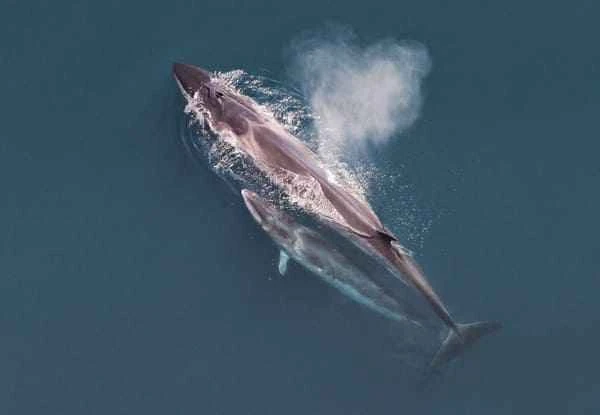
Seywhales have slender, streamlined bodies, measuring approximately 15 to 16 meters in length, with their heads about a quarter of their body length. Seywhales in the Southern Hemisphere can reach a maximum length of 20 meters, while the largest individuals in the North Pacific reach 18.6 meters. Their body shape is similar to fin whales, Bryde's whales, and pygmy Bryde's whales, and their dorsal fins are also similar in shape. The main distinguishing feature is the prominent longitudinal ridge along the center of the seywhale's head, while fin whales lack this ridge, and Bryde's whales have three longitudinal ridges. Seywhales are oceanic whales and are not commonly found in nearshore waters. They are distributed throughout both the Southern and Northern Hemispheres, from tropical to polar regions, but are more frequently found in mid-latitude temperate waters compared to other baleen whales.
8. Gray whale (10-15 meters)
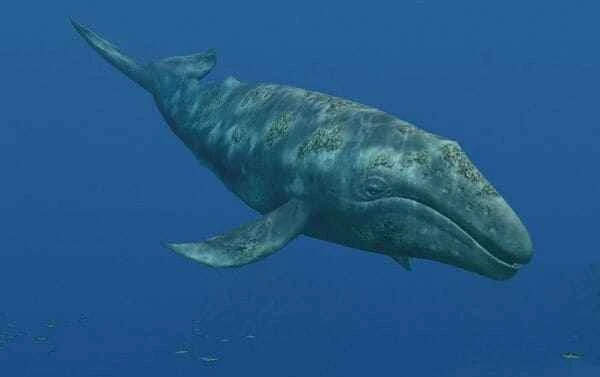
Gray whales belong to the family Gray Whaleidae within the suborder Baleen Whales of the order Cetacea. They are larger than other species in the Baleen Whale family, but smaller than right whales. Adult gray whales are approximately 10 to 15 meters long (females are slightly larger than males), and can weigh over 35 tons. Their bodies are spindle-shaped, with a relatively thick torso, most robust near the flippers, tapering towards the tail. Juvenile gray whales are dark gray, while adults are brownish-gray to light gray. Their bodies are covered with light-colored spots, as well as white to orange-yellow patches formed by whale lice and barnacles. These patches formed by ectoparasites are one of the distinctive features of gray whales.
9. Banded whale (10 meters)

The banded whale is a baleen whale, approximately 10 meters long and weighing about 7 tons. They are slender and the smallest of the baleen whales, with a total population of about 200,000. Banded whales exhibit north-south migration, typically migrating to lower latitude waters in winter and spring, and to higher latitude waters in summer and autumn to forage. They prefer to swim alone or in groups of two to three, generally not forming large groups. Banded whales swim at a speed of approximately 5 to 7 knots. The plume of breath they exhale is small and low, generally only 1.5 to 2 meters high, and their tails do not surface when diving. Their main diet consists of planktonic crustaceans such as krill and mysids, as well as some small, schooling fish.
10. Killer whale (8-10 meters)
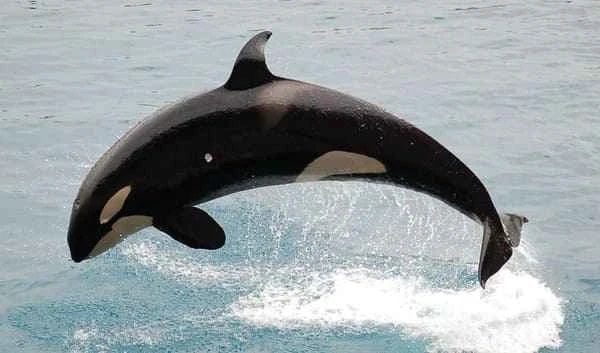
Orcas are large toothed whales belonging to the dolphin family, measuring approximately 8 to 10 meters in length and weighing around 9 tons. They are among the largest species in the dolphin family, with a slightly rounded head and no prominent beak. Orcas are highly social animals, forming family groups considered one of the most stable family forms in the animal kingdom. They exhibit a range of complex social behaviors, hunting techniques, and vocal communication, all considered evidence of a unique culture. Orcas are widely distributed, found in almost all ocean areas, from the equator to polar waters.
The ranking of the world's ten largest whale species was compiled by referencing relevant websites, collecting information on various whale species, and organizing their body length and weight data, then sorting them according to body length. This ranking is for reference only; if you have any questions, please feel free to comment or offer criticism at the end.