Dinosaurs are a group of ancient creatures that were widely distributed during the Jurassic and Cretaceous periods. Based on their biological characteristics and evolutionary history, dinosaurs can be divided into several families, genera, and species. The following is a detailed introduction to dinosaur classification:
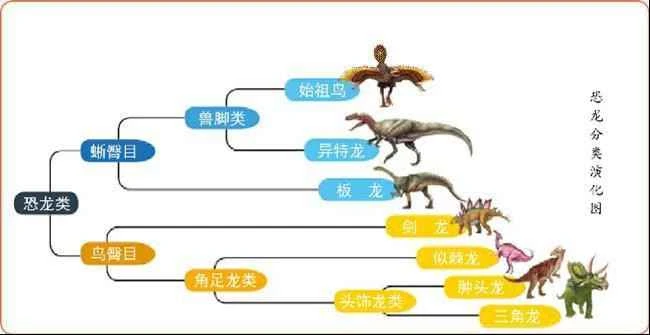
Category hierarchy
Phylum : Chordata
Class : Reptilia
Subclass : Diapsida
Group : Dinosauria
Main classifications of dinosaurs
Saurischia and Ornithischia
Saurischians : Distinguished from ornithischians by their hip bone features, including sauropod dinosaurs and theropod dinosaurs.
Sauropod dinosaurs : such as Diplodocus and Stegosaurus.
Theropod dinosaurs : such as Tyrannosaurus Rex and Tyrannosaurus Rex.
Ornithischians : Distinguished from archosaurs by their hip bone features, including ankylosaurids and hadrosaurids.
Ankylosaurs : such as Tetanurae and Triceratops.
Hadrosaurid dinosaurs : such as hadrosaurs and brachiosaurs.
Genus and species
Dinosaurs are further divided into different genera and species, each with its own unique scientific name and characteristics.
For example
Tyrannosaurus Rex :
Scientific name: Tyrannosaurus rex
Classification: Belongs to the archosauroid theropod dinosaurs.
Introduction: Tyrannosaurus Rex is one of the most famous theropod dinosaurs, living in the Late Cretaceous period.
Triceratops :
Scientific name: Triceratops
Classification: Belongs to the ornithischian group, ankylosaurs.
Brief introduction: Triceratops was a large herbivorous dinosaur with a triangular head shield and horns.
Evolution and Classification Revision
Paleontologists and paleontologists continuously revise and evolve the classification of dinosaurs based on new fossil discoveries, research techniques, and theoretical frameworks. Therefore, the classification system for dinosaurs is constantly being updated to reflect a deeper understanding of these ancient creatures.
These classification systems not only contribute to our understanding of dinosaur biology, but also provide researchers with a framework for analyzing dinosaur diversity, evolution, ecology, and other aspects.