Quick Tips
Despite their tiny size (their mantle is usually no larger than a golf ball), they carry tetrodotoxin (TTX) , which is about a thousand times more toxic than cyanide .
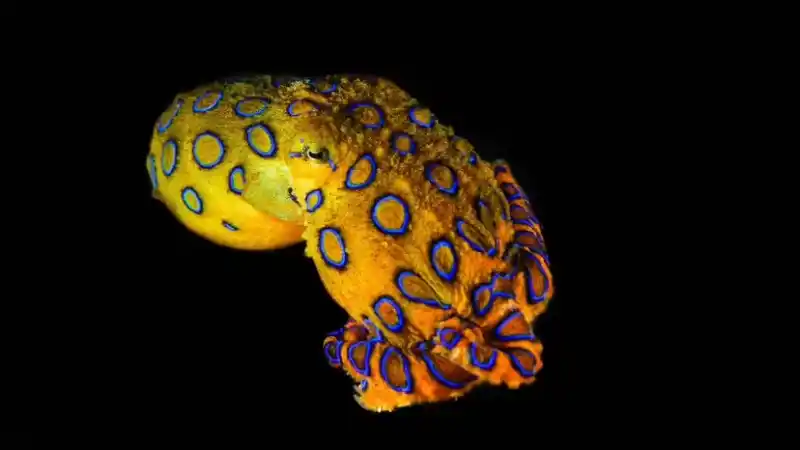
When threatened, it will flash an electric blue ring as a warning. It usually hides in tide pools, shallow waters of coral reefs, crevices in sandy and muddy bottoms , and shells.
They mainly feed on small crustaceans (crabs and shrimp), have a lifespan of about two years , are mostly active at night, and are wary.
Bites are rare but extremely dangerous : flaccid paralysis and respiratory arrest can occur within minutes, and there is currently no specific antivenom .
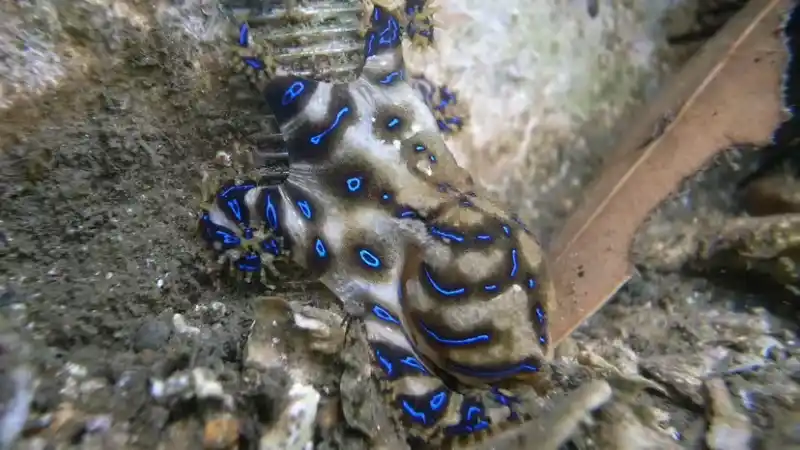
Four closely related species ( Hapalochlaena ) have been identified, including the "blue-lined octopus," which is similar in appearance and also highly toxic.
1. Getting to know the blue-ringed octopus: Small yet "dazzling"
Distribution : Widely found in the shallow waters surrounding Australia, Indonesia, the Philippines, the Solomon Islands, Japan, and South Korea in the Indo-Pacific region.
Habitat : Prefers shallow waters of tidal pools and reef areas with sandy or muddy bottoms ; mostly hides during the day and goes out at night to find food or mates.
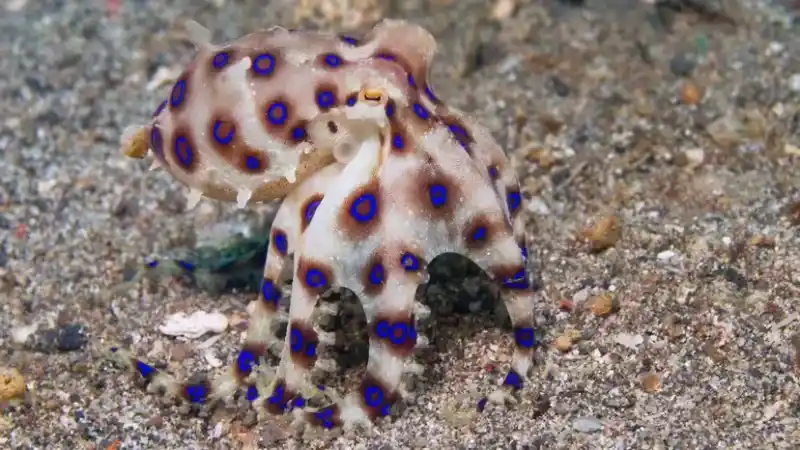
Distinctive features : Normally, the body color is yellowish-brown; when stimulated or stressed, the blue rings on the body surface brighten instantly, exhibiting a high-contrast warning color .
Lifespan and growth : Generally about 1.5–2 years ; short life history and rapid regeneration.
2. Toxicity and Danger: Why They Are "Deadly"
Tetrodotoxin (TTX)
Mechanism : Blocking voltage-gated sodium ion channels prevents nerve impulse transmission, resulting in flaccid paralysis .
Target : It does not directly damage the myocardium, but it paralyzes the diaphragm and respiratory muscles , leading to hypoxia .
The reason for carrying the toxin is that it is not synthesized by the octopus itself, but mainly produced by symbiotic bacteria in the salivary glands ; the larvae already have toxicity in the egg, and the acquisition of the toxin source and its intergenerational transmission are still frontiers of research.
Risk warning : Blue-ringed octopuses are mostly shy and will give warning signs first (the blue rings will brighten), and they rarely bite people unless provoked ; most accidents are caused by accidental touching, playing with, or teasing .
3. What happens if you get bitten? Emergency treatment procedure.
Infiltration - Progress
Within minutes : numbness of the lips/extremities, dizziness, double vision/blurred vision, slurred speech, and difficulty swallowing; followed by general weakness and flaccid paralysis .
Respiratory risks : Diaphragmatic paralysis, respiratory arrest can occur within minutes to more than ten minutes; consciousness is mostly preserved , but speech or movement is impossible .
Duration : Symptoms may last 12–48 hours ; there is no specific antitoxin , but survival is good with supportive treatment .
First-hand report from the beach/boat: How to save time
Immediately call for help and dial local emergency services ;
Stop further contact to avoid being bitten again;
Keep the airway open . If breathing is shallow, slow, or stops, immediately perform artificial respiration (mouth-to-mouth) or use a bag-valve-mask .
Continuous monitoring : consciousness, respiratory rate, pulse;
Immobilize the affected limb and restrict movement (the old-fashioned "pressure bandage + immobilization" method to slow toxin spread is controversial in neurotoxic animals; if you are not familiar with it, prioritize respiratory support ).
Continuous artificial ventilation during transport to the hospital until oxygen and mechanical ventilation can be connected.
Key point : TTX is a reversible blockade . Buying time equals saving lives . With continued oxygen and ventilation , most patients can fully recover after the toxic effects subside .
4. Ecology and Foraging: How Toxins Are Used in "Eating"
Diet : Juveniles mainly feed on small shrimp , while adults are good at catching small crabs/prawns ; they usually choose crustaceans that are similar in size to or smaller than their heads .
Predation strategies :
Close-range venom injection : Leap onto the prey from behind, bite open the carapace with the horny beak , and inject saliva containing TTX into the wound;
Water diffusion : Releases a toxic water mass near the prey, which is quickly absorbed through the gills, causing it to become paralyzed.
Risk control : When facing potentially harmful targets such as large crabs , minimize risks and implement a behavioral strategy of seeking advantage and avoiding harm.

5. Classification and Species: Not just "Blue Ring"
Confirmed members of the genus * Hapalochlaena * include:
Large blue-ringed octopus (H. lunulata ) (larger rings, slightly larger individuals, with a planktonic larval stage → wider dispersal, more dispersed populations);
Southern blue-ringed octopus ( H. maculosa ) ("small blue ring", hatching is "small adult" → it mainly spreads by crawling throughout its life, and the risk of inbreeding in local areas is higher).
Blue-striped octopus (H. fasciata ) (its body surface is mainly covered with blue stripes/bands , and it is also highly venomous);
H. nierstraszi (few records).
Key identification points : It's not only the "ringed" ones that are deadly— the blue-lined relatives are also highly dangerous venomous octopuses.
6. Safe Coexistence with Others: Self-Defense Techniques on the Beach and in Tidal Pools
Do not handle "pretty little octopuses," shells, or small mollusks in rock crevices with your bare hands ;
Take a photo as a souvenir, but keep a safe distance and do not use your hands to "invite it out";
When surveying tidal pools, it is recommended to wear wading shoes/gloves and gently place rocks back in place after turning them over.
Diving/Snorkeling: Avoid putting your hands into the cave with the back of your hands and forearms exposed ;
Home aquariums: Never illegally collect or keep wild blue-ringed octopuses;
Parenting tip: Classify it as a marine creature that is "only for viewing and not for touching" and clearly explain the rule "blue ring/line = do not touch" to children .
7. Frequently Asked Questions (FAQ)
Q1: Will it attack people on its own?
Generally not . Blue-ringed octopuses are shy and will first warn others by highlighting their blue rings . The vast majority of accidents are caused by accidental touching or handling .
Q2: Is a bite always fatal?
Not necessarily . Timely emergency calls for help and continuous ventilation are the dividing line between life and death; the effects of toxicity are reversible , and most patients can recover after supportive treatment .
Q3: Is there an "antidote"?
There is currently no available antivenom . The core of treatment is respiratory support and maintenance of vital signs until the toxic effects subside.
Q4: How can I distinguish the "blue-ringed octopus" from other octopuses?
When stimulated, a high-contrast electric blue ring (or line) will appear on the skin, which is the most intuitive warning sign ; however, please do not verify it at close range .
8. Summary
The blue-ringed octopus embodies the paradox of "power and smallness" to the extreme: a miniature body + potent neurotoxin + striking warning coloration . For humans, respecting the warnings and maintaining distance minimizes the risk; if bitten, focusing on breathing as quickly as possible greatly increases the chances of surviving the toxic effects . On the beach, it is a "miniature apex predator" worthy of distant admiration, but never to be touched .