Red kangaroos are among Australia's most iconic animals, renowned for their impressive size, remarkable agility, and vital role in the ecosystem. However, these fascinating marsupials face numerous challenges in the wild, including predators, habitat change, and the impacts of human activity. This article will explore the red kangaroo's predators, its defense mechanisms, and its crucial role in Australia's biodiversity.
Table of contents
Introduction: What is a red kangaroo?
The main predator of the red kangaroo
Wild dogs: primary predators
Wild dogs and stray dogs
Humans: Hunting and Killing
Birds of prey
snakes
Red Kangaroo's Defense Mechanism
Kicks and Counterattacks
Speed and agility
The role of red kangaroos in the ecosystem
Herbivores in the food chain
Its place in Australian biodiversity
The impact of invasive species on red kangaroos
wild cat
wild boar
Red Kangaroo Conservation and Population Management
Hunting and commercial hunting
Conservation efforts and sustainable management
Fun facts about red kangaroos
Conclusion: Maintaining the balance in the relationship between red kangaroos and predators
1. Introduction: What is a red kangaroo?
The red kangaroo (Macropus rufus) is the largest marsupial on Earth, with males reaching up to 8 feet in length (including the tail) and weighing up to 200 pounds. These herbivores inhabit the deserts and grasslands of Australia, feeding on grasses and shrubs. Despite their large size and robust build, red kangaroos still face threats from natural predators and human activity. Their survival strategies and ecological significance are fascinating.
2. The main predators of the red kangaroo
Wild dogs: primary predators
Wild dogs are native to Australia and are the most prominent predators of red kangaroos. They typically hunt in packs, targeting young, weak, or injured kangaroos. Through strategy, speed, and endurance, wild dogs pose a significant threat to red kangaroos.
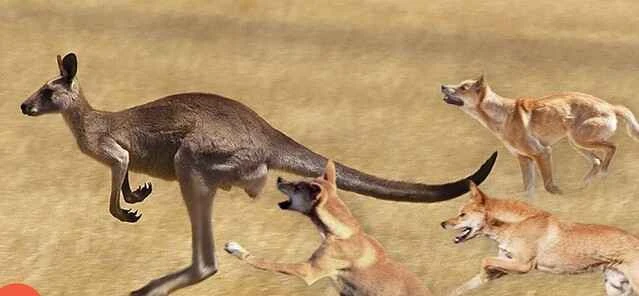
The red kangaroo escaped from the jaws of wild dogs.
Wild dogs and stray dogs
Feral domestic dogs also pose a danger to red kangaroos. These stray dogs often form aggressive packs that prey on young kangaroos or adults weakened by disease or injury. Although their hunting skills are not as good as wild dogs, they still exert predation pressure on kangaroo populations.
Humans: Hunting and Killing
Humans are a major predator of red kangaroos, hunting them for purposes including meat, leather, and population control. In some areas, kangaroo hunting is used to prevent overpopulation and agricultural damage, but this practice has also sparked ethical controversy.
Birds of prey
Large birds of prey, such as wedge-tailed eagles, occasionally prey on young kangaroos or smaller individuals. With their keen eyesight and powerful talons, these birds of prey are able to attack kangaroos that stray from the flock, but pose less of a threat to adult kangaroos.
snakes
Large pythons can constrict and devour young kangaroos, although their primary prey is usually smaller animals. Snakes pose a limited threat to adult kangaroos, but a certain risk to young ones.
3. The Red Kangaroo's Defense Mechanism
Kicks and Counterattacks
Red kangaroos use their powerful hind legs to protect themselves. A single kick can cause serious injury or even kill smaller predators. When cornered, kangaroos will attack predators' face or vital areas such as the chest and abdomen.
Speed and agility
Red kangaroos can run at speeds of up to 35 miles per hour (about 56 kilometers per hour) and leap up to 25 feet in a single bound. This ability allows them to escape predators by running or leaping at high speeds.
4. The role of the red kangaroo in the ecosystem
Herbivores in the food chain
As herbivores, red kangaroos play a vital role in controlling vegetation growth. By grazing, they prevent overgrowth and promote biodiversity in grassland and desert ecosystems.
Its place in Australian biodiversity
Red kangaroos are important prey for many predators, and their presence maintains the balance of the Australian food web. Without red kangaroos, many top predators would face food shortages, potentially leading to instability throughout the ecosystem.
5. The impact of invasive species on red kangaroos
wild cat
The feral cat is an invasive species in Australia that preys on young or injured kangaroos. These predators pose a serious threat to native Australian wildlife, including the red kangaroo.
wild boar
Wild boars indirectly impact kangaroo populations by destroying their habitat and competing with kangaroos for food resources. Their destructive environmental impact highlights the challenges posed by invasive species to ecosystems.
6. Conservation and Population Management of Red Kangaroos
Hunting and commercial hunting
In areas with high kangaroo populations, culling is used to reduce population size and protect farmland. However, this practice has sparked ethical controversy, with conservationists advocating for more ethical management methods.
Conservation efforts and sustainable management
Efforts to protect red kangaroos include habitat conservation, population monitoring, and the implementation of sustainable management practices. Conservationists hope to maintain ecological balance while protecting kangaroos.
7. Interesting facts about red kangaroos
The red kangaroo is the largest marsupial on Earth.
Their single jump distance can reach 25 feet.
Despite being called "red kangaroos," their fur color can vary depending on their habitat and age, with females often being bluish-gray.
8. Conclusion: Maintaining the balance in the relationship between red kangaroos and predators.
Red kangaroos are a cornerstone of Australia's biodiversity, supporting predators and maintaining ecosystem balance. Understanding their role, predators, and the challenges they face is crucial to ensuring their survival. By promoting sustainable conservation practices and addressing the impacts of invasive species, we can protect these remarkable animals and the biodiversity they support.
Predator Influence Table
| predators | Target | hunting strategies | Threat Level |
|---|---|---|---|
| stray dogs | Young, sick, or injured kangaroos | Group hunting, endurance pursuit | high |
| feral dog | Young kangaroo or injured adult kangaroo | Opportunistic group hunting | middle |
| Humans | All age groups | Hunting and population control | high |
| Birds of prey | Baby or small kangaroo | Aerial hunting | Low |
| snakes | baby kangaroo | Entangling Hunt | Low |