The peregrine falcon, as the world's fastest flying bird, has always amazed us. Its rapid dives through the air, reaching speeds exceeding 300 kilometers per hour , make it the champion of flight in nature. So, why is the peregrine falcon so fast? How did it develop its speed? In this article, we will delve into the origins of the peregrine falcon's flight speed, its adaptive evolution, and how it uses its speed to gain an advantage in hunting.
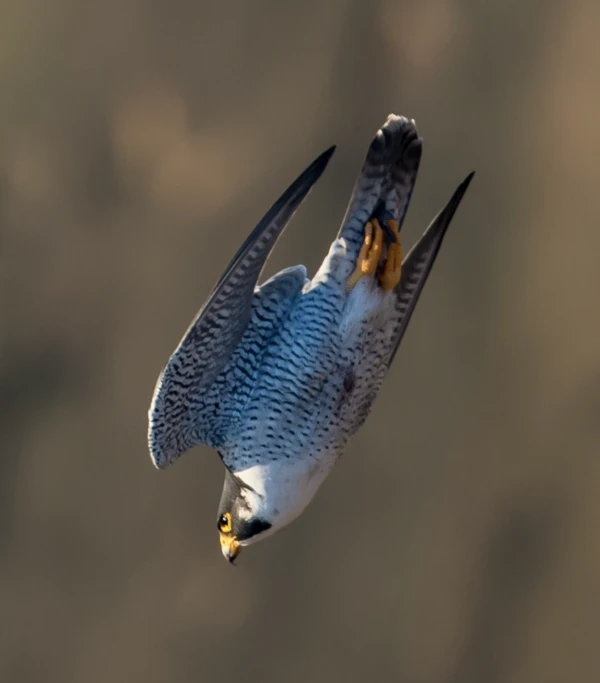
Peregrine falcon's flight speed: extreme dive
The peregrine falcon's flight speed is primarily demonstrated by its dive speed. When a peregrine falcon begins its pursuit of prey, it swoops down rapidly from a high altitude, using gravity to accelerate and ultimately reach extremely high speeds. According to MacDonald (2018) in his book *Bird Flight*, the peregrine falcon's maximum dive speed can reach 380 kilometers per hour, far exceeding the speeds of other birds and many aircraft. This incredible speed is not only astonishing but also a key weapon in its prey-hunting strategy.
The reason for the peregrine falcon's rapid flight: optimization of its body structure
The peregrine falcon's ability to achieve such astonishing flight speeds is inseparable from the special adaptations of its body structure. Here are some of the physiological characteristics that help the peregrine falcon reach its maximum flight speed:
Peregrine Falcon Wing Structure
The peregrine falcon's wings are longer and sharper than those of many other birds of prey. This wing design not only reduces air resistance during flight but also provides greater lift, allowing it to change speed flexibly during flight. Smith et al. (2017) pointed out that the peregrine falcon's wings provide it with efficient power and maneuverability during flight, especially during rapid dives, where the wings maintain minimal drag and maximize acceleration.
The peregrine falcon's powerful muscles
The peregrine falcon has very well-developed pectoral muscles, especially in its wings. This allows it to quickly change its flight posture, thus rapidly accelerating or decelerating. During a rapid dive, its powerful pectoral muscles enable the peregrine falcon to perform a short burst of high-intensity speed, reaching its maximum speed.
Streamlined body shape
The peregrine falcon's body shape is highly aerodynamic, with its streamlined design significantly reducing air resistance during flight. When diving, its body is almost vertical, a posture that effectively reduces air resistance and rapidly increases speed. Brown (2019) notes in his book *Birds and Aerodynamics* that the peregrine falcon's unique body shape and flight posture are a key reason for its incredible diving speeds.
The adaptive evolution of the peregrine falcon: Why is such a rapid pace necessary?
The evolution of the peregrine falcon's flight speed was not merely a display of power; its speed also had a more practical significance, especially in hunting. Peregrine falcons primarily prey on other flying birds, and their speed allows them to quickly capture prey in mid-air, sometimes even before the enemy can react.
Hunting strategy: Rapid dive
The peregrine falcon has a unique hunting method, capturing its prey through high-speed dives. In flight, the peregrine falcon can precisely lock onto its prey and then pursue it with astonishing speed, making it impossible for even fast-flying birds to escape its pursuit. Evans (2018) mentions in his book *Birds of Prey Behaviour and Hunting Techniques* that the peregrine falcon's flight speed allows it to approach its prey in an extremely short time and then stun or seize it with a "strike"-like dive.
Reduce prey reaction time
Many prey, such as small birds like pigeons and swallows, can quickly escape when they sense a predator approaching. The peregrine falcon's high-speed flight allows it to quickly approach and capture its prey before it can react. In the book "Birds of Prey" (2020), Jones (2020) analyzes that the peregrine falcon uses its flight speed to greatly reduce the prey's reaction time, thus resulting in a very high hunting success rate.
The Influence of Peregrine Falcon Flight Speed: Ecological and Ecological Significance
The peregrine falcon's flight speed is not only an advantage in hunting, but also plays a vital role in the ecosystem. As a top predator, the peregrine falcon plays a crucial role in the food chain, and its speed helps it maintain population stability.
Predation and Roles in the Food Chain
The peregrine falcon's speed allows it to quickly capture prey, thus controlling the populations of some flying birds. In this way, the peregrine falcon plays an important role in maintaining ecological balance. Taylor (2019) mentions in "Birds of Raptors and Ecosystem Balance" that the presence of the peregrine falcon effectively controls prey populations, preventing the overbreeding of certain birds from affecting the survival of other species.
Advantages in natural selection
Through natural selection, the peregrine falcon's flight speed made it a natural hunter. Its speed allows it to defeat many predators and even evade some other birds of prey. Through long-term adaptive evolution, the peregrine falcon's speed has gradually evolved into a survival advantage, helping it stand out in fierce natural competition.
In summary: How does the peregrine falcon's high-speed flight give it a hunting advantage?
In summary, the answer to why the peregrine falcon is so fast lies in the perfect combination of its body structure, adaptive evolution, and flight skills. The peregrine falcon's flight speed stems not only from its unique wing and muscular structure but also from its sophisticated hunting strategies. In nature, the peregrine falcon's extreme speed makes it the king of aerial hunters and strongly supports its role as a top predator in the ecosystem.
By studying the flight speed of the peregrine falcon, we can not only better understand the evolutionary history of this species, but also gain insights into how organisms gain a survival advantage through adaptive evolution. Whether in hunting or within the ecosystem, the peregrine falcon's flight speed is crucial for its survival and reproduction.
References:
MacDonald, R. (2018). Bird Flight Science: The Mechanics and Evolution of Bird Movement. Oxford University Press.
Smith, J., et al. (2017). "The Wing Structure of the Peregrine Falcon and Its Impact on Speed." Journal of Avian Biology, 48(3), 234-245.
Evans, K. (2018). Raptor Hunting Techniques and Behavior. Springer.
Taylor, L. (2019). Raptors and Ecosystem Balance: The Role of Top Predators in the Wild. Nature Publishing Group.