Among the beaver species, we found the North American beaver (Castor canadensis) and the Eurasian beaver (Castor fiber). Beavers are semi-aquatic rodents native to North America and Eurasia, belonging to the family Beaveridae.
How many types of beavers are there?
There are two species of beavers in the world: the North American beaver (Castor canadensis) and the Eurasian beaver (Castor fiber). The Kellogg beaver (Castor californicus) lived in western North America from the Miocene to the Pleistocene epochs, but unfortunately, it is now extinct.
Beavers are semi-aquatic rodents of the family Beaveridae, characterized by their flat, oval tails covered in scales and their ability to build dams in rivers and streams using tree trunks. They inhabit only the Northern Hemisphere, except for some populations introduced to Argentina and Chile where they have become invasive species. Although *C. canadensis* and *C. fiber* are very similar, they also have some differences, such as chromosome number.
North American beaver
Distribution : North American beavers are found throughout North America, extending as far north as Mexico, except for the Arctic tundra, the Florida peninsula, and the deserts of the southwestern United States. They have been deliberately introduced to Finland, parts of Russia, Tierra del Fuego in Argentina, and have also spread to some islands in Chile, becoming an invasive species that poses a threat to ecosystem conservation.
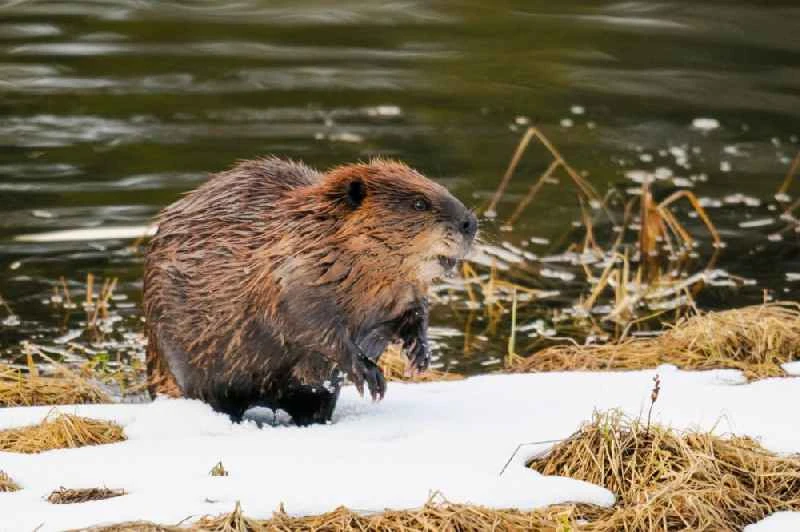
Habitat : It inhabits areas near lakes, ponds, and streams where there is ample food and building resources. It lives in burrows along the banks of rivers and lakes, with burrows about 4 meters in diameter and 1.5 meters high, always above the water surface.
Behavior : It can build dams to store water, create foraging areas (especially important when terrestrial vegetation is difficult to access), provide safe shelter, facilitate movement, and facilitate the transport of timber. It is a nocturnal animal and prefers to live in groups. You might be interested in this article about gregariousness: what it is, examples, and characteristics.
Size and weight : It is considered the largest rodent in North America, as it can reach 70 to 80 centimeters in length and weigh up to 32 kilograms. It has a strong, muscular body.
Coat : It has a waterproof, dark reddish-brown coat that prevents water from entering its body when it is in an aquatic environment.
Diet : It is a herbivore that mainly feeds on tree bark, aquatic plants, roots and buds.
Reproduction : Occurs in early summer. Mating can occur on land and in water. Gestation lasts 100 to 110 days, followed by the birth of 2 to 4 pups, each weighing between 250 and 600 grams. Newborns are hairy and partially open-eyed. Although lactation lasts about three months, the pups begin eating solid food a few weeks after birth. Sexual maturity is reached between 18 months and 2 years of age. At this time, the pups are forced by their parents to leave the group and find their own territory. In the wild, its lifespan can reach 24 years, while in captivity, it can extend to 50 years.
Conservation : Although the species is not under major threat within its range, it is hunted with traps for its fur (the fur industry).
Eurasian beaver
Distribution : Eurasian beavers (Castor fiber) were once widely distributed across continental Europe. However, overhunting led to a drastic decline in their numbers, and they are now found only in parts of the Rhône (France), Elbe (Germany), southern Norway, the Neman River, the Dnieper Basin (Belarus), and the Voronezh Basin (Russia). However, thanks to conservation and reintroduction efforts, Eurasian beavers have recovered much of their original range, and several subpopulations now extend from Spain and France into Central and Eastern Europe and Russia. Learn if beavers are found in Spain.
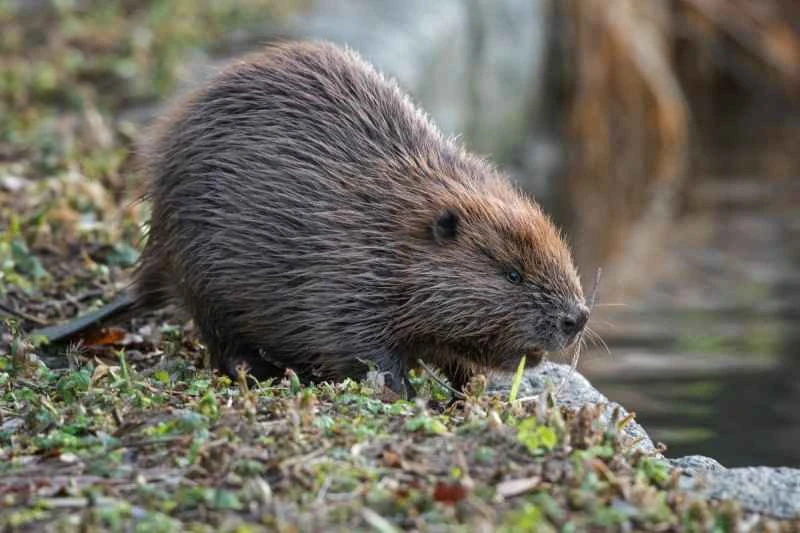
Habitat : Like the North American beaver, it is adapted to a semi-aquatic lifestyle, utilizing a variety of freshwater environments such as rivers, streams, ditches, lakes, and swamps. It typically prefers freshwater habitats surrounded by forests or scrubland, although it can also be found in farmland and even suburban and urban areas. It can build dams to store water, create foraging areas (especially important when terrestrial vegetation is difficult to access), provide safe shelter, facilitate movement, and facilitate the transport of timber. It hides and rests in burrows.
Behavior : They also build dams by altering their environment, creating safe havens, and facilitating access to food. On the other hand, they are nocturnal animals and live in family groups consisting of a pair of adults, juveniles, and sub-adults.
Size and weight : It is the largest beaver species, weighing between 15 and 20 kilograms, rarely exceeding 40 kilograms, and measuring between 73 centimeters and 1.35 meters in length.
Coat : Similar to the coat of the North American beaver, it has two layers. The undercoat is soft and dense, and is dark gray, while the outer coat is hard and long, reddish-brown.
Diet : Like C. canadensis, it is a herbivore. It feeds on aquatic and terrestrial herbaceous plants and broad-leaved woody plants.
Reproduction : The mating season begins in late winter, and mating generally takes place underwater. Gestation lasts approximately 100 days, resulting in 2 to 5 offspring. The pups are born with their eyes open and covered in fur. For the first few weeks of their lives, they remain in the burrow with their mother and the previous season's pups. Once they reach sexual maturity (usually after two years of age), they typically leave the group and establish their own territories.
Conservation : Their numbers have declined primarily due to overhunting for their fur, meat, and castoreum (a scent gland secretion), coupled with the loss of wetlands.
literature
IUCN Red List of Threatened Species (2024). Website: https://www.iucnredlist.org
Zumeta, BJ (undated). Castor fiber (Rodentia, Ricinidae). Fauna of the Ebro pine forest and its surrounding area. Mammals. URL: https://monteriza.aranzadi.eus/wp-content/uploads/mamiferos/448.castor-fiber.pdf