The Qinghai-Tibet Plateau, vast and towering, is known as the "Roof of the World." Its formation was caused by the collision of the Indo-Asian plates (approximately 50 million years ago). However, scientists hold differing opinions on how the plateau rose to its present height and size, and how the environment of the Tibetan region evolved during this uplift. Regarding the timing of the uplift, some believe it formed early in the Indo-Asian collision period and reached its current height during the Oligocene (approximately 30 million years ago) or the Middle Miocene (approximately 15 million years ago). Other scholars speculate that it didn't reach its current altitude until the Late Miocene (approximately 7 million years ago) or even later. Still other theories place the uplift in between. Regarding the pattern of uplift, various models have been proposed, including overall uplift, step-like uplift, and alternating uplift and peneplaining. In recent years, research on inferring ancient altitudes based primarily on stable isotope analysis has been very active. The plateau uplift models built on this basis, such as the "proto-Tibetan Plateau," are impressive. This school of thought holds that the main body of the plateau was formed more than 40 million years ago.
Organisms, especially fish and plants that are highly sensitive to their environment, are the most direct and reliable indicators of the environment: the temperature and humidity of the climate, and the elevation and slope of the terrain, correspond to different biological appearances. Paleontologists use the present to understand the past, and by analyzing and comparing the biological information of ancient organisms and related modern groups, they can reconstruct the paleoenvironment of fossil-bearing areas and even estimate the paleoaltitude at that time. Regarding plateau fish, the example of extant schizothorax fish (belonging to the Cyprinidae family) exhibiting "ascent with modification" makes fossil schizothorax fish and related Cyprinidae fish a relatively strong basis for inferring the paleoaltitude of the plateau. Almost all previously known Cenozoic fossil fish from the plateau belong to this category. Recently, Wu Feixiang's team from the Institute of Vertebrate Paleontology and Paleoanthropology published a paper in Scientific Reports, reporting fossil climbing perch (Fig. 1a, b, d) and their associated plants in the Late Oligocene strata of the Lunpola and Nyima Basins in the central Tibetan Plateau (about 26 to 24 million years ago), which indicate a warm and humid environment in the lowlands. This provides new independent evidence for reconstructing the geological history of the plateau.
Climbing perch (belonging to the suborder Anabantoidea along with betta fish and paradise fish) are mainly distributed today in tropical regions of South Asia, Southeast Asia, and west-central Africa (temperatures between 18 and 30 °C, with most distribution areas below 500 meters in altitude, and a maximum of less than 1200 meters) along the edges of rivers and lakes or in swampy pools. They prefer shallow, quiet, and oxygen-deficient water (dissolved oxygen levels can be as low as 1 mg/L; note: most fish require above 4 mg/L for normal life activities). Their gill cavities contain a flower-like structure called the labyrinth organ (Fig. 1c), a specialized structure formed from gill bones. The labyrinth organ is covered with respiratory epithelium and has abundant capillaries. Unlike other normal gills, blood passing through the labyrinth organ returns to the heart via veins. With this organ, climbing perch can breathe oxygen directly from the air. The labyrinthine structure is complex, occupying a large portion of the gill cavity. Consequently, the gills used for underwater breathing shrink significantly, failing to provide the necessary oxygen for the fish's survival. Therefore, climbing perch must frequently extend their heads above the water to inhale and exhale air, even climbing out of the water after rain to "walk" on land or even "climb trees." The fossil climbing perch from Tibet [scientific name: *Eoanabas thibetana*] is the earliest and most primitive fossil representative of the Anabantidae family to date, pushing back the family's fossil record by approximately 20 million years. More interestingly, researchers also observed labyrinthine gills in the *Eoanabas thibetana* specimen, with perforations on the labyrinthine bony plates, indicating that its labyrinthine gill development is closer to that of the Asian climbing perch, which has the strongest air-breathing capacity. These characteristics suggest that the fossil climbing perch from Tibet possessed physiological characteristics and ecological habits similar to modern climbing perch, indicating a warm and humid environment where they likely inhabited relatively confined bodies of water (Figure 2). This is drastically different from the environment of today's fossil sites, which are located at high altitudes (nearly 5,000 meters), with strong ultraviolet radiation, low water temperatures (annual average temperature of approximately -1.0 ℃), high water flow, and high dissolved oxygen levels. It is evident that the geographical features and natural environment within the plateau have undergone tremendous changes since the time of the fossil-bearing perch.
This inference is also supported by other paleontological evidence. The plant community in the same layer as the climbing perch included palms with large leaves typical of warm and humid environments, calamus, and aquatic plants of the Araceae family closely related to duckweed. Analysis shows that the community was located at an altitude of just over 1,000 meters. Some insects in the same layer also indicate a similar paleoaltitude. Other fish, such as the slightly later *Schizothorax bigheadensis* (a primitive schizothorax) and *Chunlinus zhangi* (a fossil barb) in the same layer as the climbing perch, represent an environment in the early stages of plateau development or before its uplift, consistent with the conclusions of this paper. The existence of such a biological community also indirectly indicates that the warm and humid air currents from the Indian Ocean could at least penetrate deep into the central region of Tibet at that time. Therefore, the huge east-west mountain range that stretches across the southern side of Tibet today was at least not developed to its current scale at that time, and was insufficient to block the tropical air currents from the south.
This demonstrates that the plateau uplift history inferred from paleontological evidence, particularly through macrofossils, differs significantly from current inferences based on geological, geophysical, and chemical data. Cross-referencing multiple pieces of evidence allows existing plateau uplift models to be continuously refined and revised. Through the life information hidden within rock strata, paleontologists are unraveling the magnificent history of the plateau's dramatic changes, revealing the wonders of nature's creation!
This research was supported by the Strategic Priority Research Program of the Chinese Academy of Sciences, the 973 Program of the Ministry of Science and Technology, the National Natural Science Foundation of China, and the Fossil Excavation Project of the Institute of Vertebrate Paleontology and Paleoanthropology.
Original link: http://www.nature.com/articles/s41598-017-00928-9
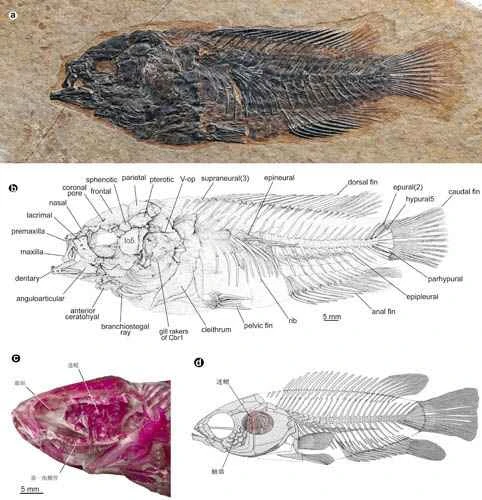
Figure 1. a. Photograph and line drawing of the holotype of *Eoanabas thibetana* (IVPP V 22782a); c. Labyrinth of a extant climbing perch; d. Skeletal reconstruction of *Eoanabas thibetana*. (Photos provided by Wu Feixiang)
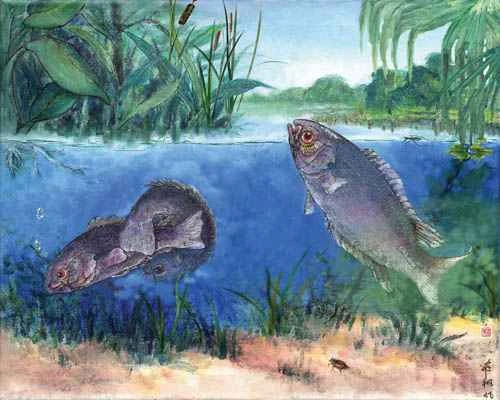
Figure 2. Reconstruction of the Tibetan climbing perch and its habitat: In the late Oligocene (approximately 26 million years ago), the Tibetan hinterland contained warm and humid lowlands, fostering an environment and ecosystem completely different from the present-day plateau interior. (Photo provided by Wu Feixiang)